拉链袋
Secure, easy-to-handle packaging is essential in many laboratory, clean handling, and general industrial workflows. When small items, samples, consumables, or components need to be stored separately and accessed quickly, a Zipper Bag offers a practical balance of protection, visibility, and convenience.
On this page, you can explore zipper bag options suited to routine packaging and organized storage tasks. The range is especially relevant for users looking for clean bag formats that simplify sorting, temporary containment, and day-to-day handling in controlled work areas.

Where zipper bags fit in laboratory and industrial use
Zipper-style bags are widely used when materials need to be packed in individual units without adding complexity to the process. The resealable closure helps operators open and close the bag repeatedly, which is useful for temporary storage, kitting, sample separation, or organizing small parts in workstations and lab environments.
Compared with more application-specific formats such as sample bags, zipper bags are often chosen for flexible, general-purpose use. They are also different from waste bags, which are intended for collection and disposal rather than repeated access during routine handling.
Why clean zipper bags are commonly selected
In technical environments, packaging is not only about containment. Users also care about clean handling, quick visual identification, and a closure method that reduces the need for extra sealing steps. A resealable bag format supports these needs by making it easier to manage small quantities of items while keeping workflows efficient.
Clean zipper bags can be especially useful for consumables, small accessories, documentation packs, non-sharp components, or temporarily separated items during inspection and preparation steps. Because the closure is built into the bag, operators can reduce handling time and keep contents more organized between stages of work.
Typical selection criteria for zipper bags
Choosing the right bag usually starts with the size of the item being packed. A compact format may be suitable for small parts or light samples, while larger formats make more sense for grouped items, wider components, or applications where easier loading is needed. Dimensions should be matched not only to the product itself but also to the required working space inside the bag.
Another important point is film thickness and overall handling feel. Depending on the task, users may look for a bag that is easy to open, sufficiently durable for repeated short-term use, and practical for storage racks, bins, drawers, or transport trays. For buyers comparing multiple options within the same family, the goal is usually to balance usable internal space, handling convenience, and the level of separation required in the process.
Representative Cleanwrap options in this category
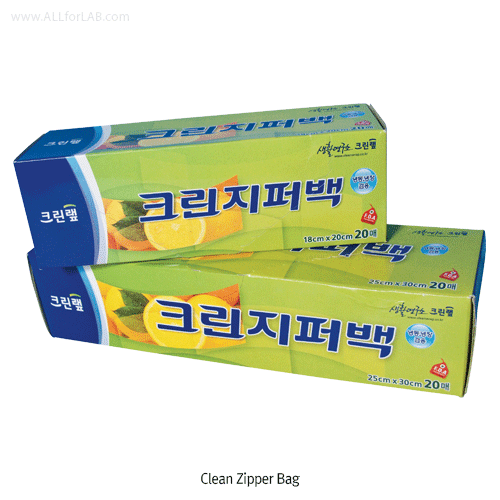
This category includes selected products from Cleanwrap, a manufacturer featured here for clean bag solutions. Examples include the Cleanwrap C10.103 Wrapping clean zipper bag 18*20cm*t50um, the Cleanwrap C10.104 Wrapping clean zipper bag 25*30cm*t50um, and the Cleanwrap C10.106 Wrapping clean zipper bag 30*35cm.
These options illustrate how users can choose among different bag sizes for different packing needs. A smaller format may suit compact items and individual packaging, while medium and larger sizes can support broader components, grouped contents, or workflows where extra room improves loading and removal.
How zipper bags support organized handling
In many facilities, efficiency depends on keeping small items separated, identifiable, and easy to retrieve. Zipper bags help support that goal by allowing fast manual access without additional tools or sealing equipment. This can be useful in receiving areas, laboratory benches, preparation stations, and internal logistics points.
They also work well as part of a broader packaging and storage system. For example, teams may use zipper bags for temporary organization and move to other bag types when the process requires dedicated sample collection or disposal handling. If you want to compare this category with similar options, you can also browse the broader zipper bag range available on this page.
Good use cases for different bag sizes
Smaller zipper bags are often practical when the priority is sorting, labeling, or isolating low-volume contents. They can help prevent mixing of small parts and make it easier to distribute materials by batch, operator, or process step. In work areas with frequent item movement, compact bags also save storage space.
Larger zipper bags are generally more suitable when items have broader dimensions, need easier insertion, or are grouped together before the next handling stage. In many cases, selecting a slightly larger bag than the minimum fit can improve usability and reduce unnecessary manipulation during packing and unpacking.
What to consider before ordering
Before selecting a zipper bag, it is helpful to define the actual use scenario: what will be stored, how often the bag will be opened, and whether the bag is intended for short-term handling or ongoing organization. Buyers should also consider how the bags will be stored after filling, since stackability and quick identification can affect daily efficiency.
If your process involves several bag types, it can be useful to standardize by application rather than using one format for every task. A clear bag selection logic makes procurement easier and helps operators choose the right packaging format at the point of use.
Find the right zipper bag for routine packaging tasks
The right zipper bag is usually the one that fits your handling process with the least friction: suitable dimensions, practical access, and a clean, organized presentation of contents. Whether you are packaging small laboratory items, separating parts for internal use, or improving storage discipline at the workstation, this category provides straightforward options for everyday technical environments.
Explore the available models to compare sizes and choose the format that best matches your workflow, item dimensions, and handling preferences.
直接联系认证专家