Ionizing radiation consists of microscopic particles or electromagnetic radiation with sufficient energy to ionize matter. In general, the term is commonly associated with penetrating radiation such as X-rays and gamma rays, as well as alpha, beta, and neutron radiation. Identifying the different types of ionizing radiation helps distinguish their nature, ionizing ability, and penetrating power, thereby supporting the selection of appropriate measurement methods, radiation meter, and shielding measures for specific situations.
What Is Ionizing Radiation ?
Radiation can generally be classified into ionizing and non-ionizing radiation.
Non-ionizing radiation does not have sufficient energy per photon to ionize atoms or molecules, meaning it cannot normally remove electrons from atoms under ordinary conditions.
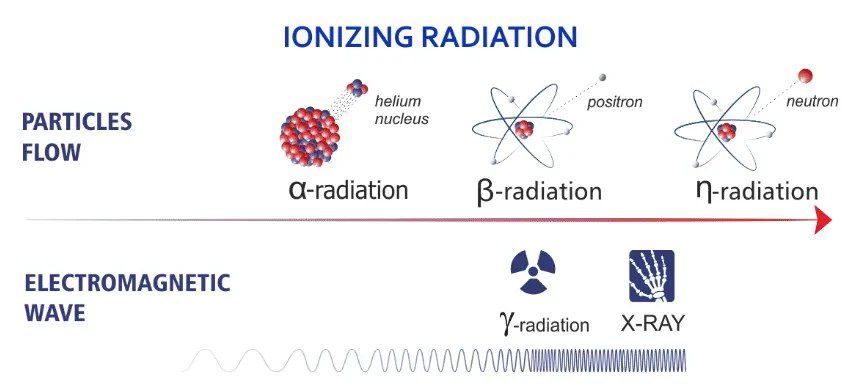
Ionizing radiation includes atomic particles, fast-moving subatomic particles, or photons with sufficient energy to cause significant ionization in matter.
Based on their nature, ionizing radiation can be divided into two main groups:
Particle radiation: alpha, beta, and neutron radiation.
Electromagnetic radiation (photon radiation): X-rays and gamma rays.
Common Types of Ionizing Radiation
Alpha Radiation
Alpha radiation consists of helium nuclei produced during the alpha decay of atomic nuclei. It has high ionizing power but low penetrating ability. For external exposure to an alpha source, simple protective barriers such as outer clothing, rubber gloves, a mask, or even a sheet of paper can significantly reduce exposure.
However, low penetrating power does not mean alpha radiation can be ignored. If an alpha-emitting source enters the body through air, water, or food, the potential hazard can increase significantly. Preventing internal contamination is therefore particularly important when dealing with alpha-emitting materials.
Beta Radiation
Beta radiation consists of electrons or positrons produced during beta decay. Compared with alpha radiation, beta radiation has lower ionizing power but greater penetrating ability. Beta particles can penetrate the skin and may cause tissue damage or radiation burns.
This characteristic shows why radiation protection should not be based solely on the type of radiation. The nature of the particles, their path, and the potential exposure scenario should all be considered. Depending on the specific conditions, a suitable shelter or physical barrier can provide protection against beta radiation.
X-rays and Gamma Radiation
X-rays and gamma rays are forms of electromagnetic radiation. Gamma rays are photons emitted from atomic nuclei and are associated with nuclear transitions. Both X-rays and gamma rays can penetrate the human body when they have sufficient energy, so shielding them generally requires more consideration than shielding alpha radiation.
The intensity of gamma radiation can be reduced by half when it passes through certain thicknesses of shielding materials, with examples including approximately 2.8 cm of steel, 10 cm of concrete, 14 cm of soil, or 30 cm of wood. These values illustrate the role of material type and shielding thickness in reducing gamma radiation intensity.
Neutron Radiation
Neutron radiation consists of neutrons, which are electrically neutral particles that form part of atomic nuclei. Protection against neutron radiation may involve shelters, radiation shielding structures, basements, or specially designed protected spaces.
Materials such as polymers, polyethylene, and water can be effective for neutron shielding because of their hydrogen content and interaction with neutrons.
See also: How to Choose a Radiation Meter
Quick Comparison of Ionizing and Penetrating Ability
Alpha radiation is characterized by high ionizing power and low penetrating ability. Beta radiation has lower ionizing power than alpha but greater penetrating ability. X-rays and gamma rays are electromagnetic radiation that can penetrate the human body when sufficiently energetic and require appropriate shielding. Neutron radiation has different shielding requirements, with materials such as polymers, polyethylene, and water commonly used as protective barriers.
Because each type of radiation has different physical properties and interactions with matter, there is no single shielding solution suitable for every situation. Correctly identifying the type of radiation is an important step in assessing the potential hazard and selecting an appropriate protection method.
Different types of ionizing radiation should be evaluated according to the specific exposure conditions, including the radiation type, penetrating ability, and potential pathways by which radioactive material can enter the body. For alpha radiation, internal contamination through air, water, or food is a particular concern. For beta radiation, X-rays, gamma rays, and neutrons, shielding requirements vary according to their respective characteristics.
Understanding the differences between alpha, beta, X-rays, gamma rays, and neutrons provides a better technical basis for using a radiation detector to measure and monitor ionizing radiation.