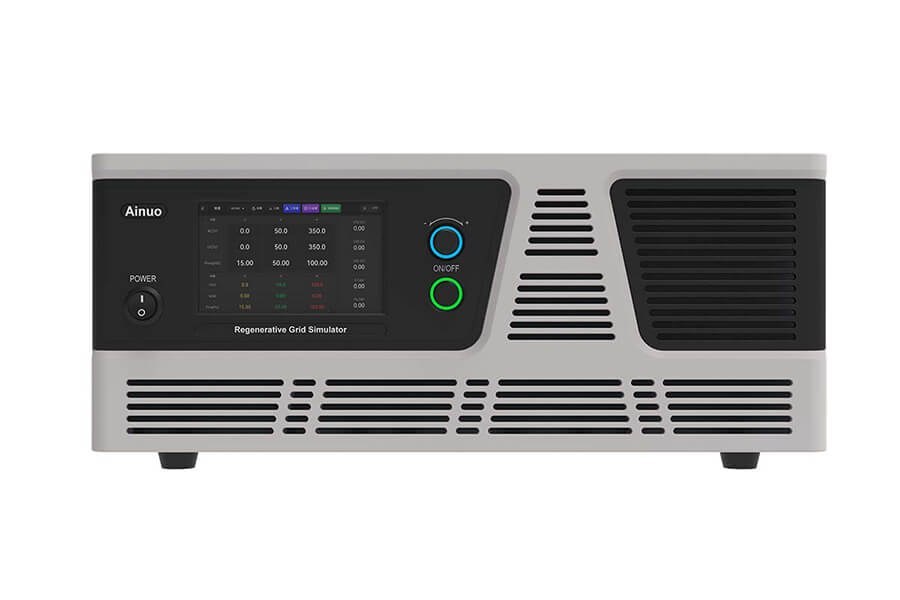
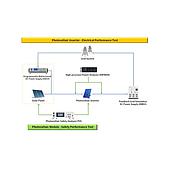
A regenerative grid simulator for PV inverter testing is a test power supply designed to reproduce grid conditions, including abnormal voltage events, frequency changes, waveform distortion, and short-circuit scenarios. It allows an inverter to be evaluated against controlled electrical conditions rather than an uncontrolled utility supply.
The supplied information for Ainuo ANRGS also describes rated-power feedback to the grid and four-quadrant operation. These functions are intended to return energy during testing instead of treating all test energy as dissipated load.
Summary: A regenerative grid simulator recreates grid disturbances for PV inverter tests. The ANRGS description includes four-quadrant operation and rated-power energy feedback. Its stated use cases span R&D verification, production testing, and on-site maintenance workflows.
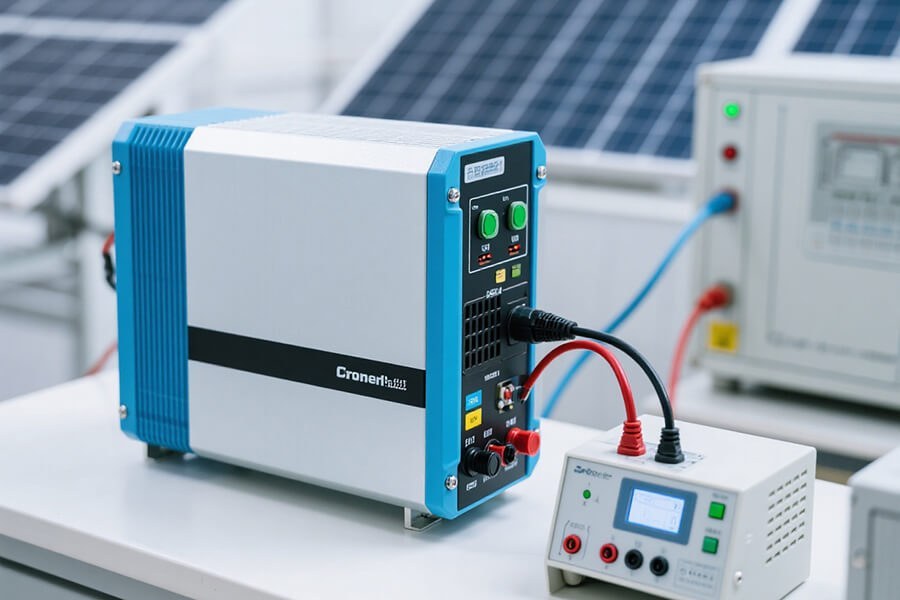
What does a regenerative grid simulator test on a PV inverter?
A regenerative grid simulator tests how a PV inverter responds when grid voltage, frequency, impedance, or waveform conditions depart from nominal operation. The supplied material lists instantaneous voltage rise and drop, short circuits, jitter, and distorted mains waveforms among the conditions that ANRGS can simulate.
For grid-adaptability checks, the source describes low-voltage ride-through (LVRT), high-voltage ride-through (HVRT), and frequency-offset testing. These tests focus on whether the inverter can maintain or assess operation under specified abnormal supply conditions.
| Test condition described | Stated setting or capability |
|---|---|
| LVRT | Operation maintained for at least 0.5 seconds at 20% of rated voltage |
| HVRT | Stable operation at 130% of rated voltage |
| Frequency offset | Continuously adjustable from 45 to 55 Hz |
| Harmonic simulation | Simulation of harmonics 0 to 50 |
How does regenerative operation change the test setup?
Regenerative operation changes the energy path in a test setup: power from the test process can be fed back to the grid rather than only consumed by a load. According to the supplied ANRGS description, the unit supports 100% rated-power feedback and can operate in four quadrants.
This approach is relevant where repeated inverter tests involve substantial power transfer. The source presents energy feedback as a means to reduce energy consumption and operating costs, but actual results depend on the test configuration and operating conditions.
Note: Performance figures and operating outcomes should be verified against the applicable product documentation and the specific inverter test method.
Which grid disturbances can the described system reproduce?
The supplied material describes a grid-disturbance waveform library containing 287 typical fault waveforms, including voltage surge, voltage sag, and frequency offset. It also describes adaptive impedance matching to compensate test-system impedance and reduce the influence of reflected waves.
For waveform-focused tests, the source states a harmonic injection accuracy of 0.1% level and support for 0 to 50 harmonics. These capabilities can help create repeatable input conditions when comparing inverter behavior across a defined test sequence.
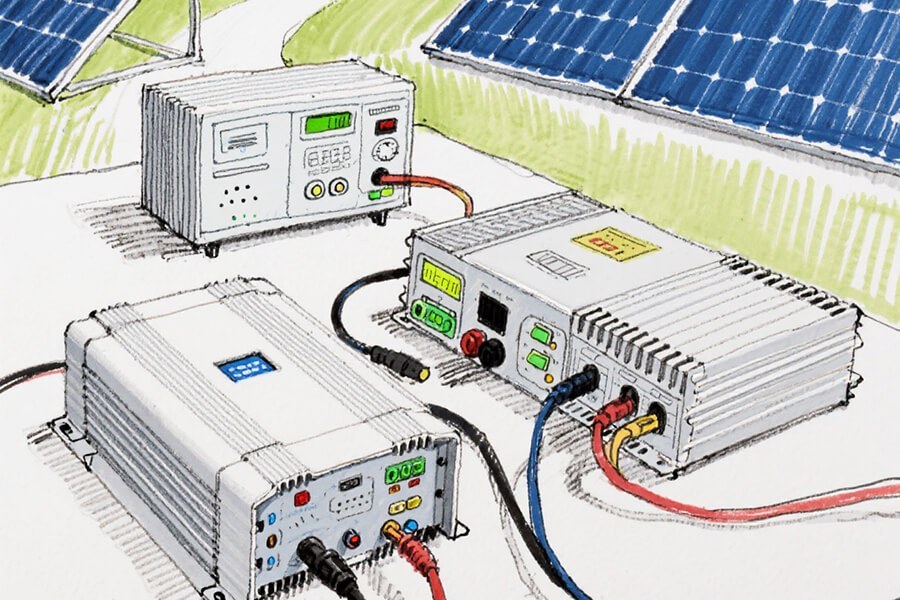
When is a regenerative grid simulator used during the inverter lifecycle?
A regenerative grid simulator can be used from R&D validation through production-line inspection and field maintenance. The source divides the workflow into these three stages, with different emphasis at each stage.
| Lifecycle stage | Use described in the supplied material |
|---|---|
| R&D validation | Extreme-condition and grid-adaptability testing, including ambient-temperature simulation from -40°C to 85°C |
| Production-line inspection | Automated loading of test sequences; stated single test cycle of 120 seconds or less |
| On-site maintenance | Portable testing with power-curve scanning, thermal-imaging fault location, and wireless data synchronization |
What response and power-quality figures are stated for ANRGS?
The provided ANRGS information states a dynamic response time of less than 5 ms for load-change scenarios and THDI below 3%. It also associates the THDI figure with IEC 61000-3-12 in the source material.
The same material describes liquid cooling intended to support continuous full-power operation at a 40°C ambient temperature. It further states that the design passed CISPR 16-1-1 Class A certification; buyers should confirm the certification scope and applicable configuration before using it as a compliance basis.
How should a test team select a regenerative grid simulator for PV inverter work?
Select a regenerative grid simulator by matching its controllable voltage, frequency, disturbance, harmonic, and power-flow functions to the inverter test procedure. The supplied data supports checking whether required tests include ride-through behavior, distorted waveforms, short-circuit events, automated sequencing, or field diagnostics.
For the ANRGS regenerative grid simulator power supply, the available description highlights grid-event simulation, power-parameter measurement, four-quadrant operation, and rated-power grid feedback. Confirm the precise ratings, interfaces, and test-method compatibility for the intended inverter before final selection.