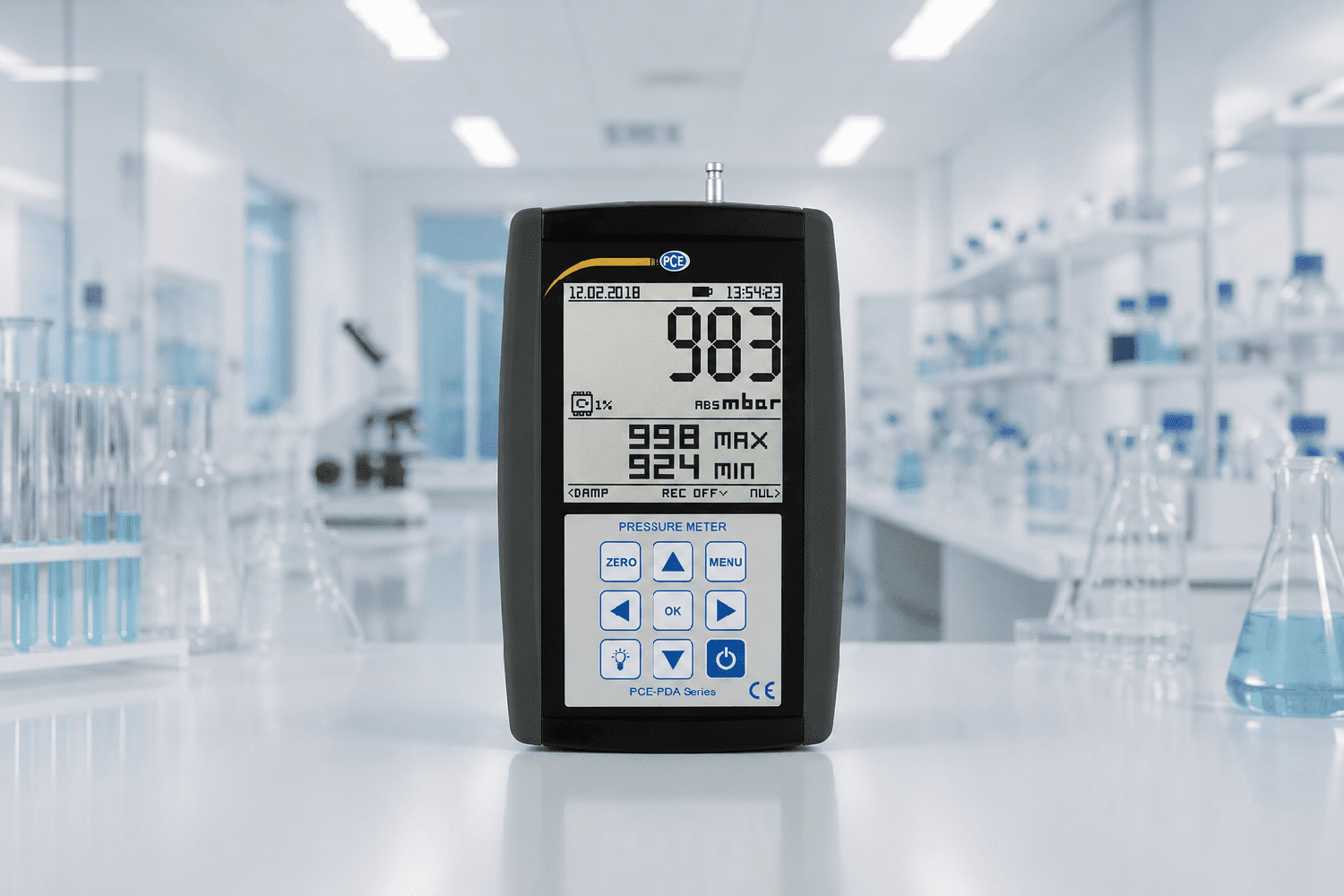
Atmospheric pressure measurements are influenced not only by environmental conditions but also by the sensor technology, signal-processing algorithms, temperature compensation, and the accuracy specifications of the Air pressure meter provided by the manufacturer.
Every Air Pressure Meter Samples Atmospheric Pressure Differently
Atmospheric pressure is constantly changing, even if the variation is only a fraction of a hectopascal from one second to the next. Some barometers update their readings continuously, while others calculate and display the average of multiple measurements.
As a result, instruments with different sampling intervals rarely produce identical readings, even when placed side by side.
The Same Measurement Range Does Not Mean the Same Accuracy
Two barometers may share the same measurement range of 300–1100 hPa, yet still report slightly different values. The specification that deserves closer attention is accuracy.
For example, one instrument may have an accuracy of ±0.3 hPa, while another is rated at ±1 hPa. A difference of 0.5 hPa between the two readings can still fall within the specified tolerance of both instruments.
For this reason, calibration laboratories compare each instrument with a certified reference standard instead of comparing one display directly with another.
Temperature and Installation Location Can Influence the Reading
Pressure sensors require time to reach thermal equilibrium after the instrument is powered on. Atmospheric pressure also decreases with altitude at a rate of approximately 1 hPa for every 8 meters under standard atmospheric conditions.
As a result, two barometers installed at different locations within the same building—or positioned near a heat source or an air-conditioning vent—may display slightly different readings.
Signal Processing Contributes to Reading Differences
The value displayed on the screen is not the raw output from the pressure sensor. It has already been processed by the instrument's firmware.
Some barometers are designed to respond quickly, causing the displayed value to change more frequently. Others apply digital filtering to minimize noise, resulting in a steadier display with a slight response delay.
Calibration Does Not Make Every Barometer Display the Same Value
Calibration is performed to determine an instrument's measurement error relative to a reference standard, not to force every instrument to display identical readings.
As long as the measured error remains within the specified tolerance and meets the required measurement uncertainty, the instrument is considered to perform correctly after calibration.
The Value of a Barometer Lies in Data Stability
In meteorological observation, environmental monitoring, and laboratory applications, the objective is not to make every instrument display the same number.
A barometer with excellent repeatability, low long-term drift, and well-controlled measurement error provides far more reliable data than one whose readings fluctuate constantly, even if its instantaneous values appear close to the reference.
When selecting a barometer, users should look beyond measurement range and resolution. Accuracy, temperature compensation, long-term stability, calibration interval, and repeatability are the specifications that determine the quality and reliability of atmospheric pressure measurements in meteorology, environmental monitoring, laboratories, and industrial applications.