A multi-channel power analyzer is useful in appliance testing because it measures electrical behavior across multiple circuits or motor phases at the same time. This helps engineering and quality teams relate the appliance’s total energy use to the loads of individual components, such as motors, heaters, and control systems.
For appliances with inverter-driven motors, switching power supplies, or sequenced operating cycles, synchronized measurement can reveal relationships that an aggregate reading at the mains input may not show.
Summary: Multi-channel measurement provides synchronized views of separate circuits. It supports component-level power analysis, transient capture, efficiency investigation, and harmonic analysis. A single input measurement shows total consumption but may not identify the contributing component.
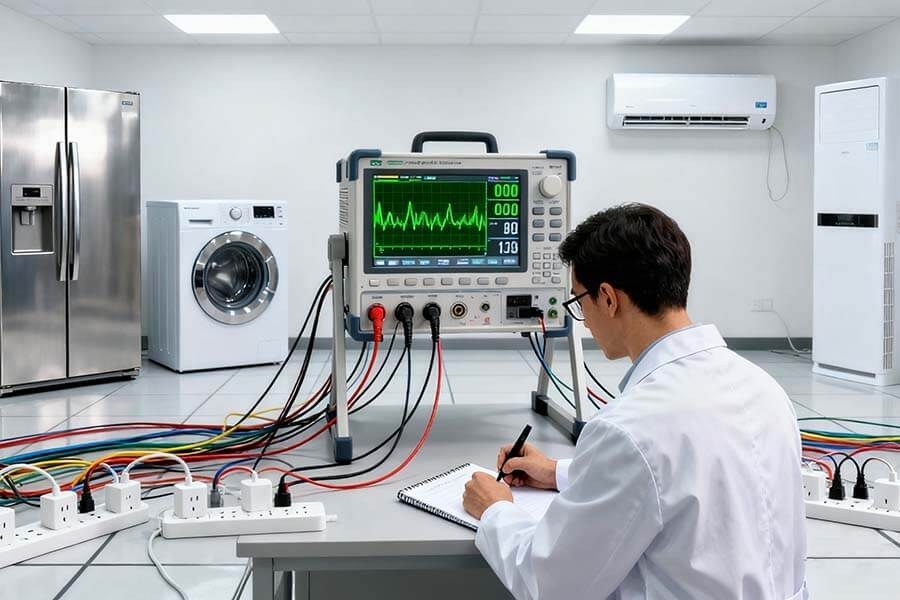
What is a multi-channel power analyzer?
A multi-channel power analyzer is an electrical measuring instrument that can measure parameters across several independent circuits or motor phases simultaneously. The source describes parameters including voltage, current, power, power factor, and harmonic distortion.
Because channels are synchronized, teams can compare electrical events in different parts of one appliance on a shared time basis. The instrument may also calculate values such as true power in W, apparent power in VA, reactive power in VAR, efficiency, and harmonic spectra, depending on its measurement and analysis capabilities.
Why is a single power measurement often insufficient for modern appliances?
A single-channel measurement at the wall outlet can show total appliance power consumption, but it does not by itself identify where power is being used inside the appliance. When consumption differs from expectations, that aggregate value cannot isolate whether a compressor, heater, fan, pump, or control system is contributing to the result.
Measuring components one at a time can also make it harder to compare their operation during the same cycle. Appliance functions may switch on and off in sequence, so manually collected readings from separate times may not represent the same operating condition.
| Measurement approach | What it can show | Main limitation described |
|---|---|---|
| Single input measurement | Total appliance power consumption | Does not identify the contributing circuit or component |
| Multi-channel synchronized measurement | Electrical behavior of multiple circuits at the same time | Requires measurement channels connected to the relevant circuits |
How does synchronized measurement help analyze appliance components?
Synchronized channels allow a test team to examine each selected component while the appliance operates normally. In a dishwasher example, separate channels can be assigned to the circulation pump, heating element, drain pump, and control system.
This arrangement makes it possible to compare energy use during different parts of a cycle, such as washing and heated drying. It can also help assess whether simultaneous loads create peaks that may be relevant when refining control timing.
When is transient and inrush current measurement important?
Transient measurement matters when a motor, transformer, or other load is energized, because its initial current may differ substantially from its normal operating current. The source notes that inrush current can be five to ten times the normal operating current.
A power analyzer with suitable sampling capability can capture the magnitude and duration of these events. With multiple channels, teams can examine startup behavior for more than one motor or circuit during the same test sequence.
Note: Inrush-current results depend on the appliance, operating state, connected loads, and measurement setup. The stated range is a general example from the source, not a specification for every appliance.
How can a multi-channel power analyzer support efficiency investigation?
Efficiency analysis benefits from measuring energy flow at multiple points instead of relying only on total input power. For an inverter-driven refrigerator compressor, the source gives an example of measuring the DC input to the motor and the AC output of the inverter drive simultaneously.
Comparing these measurements can help locate stages where losses may occur within an electrical conversion chain. Mechanical output measurements, when available, can add further context, but they are separate from electrical measurements.
Why are harmonics and power quality relevant in appliance testing?
Appliances that use switch-mode power supplies or inverter drives can produce harmonic distortion. Channel-by-channel harmonic analysis can help identify which measured circuit contributes most to the observed distortion.
This information can guide investigation of filtering at the source component. It also gives teams a more detailed view of power quality than a total-power reading alone.
How can teams choose a measurement approach for appliance testing?
Choose a multi-channel approach when the test objective requires comparing several circuits, motor phases, or components during the same operating cycle. It is particularly relevant for appliances with coordinated loads, inverter-driven systems, or a need to study startup events and harmonics.
A single measurement may be adequate when only overall input consumption is needed. When the goal is to understand how individual loads contribute to that total, synchronized multi-channel data offers a clearer basis for analysis.
What are the practical testing benefits of collecting all channels in one run?
Collecting correlated data in one comprehensive test can reduce the need to stop, reconnect probes, and manually align readings from different test periods. This may reduce opportunities for mismatch between separate data sets.
It also lets engineers observe how a design change in one measured component corresponds with power changes elsewhere in the appliance. The resulting data can support development, validation, and quality-control discussions without treating the appliance as a single undifferentiated load.