
Battery Impedance Tester
Fast, repeatable battery checks are essential wherever backup power, energy storage, and critical DC systems must remain reliable. In maintenance routines for UPS strings, telecom sites, data centers, and industrial battery banks, a Battery Impedance Tester helps technicians evaluate battery condition without relying only on open-circuit voltage or basic load checks.
These instruments are designed to measure internal resistance or impedance together with battery voltage, giving a clearer view of battery health and trend changes over time. For service teams managing preventive maintenance, acceptance testing, or troubleshooting weak cells in a larger string, this category brings together handheld and bench-oriented solutions as well as practical accessories for everyday field work.
Why impedance testing matters in battery maintenance
A battery can still show acceptable terminal voltage while its internal condition is already degrading. That is why impedance and resistance measurement is widely used as part of a broader maintenance strategy: it helps identify developing issues such as aging, sulfation, poor connections, or imbalance before they turn into unexpected downtime.
Compared with more disruptive test methods, impedance testing is valued for its speed and practicality. Many instruments in this category are intended for routine inspections, allowing maintenance personnel to gather readings quickly, compare them against baseline values, and build a historical trend for each battery asset.
What to expect from instruments in this category
Most battery impedance testers combine internal resistance measurement with DC voltage measurement in one device. This makes them suitable for inspecting individual cells and batteries while reducing the need to switch between multiple instruments during field service. Depending on the model, users may also benefit from memory functions, USB communication, temperature-related features, or data export for reporting.
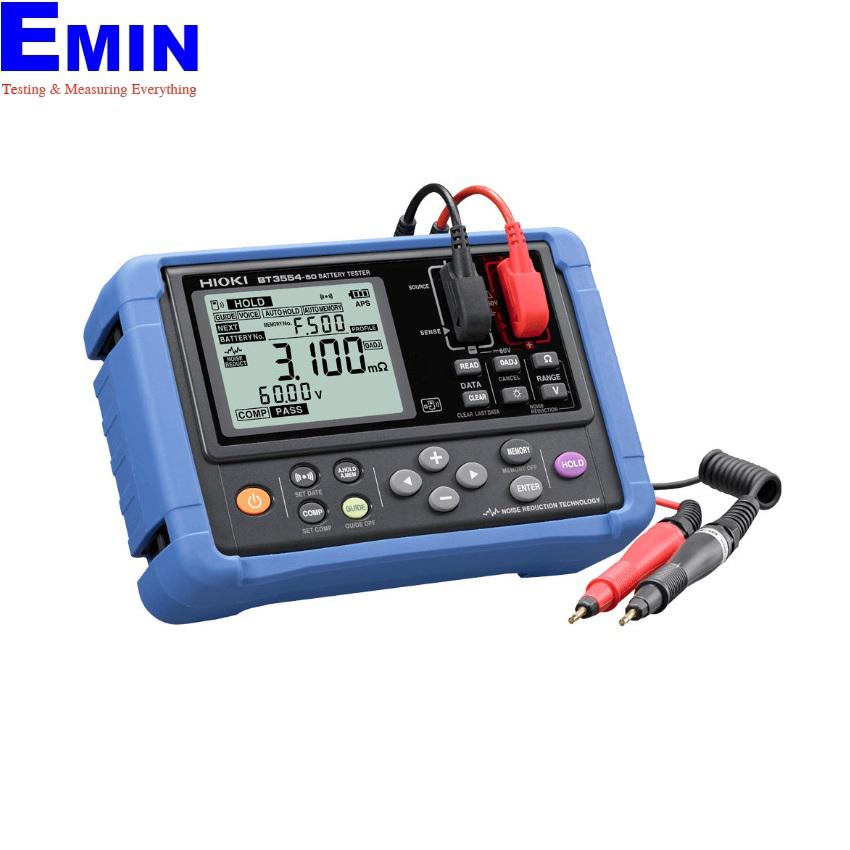
Measurement ranges and workflow differ by application. Portable units such as the HIOKI BT3554-51 Battery Tester and HIOKI BT3554-52 Battery Tester are designed for fast on-site checks in common maintenance environments, while analyzers such as the FLUKE FLUKE-BT508 Battery Analyzer or FLUKE FLUKE-BT510/APAC Advanced Battery Analyzer support broader diagnostic work and record management. For production, lab, or automated measurement setups, a bench model like the HIOKI BT3561A Baterry HiTester may be more appropriate.
Portable testers, analyzers, and bench instruments
Not every battery test task requires the same type of instrument. A handheld tester is often the practical choice when technicians move across racks or visit distributed sites. It supports quick checks, straightforward operation, and easier access in tight spaces, especially when a large number of batteries must be inspected in one maintenance round.
An analyzer typically adds more diagnostic depth or broader measurement capability, which can be useful when trending system condition, documenting service results, or investigating irregular performance. Bench instruments, on the other hand, are better suited to controlled environments where repeatability, faster response, interface options, and integration into test stations are more important than portability.
In some maintenance programs, impedance testing is used alongside battery monitoring equipment to combine periodic manual inspection with continuous system oversight. That approach can be especially valuable in critical backup applications where both trend visibility and field verification are important.
How to choose the right Battery Impedance Tester
The most suitable instrument depends on battery type, voltage level, test volume, and reporting requirements. Start by checking the resistance and voltage ranges you need, then consider whether your workflow calls for simple pass/fail-style inspection or more detailed records and diagnostics. If your team maintains many battery strings, data logging and PC connectivity can save significant time in documentation.
Probe and lead configuration also matter more than many buyers expect. Accessories such as the HIOKI 9465-10 Pin type lead, HIOKI 9465-90 Tip Pin for Battery Tester, and BKPRECISION TLBA1, TLBA2, or TLBA3 lead sets can influence contact quality, convenience, and the ability to work across different terminal styles. For consistent results, lead selection should match the battery construction and the measurement environment.
Another factor is whether you need a dedicated field checker or a more complete test ecosystem. In broader battery labs or power test environments, users may also pair these instruments with a battery simulating DC power supply or a DC power supply for battery test when validating behavior under controlled conditions.
Representative products and brands in this range
This category includes instruments from established test and measurement manufacturers such as HIOKI, FLUKE, BKPRECISION, and EXTECH. Each brand serves slightly different needs, from compact field testers to analyzers with onboard storage and communication features.
Examples in this selection include the HIOKI BT3554-51 and BT3554-52 for portable battery testing, the HIOKI BT3561A for bench measurement, the FLUKE BT508 and FLUKE BT510/APAC for battery analysis and record handling, and the EXTECH BT100 or BK Precision 603B for users comparing different approaches to battery condition and capacity-related workflows. Rather than focusing only on brand preference, it is usually more effective to compare use case, measurement method, and required test speed.
Typical applications across industry
Battery impedance testing is commonly used in preventive maintenance programs for UPS systems, switchgear support batteries, telecom backup installations, and other standby power assets. It is also relevant in service environments where weak batteries need to be identified quickly without taking an entire system offline for more extensive testing.
For organizations that distinguish between different battery evaluation methods, it can also be useful to compare this category with a battery conductance tester. While both are used to assess battery condition, buyers often review the preferred method based on maintenance standard, installed battery type, and existing service practice.
What good testing practice looks like
A reliable result depends on more than instrument accuracy alone. Clean contact points, stable probe pressure, correct lead selection, and consistent measurement procedure all affect repeatability. For trend-based maintenance, readings should be taken under similar conditions and stored in an organized way so that changes can be evaluated over time instead of interpreting a single number in isolation.
It is also important to treat impedance as one part of a wider diagnostic picture. Voltage measurement, temperature observation, physical inspection, and maintenance history should all be considered when judging battery condition. This is especially true in large systems where one poor connection or one aging cell can influence the overall reliability of the string.
Find the right fit for your battery test workflow
Choosing a battery impedance tester is ultimately about matching the instrument to your maintenance process, battery technology, and reporting needs. Whether you need a portable tester for routine field rounds, an analyzer for deeper diagnostics, or a bench unit for production and lab work, this category covers practical options from well-known manufacturers together with the leads and accessories needed to support day-to-day testing.
If you are comparing models, focus on the balance between measurement range, portability, memory functions, communication options, and probe compatibility. A well-matched solution will make battery inspections faster, more consistent, and easier to document over the long term.
Get exclusive volume discounts, bulk pricing updates, and new product alerts delivered directly to your inbox.
By subscribing, you agree to our Terms of Service and Privacy Policy.
Direct access to our certified experts
