EV Charger Accessories
Reliable charging infrastructure depends on more than the charger itself. In day-to-day operation, the small supporting parts around the interface, connector, socket outlet, and service process often make the difference between smooth uptime and avoidable maintenance issues. This is why EV Charger Accessories are an important part of any professional e-mobility setup, especially in commercial, public, and high-use charging environments.
On this category page, buyers can explore practical accessories used to protect charging interfaces, support installation, simplify servicing, and maintain compatibility with different connector formats. These components are especially relevant for OEMs, panel builders, charging station integrators, maintenance teams, and B2B buyers who need dependable parts for long-term operation.

Why accessories matter in EV charging systems
In an e-mobility system, accessories are not just add-ons. They help protect exposed interfaces, support safe handling, and make servicing easier when connectors or outlet parts are subject to wear. For charging stations installed outdoors or used frequently, protective and replacement components can help reduce downtime and keep the equipment in service longer.
They also play a role in maintaining a consistent user experience. Items such as covers, frames, parking elements, repair kits, and service tools support the mechanical side of the charging process, while communication-related accessories can help with setup or diagnostics. When selecting components for a charging project, it is often useful to consider accessories alongside the main EV chargers to ensure the full system is practical to install and maintain.
Typical accessory types found in this category
This category includes several types of supporting components for charging hardware. Protective covers are used to shield socket outlets against dust, contact exposure, and general environmental stress when the charger is not in active use. Parking and holder-related parts help keep charging connectors positioned correctly when disconnected, which can support cleanliness and reduce mechanical strain.
Other items are intended for service and replacement tasks. These include repair kits, spare levers, special bits, and mating-face related parts used when maintaining connector assemblies. There are also structural accessories such as frames and grip-related components that support the fit, handling, or mounting of charging interfaces.
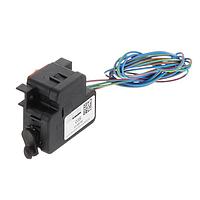
In addition, some accessories help on the commissioning or communication side. A product such as the PHOENIX CONTACT USB-DONGLE-EV-EMOB illustrates how certain accessories can be used beyond purely mechanical protection, supporting tasks linked to configuration or service work in an e-mobility environment.
Examples of accessories in practical use
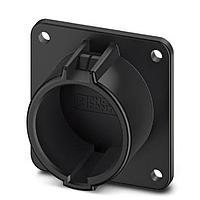
Several products in this range show how focused these components are. The PHOENIX CONTACT EV-T2AC-PARK is a Type 2 related accessory intended for connector parking, while EV-T2SOCR-PA and EV-T2SOCR-B are protective covers for socket outlets. These are straightforward but important examples of how accessories support everyday charger usability and interface protection.
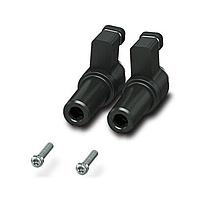
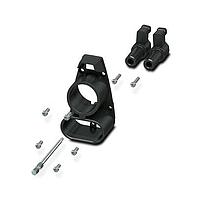
For maintenance scenarios, PHOENIX CONTACT offers products such as the CHARX connect repair kit and the EV-T1CCS-MF-M4X10 accessory for CCS Type 1 HPC DC vehicle connector applications. These parts are relevant when charging connectors require replacement of specific mechanical elements instead of a full assembly change. In a similar service context, the HUBER+SUHNER spare lever set is designed as a replacement part for CCS1 connector head applications, which is especially useful where uptime and field service efficiency matter.
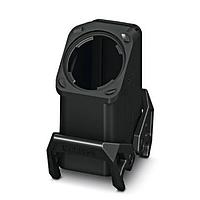
There are also installation-oriented parts like the PHOENIX CONTACT EV-T2SF-EM frame and EV-GRIP-D35,7MM grip accessory, which support the mechanical ecosystem around the charger connection point. Rather than treating all accessories as the same, it is better to match each item to its intended role in operation, protection, or repair.
How to choose the right EV charger accessory
The first step is to identify where the accessory fits in the charging system. Some parts are meant for socket outlets, some for vehicle connectors, and others for specific charging standards or high-power connector families. A cover for a socket outlet, for example, serves a very different purpose from a spare lever or a repair kit for a CCS connector assembly.
It is also important to check compatibility with the connector type in use, such as Type 2, CCS Type 1, CCS Type 2, or GB/T where indicated. In B2B purchasing, the accessory should be evaluated in the context of the complete hardware design, servicing plan, and installation environment. If the application includes control integration or charger-side intelligence, it may also be worth reviewing related charge controllers as part of the broader charging architecture.
Another practical consideration is whether the site team needs a protective part, a replacement part, or a service tool. This avoids ordering a maintenance accessory for an installation task, or vice versa. For fleet charging, public charging, and high-cycle use cases, keeping selected spare accessories available can also support faster maintenance turnaround.
Key manufacturers in this range
This category prominently features solutions from PHOENIX CONTACT and HUBER+SUHNER, both of which are well known in industrial and connection technology environments. Their accessories in this range reflect practical needs around EV connector handling, interface protection, and repairability.
PHOENIX CONTACT appears across multiple product examples here, including parking accessories, protective covers, frames, dongles, and repair-related parts. HUBER+SUHNER is represented with spare components for connector head maintenance. For buyers working on charging hardware programs, choosing accessories from established manufacturers can simplify sourcing and help maintain consistency across the installed base.
Where these accessories are commonly used
EV charger accessories are relevant across many professional charging scenarios. This includes AC and DC charging stations, commercial parking facilities, fleet depots, workplace charging, service centers, and public charging points. In each of these environments, accessories support the mechanical reliability and serviceability of charging hardware.
They are also useful for machine builders, panel integrators, and OEM teams building out charging assemblies or subassemblies. In those cases, the accessory is part of a wider system rather than an isolated product. Buyers who need a broader overview of similar supporting components can also browse the wider accessory range for EV charging to compare options by function and compatibility.
Support cleaner maintenance and longer service life
Well-chosen accessories help charging equipment stay easier to use, easier to protect, and easier to service. Covers help shield interfaces, parking components help manage connector placement, and repair parts support targeted maintenance when assemblies are subject to wear. In demanding charging applications, these details can have a real effect on service efficiency.
For B2B buyers, the most effective approach is to select accessories based on connector standard, charger interface, service workflow, and expected usage conditions. With the right combination of protective, structural, and maintenance-oriented parts, an EV charging installation becomes easier to maintain over time and better aligned with real operating needs.
Get exclusive volume discounts, bulk pricing updates, and new product alerts delivered directly to your inbox.
By subscribing, you agree to our Terms of Service and Privacy Policy.
Direct access to our certified experts