Common Types of Electric Screwdriver Bits and How to Choose the Right Bit for Each Screw
A bit set usually holds dozens of pieces in different shapes. Each shape matches one type of screw recess, and using the wrong bit makes it slip and strip the screw head, especially with a fast-spinning electric screwdriver. This article introduces the common types of electric screwdriver bits, how to tell apart the types that are easy to confuse, and the specifications to check when buying.
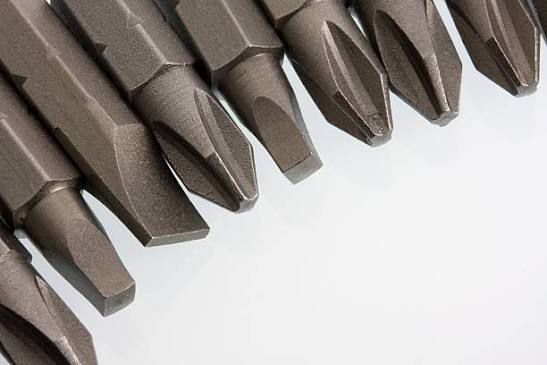
What are the common types of electric screwdriver bits, and which screws do they fit?
The table below lists the common electric screwdriver bits by recess shape, typical designation and the screws they usually fit. The illustrations below help identify the recess type quickly before reading the table.
Illustration of the screw head with the recess shown in dark
| Type | Common designation | Recess shape | Typical screws |
|---|---|---|---|
| Slotted | SL | A single straight slot | Old electrical items, hinges, some simple mechanical equipment |
| Phillips cross | PH000, PH00, PH0, PH1, PH2, PH3 | Plus sign, tapered tip | Electronics, household appliances, computer cases, assembled goods |
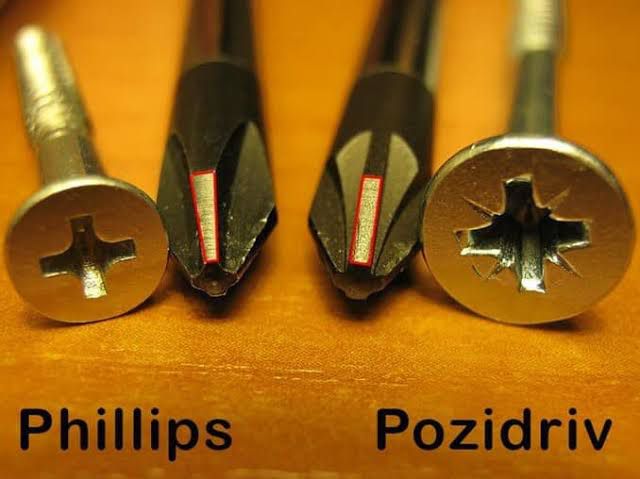
| Pozidriv | PZ0 to PZ5 | Plus sign with 4 extra grooves at 45 degrees | Electrical cabinets, European equipment, wood screws, load-bearing screws |
| JIS | May be marked JIS | Plus sign, square corners, less tapered tip | Equipment made in Japan |
| Hex (Allen) | H | Six-sided socket | Flat-pack furniture, bicycles, mechanical equipment |
| Torx | T, security variants marked TR | Six-point star | Electronics, many household appliances |
| Other security screws | Pentalobe, tri-point | Five lobes, three lobes | Some Apple electronic devices |
How do you tell Phillips, Pozidriv and JIS apart?
These three cross-shaped recesses look almost the same, and they are the most common source of mix-ups.
How to recognizePlain arms only
Bit markingPH
How to recognize4 small extra grooves between the arms, offset by 45 degrees
Bit markingPZ
How to recognizeSquare recess corners, less tapered tip, screw marked with a small dot or an X
Bit markingJIS
Pozidriv has 4 smaller extra grooves between the arms, offset by 45 degrees from the main plus sign. Phillips has plain arms only. Pozidriv bits are marked PZ and Phillips bits are marked PH. JIS has square recess corners and a less tapered tip than Phillips. JIS screws are usually recognized by a small dot or an X next to the recess.
A Phillips bit can still turn a Pozidriv screw at light force, but as the force rises the bit slips out of the recess, damaging the screw head and wearing the bit. A Phillips bit can also slip on a JIS screw. With an electric screwdriver, the high rotation speed makes this happen faster, so confirm the screw type before choosing a bit. The common sizes for household, electrical and general assembly work are PH1 and PH2, while smaller bits (PH000, PH00, PH0) are used for small electronics.
What should you know about slotted bits on an electric screwdriver?
A slotted screw has nothing to hold the bit in the center, so the bit easily slides sideways when the tool spins. The history of fastener design shows that this weakness, together with the difficulty of using them with powered tools, is why cross-head screws were developed.
When a slotted bit is unavoidable, choose one whose width is close to the slot length and whose thickness fits the slot width, set a low speed and low torque, and keep the tool in line with the screw axis. A bit narrower than the slot easily damages the slot, while a bit wider than the slot scratches the surrounding surface.
When are hex bits, Torx bits and security screws used?
Hex bits are used for six-sided socket screws, common in flat-pack furniture, bicycles and mechanical equipment. The six-sided recess holds the bit firmly, so it rarely slips.
A Torx bit has a six-point star shape that transmits torque well and resists slipping without heavy pressure. Sizes T6 to T10 are the ones met most often when repairing electronics. Torx needs the exact size, since a bit that is off by one size easily damages the recess. Security Torx screws have a small pin in the middle of the recess and need a bit with a hole in the center.
- T3
- T4
- T5
- T6
- T7
- T8
- T9
- T10
The shaded sizes are the ones met most often when repairing electronics
Some devices use security screws to discourage casual disassembly. Pentalobe (five lobes) is used by Apple for some external screws, and tri-point is used for internal screws in some devices. These screws need special bits, and because they are small they are easily damaged when the wrong tool is used.
What should you check in the shank, length, material and magnetism of a bit?
The two shank sizes are drawn to scale and are not directly interchangeable
Most bits use a 1/4 inch (6.3 mm) hex shank following ISO 1173 (types C 6.3 and E 6.3), suited to common handheld electric screwdrivers, drills and bit holders. For small electric screwdrivers used on electronics, many models take a 4 mm hex shank bit (type C4), known as a precision bit. The two shanks are not directly interchangeable, although adapters are available to convert from 1/4 inch to 4 mm. Check which type of bit holder the tool has before buying bits, because not every small electric screwdriver uses a 1/4 inch shank.
A standard bit is 25 mm long. Screws sunk deep in a recess need a longer bit, together with an extension holder.
Bits are usually made from alloy steel, and the two grades seen most often are S2 steel (used in many precision bit sets) and chrome vanadium steel (used in many standard bit sets). Choose a bit hard enough not to chip at the tip. A standard bit may fail early when used in an impact driver, which needs bits designed for impact.
A bit or bit holder with a magnet keeps small screws in place while driving, so they do not fall into gaps on circuit boards or housings.
How do you choose the right bit size and check the fit?
A correctly sized bit sits snug against the bottom of the recess with little play when wiggled gently. A bit smaller than the recess concentrates force on the recess edge, and a bit that is too large does not seat fully. The points below help the bit engage well.
Check that the bit still has sharp edges. A bit with a rounded, worn tip slips easily and should be replaced.
Hold the screwdriver in line with the screw and press lightly before pulling the trigger.
For small screws, set a low torque level if the tool has torque adjustment.
Start turning slowly and speed up once the bit has engaged.
Which bits should a bit set include for each need?
The table below is a general suggestion, since it depends on the screws each person meets.
| Need | Bits to have |
|---|---|
| Home assembly, furniture | PH1, PH2, PZ1, PZ2, medium slotted, common hex sizes |
| Repairing phones, laptops and small electronics | PH000 to PH1, small Torx (T3 to T10), JIS bit when repairing Japanese devices, pentalobe, tri-point |
| Production workshop assembly | According to the screw type of the product, a shank that suits the tool, and spare bits because bits wear with use |
Browse EMIN's range of electric screwdrivers and bits, or leave your details so an engineer can advise based on screw type, shank and assembly environment.