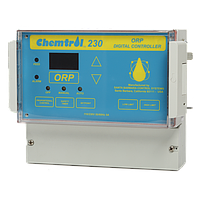
ORP Controllers
Maintaining stable oxidation-reduction potential is essential in many water treatment and process control applications, especially where disinfection, chemical dosing, and reaction consistency must be closely managed. A well-matched ORP controller helps operators monitor millivolt values in real time, trigger alarms or relays, and support more reliable control of oxidizing or reducing conditions.
This category brings together panel controllers, compact mini controllers, transmitters, and integrated monitoring solutions used across industrial water systems, treatment skids, utility processes, and other environmental control setups. Depending on the installation, users may need a simple display and relay output, a loop-powered transmitter for PLC integration, or a multi-function platform with logging and communication features.
Where ORP controllers are commonly used
ORP measurement is widely used to indicate the oxidizing or reducing condition of a liquid process. In practice, this is valuable in applications such as water treatment, chlorination control, chemical dosing, rinse systems, and general liquid process monitoring where redox conditions influence product quality or system safety.
These instruments are often selected as part of a broader control architecture that may also include water quality controllers and monitors for related process variables. In systems where multiple parameters need to be managed together, ORP is frequently monitored alongside pH, dissolved oxygen, conductivity, or resistivity depending on the process objective.
Typical device formats in this category
The range of products in this category reflects different installation and control needs. Some users need a compact controller with a local setpoint and relay for direct dosing control, while others need a transmitter that converts the ORP signal into a stable 4-20 mA output for a control panel, PLC, or SCADA system.
For example, compact devices such as the HANNA BL932700-1 ORP Mini Controller and HANNA BL982411-1 ORP Mini Controller are suited to installations where space is limited and a straightforward local control function is required. Panel-mounted options such as the Hanna HI8720 ORP Analog Controller with Self-Diagnostic Test and the HORIBA HO-480 ORP meter are more aligned with cabinet integration, local display, and relay-based monitoring in fixed control systems.
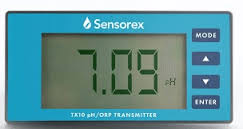
For signal transmission rather than standalone control, the Sensorex TX105 pH/ORP Loop Powered 4-20mA Transmitter and the Georg Fischer 3-9900-1P Transmitter illustrate how ORP measurement can be integrated into wider instrumentation networks. More advanced platforms such as the Meinsberg MV5010/ORP EC Controllers or Aqualabo ACTEON 5000-based ORP solutions add communication, data handling, or broader process management capability.
Important selection criteria for an ORP controller
Choosing the right device starts with the control task. If the goal is only to display ORP and provide a basic switching signal, a simple analog or mini controller may be enough. If the process requires analog retransmission, alarm handling, logging, or communication with higher-level systems, a transmitter or multifunction controller is usually the better fit.
Measurement range, output type, mounting format, and environmental protection are practical points to compare. Across the products shown here, you can find instruments with common ORP ranges such as ±1000 mV, ±1999 mV, or similar broad spans used in process applications, along with relay outputs, 4-20 mA outputs, and panel or field mounting options.
It is also important to consider how the controller will work with the rest of the system. Some applications need direct dosing control with adjustable setpoints and overfeed timing, while others need stable signal transmission and isolation for connection to automation hardware. In many projects, ORP control is planned together with related measurement categories such as DO controllers when multiple water quality parameters must be monitored in parallel.
Examples from leading manufacturers
Several established brands are represented in this category, each relevant to different project types. HANNA is well known in this selection for compact and panel-mounted ORP control devices, including mini controllers, analog indicators, and self-diagnostic controller formats that suit practical water treatment installations.
HORIBA offers panel-mount ORP instrumentation suited to control cabinets and process monitoring setups, while Meinsberg provides controller platforms designed for users who need a broader control interface. Aqualabo solutions are useful where digital sensor integration, communication functions, and recorded process data matter. Chemtrol products are relevant for applications requiring combined ORP and pH control logic, and SENSOREX supports installations that rely on loop-powered transmission to existing control infrastructure.
ORP control and system integration
An ORP controller rarely works alone. In a real installation, it is normally part of a wider control loop that includes the sensor, cabling, relays, chemical feed equipment, transmitters, and sometimes a supervisory control system. Because of this, buyers should think beyond the front-panel display and review how the unit handles outputs, maintenance mode, signal isolation, and compatibility with the intended process architecture.
Some products in this category are designed primarily for direct local control, while others are better suited to data transmission and networked monitoring. For instance, loop-powered transmitters simplify integration into analog current loops, whereas more advanced transmitters with digital communications can support modern process visibility and diagnostics. Where high-purity or specialty water systems are involved, users may also review related categories such as water resistivity controllers to build a more complete monitoring strategy.
When combined ORP and pH control makes sense
In many treatment processes, ORP alone does not tell the whole story. Chemical effectiveness, dosing behavior, and reaction conditions may also depend on pH, which is why some installations prefer a combined platform rather than separate instruments. Products such as the Chemtrol CH250 ORP/pH Digital Controller and the Sensorex TX105 pH/ORP Loop Powered 4-20mA Transmitter reflect this need for multi-parameter measurement within a compact footprint.
Combined monitoring can simplify wiring, panel space, and operator workflow, especially where both values are routinely checked to guide dosing decisions. The best choice depends on whether the site needs local control actions, analog retransmission, or a scalable instrumentation platform for future expansion.
What to review before ordering
Before selecting a unit, it is worth confirming the installation method, required outputs, power supply, and intended control logic. Panel cutout dimensions, enclosure protection, relay capacity, current output requirements, and whether the application needs simple on/off control or more advanced control behavior can all influence the final choice.
Sensor compatibility is another key point. A controller or transmitter must fit the sensor type and signal path used by the process, especially when the system includes amplified sensors, temperature input, or digital communication. Looking at the complete measurement chain helps reduce commissioning issues and supports more stable long-term operation.
Finding the right ORP controller for your process
This category covers a practical mix of ORP control solutions, from compact single-function units to more configurable transmitters and process controllers. Whether the need is local relay control, analog signal retransmission, or integration into a broader water monitoring system, the right product depends on how the measurement will be used in the field.
Review the available models based on control method, mounting style, and integration requirements rather than selecting on range alone. A well-chosen ORP controller can improve process visibility, support safer dosing control, and make it easier to maintain stable operating conditions over time.
Get exclusive volume discounts, bulk pricing updates, and new product alerts delivered directly to your inbox.
By subscribing, you agree to our Terms of Service and Privacy Policy.
Direct access to our certified experts