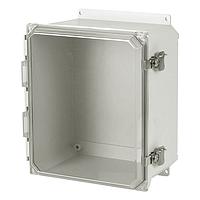
Control Enclosure
In industrial control and measurement systems, the enclosure around the instrument is more than a protective shell. It helps determine how well panel meters and related devices withstand moisture, dust, washdown conditions, and day-to-day plant exposure while remaining readable and accessible for operators and maintenance teams. Choosing the right Control Enclosure is therefore an important part of building a reliable monitoring point.
On this page, you can explore enclosure solutions used to house panel meters in process monitoring environments. These products are relevant wherever instruments need a dedicated mounting space, whether for local indication, grouped meter displays, or protected field installation in manufacturing, utilities, water treatment, and general industrial facilities.
Why control enclosures matter in industrial measurement
A control enclosure helps protect installed devices from environmental stress and accidental contact while giving the system a more organized and serviceable layout. In many applications, panel meters are not mounted in a large cabinet but instead need a compact, standalone housing near the process. That is where dedicated enclosure solutions become practical.
For process users, the benefit is not only protection but also installation efficiency. A properly selected enclosure can simplify meter grouping, improve front-panel visibility, and support more consistent field deployment across multiple lines or stations. In broader control systems, these housings often sit alongside equipment such as PID controllers or other monitoring devices where local indication remains important.
Typical enclosure features to look for
When comparing options in this category, the first considerations are usually environmental protection, construction material, and mounting capacity. Many of the highlighted models in this range are built for demanding industrial use with IP66 and NEMA Type 4X ratings, making them suitable for locations where dust, splashing water, or washdown resistance may be relevant.
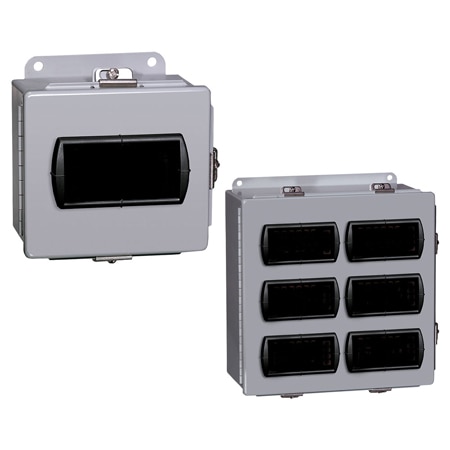
Another practical factor is the number of meters the enclosure is designed to accommodate. Depending on the installation, a single-meter housing may be enough for a dedicated point indication, while multi-meter versions support grouped readings in one location. Material selection also matters: steel, 304 stainless steel, thermoplastic, and polyester each bring different advantages in terms of durability, weight, and corrosion resistance.
Examples from the Dwyer PME enclosure range
This category includes representative panel meter enclosures from Dwyer, a familiar name in process instrumentation. The PME series illustrates how enclosure selection often revolves around meter count, material preference, and site conditions rather than a one-size-fits-all approach.
For compact installations, models such as the Dwyer PME-21 and PME-31 are designed for a single meter, making them suitable where space is limited or where each measurement point is housed separately. If the application needs a little more consolidation, the PME-22 and PME-42 support two meters, while larger options such as the PME-43, PME-15, PME-16, PME-26, PME-35, PME-45, and PME-46 provide capacity for three to six meters depending on the model.
The range also shows the importance of housing material. Steel and 304 stainless steel versions are relevant when mechanical strength or corrosion resistance is a priority, while thermoplastic and polyester designs may be attractive in applications where lower weight or non-metallic construction is preferred. Instead of focusing only on enclosure size, it is better to match the housing to the actual environment and maintenance expectations.
How to choose the right model for your application
A useful starting point is to define how many displays or measuring points need to be grouped together. Single-meter enclosures are often selected for isolated instruments mounted near pumps, tanks, or local operator stations. Multi-meter versions make more sense when several related values need to be viewed in one place, such as pressure, temperature, flow, or level indicators associated with the same skid or process area.
Next, consider the installation environment. Where corrosion resistance is important, stainless steel options may be more appropriate. For general industrial duty, painted steel designs can be a practical fit, while non-metallic materials may suit applications that value lighter weight or material compatibility. It is also worth checking how the enclosure fits into the wider control architecture, especially if the measurement point works together with devices such as limit controllers or alarm functions.
Finally, think about service access and future expansion. A well-sized enclosure should not only fit the initial meter arrangement but also support clear wiring routes, convenient maintenance, and a clean front-panel layout. Selecting purely on minimum dimensions can create avoidable problems later.
Common use cases for control enclosures
Control enclosures in this category are commonly used where panel meters need a dedicated protective housing outside a main control cabinet. This can include utility systems, pump and filtration skids, HVAC monitoring points, water and wastewater installations, food and beverage process areas, and general industrial machine support stations.
They are especially useful when local display is needed close to the process rather than only at a central control room. In those situations, the enclosure acts as a bridge between field exposure and operator usability. It can also complement adjacent solutions such as multi-loop controllers where multiple values are monitored and organized across a process area.
Material and rating considerations
Material selection has a direct effect on lifecycle, maintenance, and installation suitability. Steel enclosures are often chosen for ruggedness, while 304 stainless steel can be better aligned with harsher or more corrosive environments. Thermoplastic and polyester options can provide a different balance of corrosion resistance, weight, and handling convenience.
The protection rating should be assessed in relation to the real site conditions, not just the specification sheet. An enclosure with IP66 and NEMA Type 4X protection may be a strong fit for many industrial areas, but users should still consider washdown exposure, chemical contact, mounting location, and cable entry methods as part of the complete installation. If the project also includes larger housing requirements, related control enclosure solutions may be reviewed in the same system planning process.
Supporting a cleaner and more reliable panel layout
A good enclosure choice contributes to more than physical protection. It can improve labeling clarity, reduce clutter around local instrumentation, and create a more professional layout for both operation and maintenance. This becomes increasingly important when multiple meters are grouped together and expected to remain readable in busy plant environments.
For procurement teams and engineers, the right product is usually the one that aligns enclosure capacity, construction material, and protection rating with the actual application. The Dwyer PME series shown in this category provides a practical spread of one-meter to six-meter configurations, helping users match the enclosure to field requirements without overcomplicating the design.
Final considerations before ordering
Before selecting a model, confirm the number of meters required, review the preferred housing material, and verify that the environmental rating matches the site conditions. It is also helpful to consider how the enclosure will integrate with the surrounding measurement and control devices so the final installation remains accessible and easy to maintain.
With the right panel meter enclosure, a measurement point becomes easier to protect, easier to organize, and more dependable in daily operation. Browse this category to compare available configurations and identify the enclosure format that best fits your industrial monitoring application.
Get exclusive volume discounts, bulk pricing updates, and new product alerts delivered directly to your inbox.
By subscribing, you agree to our Terms of Service and Privacy Policy.
Direct access to our certified experts