Limit Controllers
When a process must stay within a safe temperature boundary, a simple alarm point is often more important than a full control loop. Limit Controllers are designed for that job: they monitor a temperature input, compare it against a defined limit, and trigger an output when the threshold is reached. In industrial heating systems, ovens, furnaces, and equipment protection circuits, this function helps reduce the risk of overheating, product damage, and unplanned shutdowns.
On this page, you can explore limit control devices suited to thermal monitoring applications, including compact panel-mounted models with thermocouple input and relay output. These products are commonly selected where operators need a clear display, dependable switching, and straightforward setup rather than a complex multi-loop strategy.
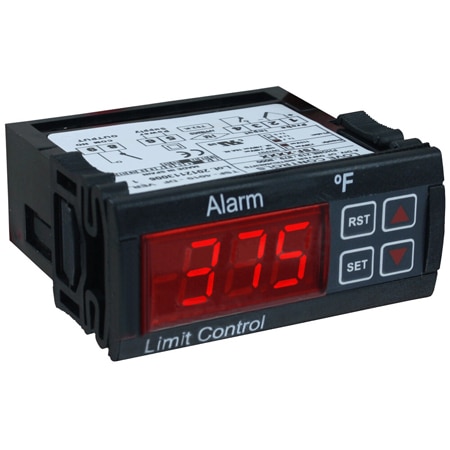
Where limit controllers fit in industrial process control
A limit controller is typically used as a protective monitoring device. Instead of continuously modulating a heater like a standard controller, it watches for a maximum or minimum condition and changes output status when the process crosses the configured limit. This makes it useful in safety-oriented temperature supervision, burner-related applications, and equipment interlock schemes.
In broader control architecture, limit devices often work alongside other hardware rather than replacing it. For example, a machine may use a separate temperature regulator for normal operation while a dedicated limit unit provides an independent trip or alarm layer. If your application requires closed-loop temperature regulation instead of threshold-based protection, it may also be worth reviewing PID controllers for comparison.
Typical applications for thermocouple limit monitoring
Many limit control applications involve high-temperature processes measured with thermocouples. That is why this category commonly includes models designed for J and K thermocouple inputs, which are widely used in ovens, heated chambers, process skids, and thermal equipment. In these setups, the controller reads the sensor signal, displays process temperature, and activates a relay output when the alarm condition is met.
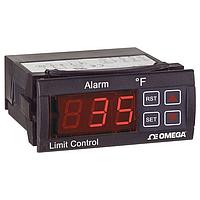
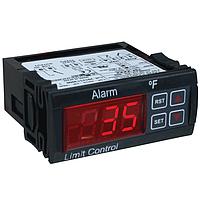
The featured Dwyer TSF series is a good example of this type of solution. Models such as the Dwyer TSF-4041-DF and Dwyer TSF-4010-MDF are intended for gas oven control environments where a visible LED display and relay switching are important. Their role is not to complicate the control scheme, but to provide a practical and readable limit alarm function within the panel.
Key selection points before you choose
The first thing to confirm is the sensor input type. In this category, thermocouple-compatible devices are especially relevant, so you should match the controller to the sensor already used in the machine or specified in the design. J and K thermocouples are common, but the correct choice depends on your operating range, plant standard, and installed instrumentation.
Next, review the required temperature units and range. Some models are configured in °F and others in °C, which matters for operator usability and commissioning consistency. You should also check the supply voltage available in the panel, since different versions in the TSF family are offered for 12 Vac/Vdc, 24 Vac/Vdc, 115 Vac, and 230 Vac systems.
Output type is another practical decision. For many thermal protection applications, a relay output is preferred because it can be integrated into alarms, contactor logic, shutdown circuits, or interlocks. Where a more specialized architecture is needed, it can also be helpful to compare the system role of a limit unit with dedicated control enclosures or other process control assemblies.
What to expect from the featured product range
The products highlighted in this category reflect a compact, panel-oriented approach to limit monitoring. Across several Dwyer TSF variants, common characteristics include a 3-digit LED display, non-volatile memory backup, and SPST NO relay output. These are practical features for machines where operators need to see the current value quickly and where the switching output must remain easy to integrate into existing control wiring.
Several versions also support panel environments that require a degree of front protection, with IP64 enclosure rating noted in the product data. Depending on the model, users can choose Fahrenheit or Celsius resolution and select the power version that aligns with the installation. For buyers standardizing around a specific brand ecosystem, the broader Dwyer product range may also provide complementary process instrumentation for the same project.
Limit controllers versus other controller types
Although these devices are often grouped with other process controllers, their purpose is narrower and more focused. A limit controller is centered on threshold detection and response, while a standard process controller may continuously regulate output to maintain setpoint stability. This difference is important when specifying hardware for compliance, protection, or alarm-driven applications.
In more advanced systems, a limit controller may be paired with a conventional control device rather than used alone. For example, a heater could be regulated by one controller and independently supervised by a high-limit unit. If the application expands beyond a single monitored point, users may also evaluate multi-loop controllers for more complex thermal management across multiple zones.
Why display, power, and wiring details matter
In B2B purchasing, seemingly small specifications often determine whether a controller fits the job without extra engineering work. Display style matters when operators must verify process status from the front panel, especially in heated equipment or maintenance-intensive environments. A straightforward LED readout can improve usability during startup, troubleshooting, and routine checks.
Power compatibility is equally important. Selecting the wrong supply version can delay installation or require panel redesign. Matching the controller to available AC or AC/DC power from the start helps simplify procurement, while confirming relay rating and wiring logic helps ensure the unit can be integrated properly into the machine’s alarm or shutdown circuit.
Choosing the right model for your process
If your application is centered on temperature limit supervision, start with the actual sensor type, operating range, unit preference, and available supply voltage. Then confirm how the relay output will be used in the overall control scheme. This approach is usually more effective than choosing by model name alone, especially when several variants share the same basic form factor but differ in configuration.
For industrial ovens, thermal safety layers, or equipment that requires a clear and dependable high-limit indication, limit controllers provide a focused solution without unnecessary complexity. Reviewing the available models on this page can help you narrow down the best fit for your panel, your wiring standard, and your process protection strategy.
Get exclusive volume discounts, bulk pricing updates, and new product alerts delivered directly to your inbox.
By subscribing, you agree to our Terms of Service and Privacy Policy.
Direct access to our certified experts