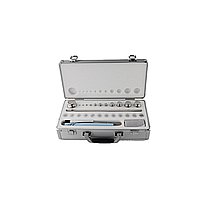
Test weights E1
Accurate mass standards are essential wherever balances need to deliver traceable, repeatable results. In laboratories, calibration rooms, and high-precision weighing workflows, Test weights E1 are typically selected for demanding verification and adjustment tasks where very tight tolerances matter.
This category brings together E1-class weights, weight sets, and related accessories used to support highly precise balance calibration and routine performance checks. It is especially relevant for users working with analytical and other high-resolution weighing systems where even small deviations can affect measurement quality, documentation, and process confidence.
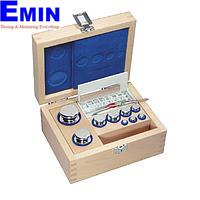
Where E1 test weights are used
E1 weights are commonly chosen for applications that require a very high level of mass accuracy. They are often used to check or calibrate sensitive weighing instruments in laboratories, research environments, metrology-related workflows, and quality control processes where measurement uncertainty must be kept low.
They also play an important role in internal verification routines. When paired with suitable balances such as an analyzer scale or other high-resolution weighing equipment, E1-class weights help users confirm whether the instrument is performing within the expected range before critical measurements are taken.
Understanding the scope of this category
This selection includes both individual weights and multi-piece sets, allowing users to choose according to their calibration routine. For example, a single reference piece such as the KERN 307-06 OIML E1 Single weight (50g, ±0,03mg) may be suitable for focused checks at a specific nominal point, while a full set provides more flexibility across a wider weighing range.
Several KERN sets in this category cover different nominal value ranges, from very small milligram increments up to larger values. Models such as KERN 303-056 Sets of weights (E1, 1 ~ 500000 mg), KERN 304-056 Sets of weights (E1, 1000 ~ 500000 mg), and KERN 304-096 Sets of weights (E1,1000 ~ 10000000mg) illustrate how users can select a set based on the span of masses they need to test.
Single weights, sets, and supporting items
Choosing between a single weight and a set depends on how the balance will be checked. A single E1 weight is practical when a process requires repeated verification at one specific load point. This can be useful in controlled routines where only one nominal value is critical to daily operation.
A set is usually more appropriate when multiple test points are needed across the weighing range. For broader calibration support, users may prefer dedicated sets together with storage and handling accessories. The KERN 313-040-600 Aluminium Protective Box is an example of a supporting item designed to help protect weights during storage and transport. If you are also reviewing related tools, you can explore more weighing accessories for a complete setup.
Why handling and storage matter
High-accuracy weights should be treated as precision instruments rather than simple metal masses. Surface condition, contamination, and handling practices can all influence long-term reliability. For that reason, storage cases and dedicated protective boxes are not just optional add-ons; they are part of maintaining the usable condition of the weight over time.
Polished stainless steel construction, as seen in products such as KERN 307-11 E1 Test Weight (1000g/ 0.5mg) and KERN 307-12 E1 Test Weight (2000g/1mg), supports durability and stable use in controlled environments. Even so, good handling discipline remains important, especially when the weight is used in calibration or verification work tied to documented quality procedures.
How to choose the right E1 test weight
The most practical starting point is the weighing instrument itself. Consider the balance resolution, the nominal load points you need to verify, and whether you need a single reference mass or a full set. Users working with highly sensitive laboratory instruments often review this category alongside precision scale options or analytical weighing equipment to ensure compatibility between the instrument and the reference standard.
It is also useful to think about workflow frequency. If weights are used regularly, a durable storage solution and clear identification of nominal values become more important. For applications that require documented calibration support, items such as KERN 963-233 DKD Cal Cert E1 Weight 5g and KERN 963-234 DKD Cal Cert E1 Weight 10g may be relevant within the broader calibration process, depending on internal procedures and documentation requirements.
Manufacturers featured in this category
KERN is the main highlighted manufacturer in this category and is well represented through individual E1 weights, sets, calibration-related items, and protective accessories. This makes it easier for buyers to source products within one consistent measurement ecosystem, especially when standardizing internal calibration routines.
Masseprazise is also listed as a featured manufacturer for this category context. In practice, many buyers compare available brands based on required nominal values, tolerance expectations, and the way the weights fit into existing quality and metrology procedures rather than choosing on brand alone.
Fit within a broader precision weighing workflow
E1 test weights are rarely selected in isolation. They are usually part of a wider weighing and verification environment that may include analytical balances, document-controlled calibration steps, and routine checks before use. In moisture determination or material testing workflows, users may also depend on related equipment such as a moisture analyzer, but the underlying need remains the same: confidence in measurement results.
By selecting the right class, nominal values, and supporting accessories, users can build a calibration routine that is better aligned with actual operating conditions. That is often more valuable than simply choosing the widest or heaviest set available.
Practical considerations before ordering
Before selecting a product, it helps to define the mass range you need to cover and how the weights will be used day to day. A compact set may be enough for routine checks, while a broader range can support more complete calibration points. Storage conditions, transport needs, and the level of documentation required by your process should also be considered early.
This category is intended for buyers who need a reliable source of high-precision calibration weights for sensitive weighing applications. Whether you need an individual mass, a broader set, or supporting storage and certification-related items, the available E1 options provide a structured starting point for building a more controlled and repeatable weighing process.
Get exclusive volume discounts, bulk pricing updates, and new product alerts delivered directly to your inbox.
By subscribing, you agree to our Terms of Service and Privacy Policy.
Direct access to our certified experts