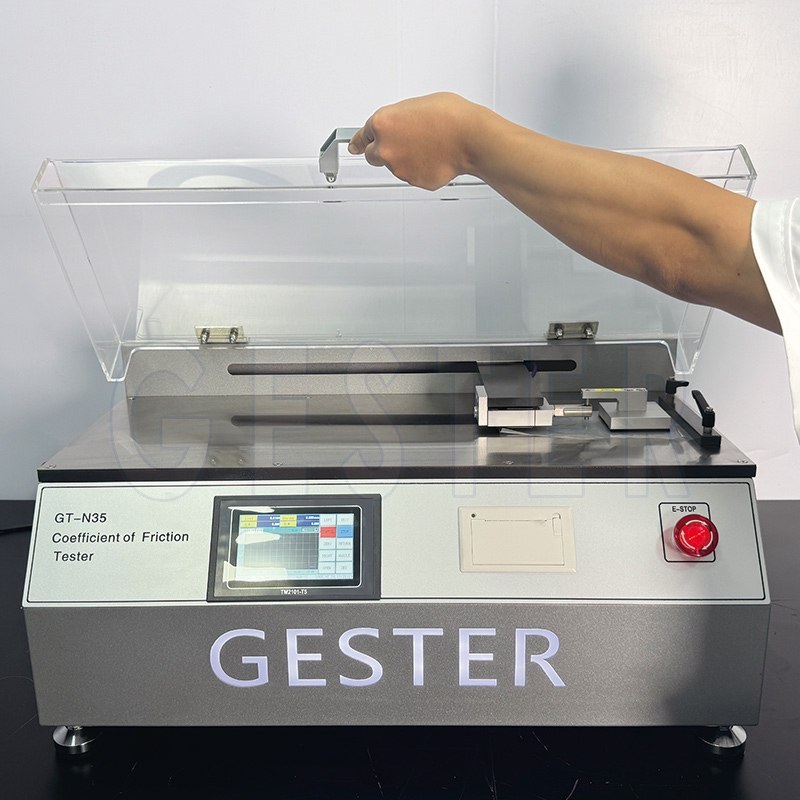
The GT-N35 coefficient of friction tester is intended to evaluate how two material surfaces behave when they slide against one another. For quality-control teams, this information can support assessment of slip resistance, surface smoothness, and material-to-material interaction. The instrument is described for measuring both static and dynamic coefficients of friction on a range of planar materials.
Friction testing can be relevant wherever surface movement affects product handling or performance. Examples in the supplied product information include plastic film, paper and cardboard, leather, rubber, woven bags, fabrics, cable-related composite belts, wood, coatings, shoe materials, tires, and wiper materials. Material shape and surface condition should be considered before selecting a test method.
What the GT-N35 coefficient of friction tester measures
A coefficient of friction expresses the relationship between friction force and the load applied to the contacting surfaces. In a sliding test, static friction relates to the force needed to initiate movement, while dynamic friction relates to the force recorded after relative motion begins.
The GT-N35 is described as providing real-time digital display of static and dynamic friction coefficients. This enables an operator to observe both values during a test rather than treating friction as a single, undifferentiated result. The source information also states that the slider stroke can be preset and adjusted over a wide range.
How the friction test principle works
The basic method uses two test surfaces. One specimen is laid flat on the test table, while the other is attached to a slider with a specified weight. The surfaces are brought into contact under the test conditions, and the system drives relative sliding movement.
During movement, the instrument records friction force. The coefficient of friction is calculated by dividing the measured friction force by the gravity of the slider. Consistent specimen placement, slider positioning, and surface contact are important because variation in these factors can affect the result.
The GT-N35 is described as combining mechanical movement with electronic measurement. Its fixed-point force measurement approach is intended to reduce the effect that motion vibration can have on sensor readings.
Listed test modes and standards
According to the supplied information, the GT-N35 offers national standard, American standard, and free test modes. The appropriate mode should be selected according to the laboratory procedure and the specification being evaluated. A free mode may be useful where a defined internal test setup is required, but results should still be interpreted against the relevant acceptance criteria.
The listed applicable standards are GB 10006, GB/T 17200, GB/T 22895, ISO 8295, ASTM D1894, TAPPI T816, and GB/T 2792. Before testing for compliance or customer approval, laboratories should verify that the selected method, specimen preparation, and test settings match the applicable standard requirements.
Key operating features described for GT-N35
Display and data output
The supplied product details describe a TFT LCD display with real-time curve display and a high-speed micro printer. These features can assist with reviewing test behavior during the run and producing a printed record. The printer is also described as supporting low-noise operation and ribbon-free paper-roll replacement.
Movement and repeatability considerations
The instrument is described as using a precision differential motor for transmission. Smooth, controlled movement is important in friction testing because abrupt or inconsistent travel can complicate comparison between samples. The product information associates this drive arrangement with lower noise and improved repeatability.
Flexible test setup
With adjustable slider stroke and selectable modes, the GT-N35 can be configured for different planar-material friction evaluations within its stated scope. Operators should document the selected mode, slider arrangement, specimen orientation, and test environment so that subsequent tests can be compared on a consistent basis.
Typical material applications
For packaging and paper-based materials, friction data can help evaluate how sheets, films, or related surfaces move during handling and conversion. For rubber, tires, and wiper materials, testing may contribute to assessment of surface friction behavior. The stated applications also include metal composite belts used with communication and optical cables, pipe belts, wood, and coatings.
These applications do not mean that every sample will use the same conditions. Material thickness, surface texture, coating condition, and intended end use may require a specific method or test configuration.
Test limitations and good practice
The GT-N35 is principally described for planar-material friction tests. Special-shaped specimens, very thick materials, or materials with complex surfaces may not be suitable without confirming the test arrangement first.
Temperature, humidity, and surface cleanliness can influence friction results. A stable test environment and clean, consistently prepared specimens help reduce avoidable variation. Uneven specimen placement or incorrect slider positioning can also affect measurements.
Routine care is important for continued operation. The supplied information recommends regular maintenance of the sensor, guide rail, and transmission components. Laboratories should also follow their own maintenance and verification procedures before relying on results for quality decisions.
Choosing a coefficient of friction test approach
When evaluating the GT-N35 coefficient of friction tester for a workflow, begin by defining the material, specimen geometry, target friction value, and applicable test method. Confirm that the sample is planar and that the desired standard or internal procedure can be set up appropriately. Then establish controlled practices for conditioning, placement, data recording, and equipment maintenance.
By connecting the instrument setup to a documented procedure, teams can use static and dynamic friction results more consistently when comparing materials or monitoring production variation.