In industrial safety installations, many facilities invest in genuine sensors yet still suffer fire, explosion, or toxic exposure incidents because alarms fail to trigger on time. The root cause rarely lies in hardware quality; instead, it typically stems from improper mounting height or placing detectors inside aerodynamic "dead zones."
For a fixed gas detector system to deliver reliable 24/7 monitoring, M&E engineers and HSE teams must calculate mounting locations based on two fundamental physical parameters: the vapor density of the target gas and airflow patterns across the facility.
Golden Rule for Field Gas Detector Placement:
Gas vapor density determines the vertical mounting height (Z-axis), while exhaust fan airflow, HVAC supply vents, and ceiling beams determine the horizontal floorplan coordinates (X-Y axes) to avoid air dead zones.
1. Determining Mounting Height Based on Gas Vapor Density
The vapor density of a gas is defined as the ratio of its molar mass to the average molar mass of dry air (approximately 28.97 g/mol under standard conditions, where air density equals 1.0). Based on this value, the stratification behavior of a gas cloud immediately after leaking from a pipe or pressurized valve falls into three distinct elevation groups.
For gases lighter than air (vapor density below 0.8) such as Hydrogen (H2 ~ 0.07), Methane (CH4 ~ 0.55), or Ammonia (NH3 ~ 0.59), leaked gas rises rapidly and accumulates beneath the roof. Detectors should be mounted 0.3 m to 0.6 m below the ceiling or roof peak to intercept the accumulation zone, while avoiding tight wall-to-ceiling corners where air remains stagnant.
Conversely, gases heavier than air (vapor density above 1.2) such as liquefied petroleum gas LPG (Propane ~ 1.52, Butane ~ 2.01), Hydrogen Sulfide (H2S ~ 1.19), Chlorine (Cl2 ~ 2.45), or organic solvent vapors (Toluene, Xylene, Acetone) sink toward the floor and collect in cable trenches and utility pits. Standard mounting height for this group is 0.15 m to 0.3 m above the floor, with the sensor head oriented downward to prevent dust and splash water from clogging the filter membrane.
The most frequently misjudged category in practice involves gases with vapor density close to air (0.85 to 1.15), notably Carbon Monoxide (CO ~ 0.97), Ethylene (C2H4 ~ 0.97), and Nitrogen (N2 ~ 0.97). These gases neither rise fully to the ceiling nor sink strictly to the floor, dispersing instead with thermal convection currents. Therefore, detectors for CO or Oxygen (O2) depletion must be positioned within the worker breathing zone at 1.5 m to 1.8 m above the operating floor.
| Target Gas | Vapor Density vs. Air (=1.0) | Standard Mounting Height | Priority Detector Placement |
|---|---|---|---|
| Hydrogen (H2), Methane (CH4), Ammonia (NH3) | 0.07 – 0.59 (Light) | 0.3 m – 0.6 m below ceiling | Above supply valves, storage tanks, and roof ventilation peaks. |
| Carbon Monoxide (CO), Ethylene (C2H4), Oxygen (O2) | 0.97 – 1.10 (Neutral) | 1.5 m – 1.8 m above floor | At breathing level along operator walkways, engine rooms, and basements. |
| LPG, H2S, Chlorine (Cl2), Solvent Vapors | 1.19 – 2.50 (Heavy) | 0.15 m – 0.3 m above floor | Near tank bases, pressure regulator manifolds, and utility trench openings. |
2. Identifying and Eliminating Aerodynamic "Dead Zones" in Plants
Even at the correct elevation for vapor density, a detector can fail to respond if placed in an aerodynamic dead zone—where leaked gas is over-diluted or mechanically blocked before reaching the sensing element. In enclosed industrial spaces, design engineers must eliminate three common dead-zone configurations directly on the layout drawing.
First is the area directly adjacent to HVAC fresh air supply diffusers or cooling blowers. Positive-pressure clean air streams push leaked gas plumes away and dilute concentrations below alarm thresholds. Detectors should be installed at least 1.5 m away from supply vents and positioned downwind from potential leak sources (such as flanges, pressure relief valves, and pump seals) toward exhaust extraction intakes.
Second are structural ceiling pockets partitioned by deep concrete beams or steel trusses. For light gases like Hydrogen or Methane, each bay between ceiling beams acts as an independent gas trap; installing a single detector in an adjacent bay allows leaked gas to reach explosive levels inside the source bay while the neighboring sensor still reads 0% LEL. Third are low-pressure stagnant corners behind large electrical cabinets or partition walls where air remains nearly motionless with minimal convective exchange.
Note on Coverage Radius and Hot Gas Leaks:
In enclosed low-draft spaces, a point gas detector provides an effective monitoring radius of roughly 3 m to 5 m (covering 30–50 m²). Additionally, if heavy gases such as LPG or solvent vapors leak from high-temperature piping, initial thermal buoyancy lifts the plume toward the ceiling before it cools and settles toward the floor; such points require dual-elevation monitoring.
3. Selecting Fixed Gas Detector Configurations for Specific Mounting Locations
Whether a detector is mounted near floor level or high under the roof directly impacts enclosure ingress protection requirements, signal interference resistance, and routine maintenance accessibility. Choosing the right hardware configuration upfront significantly reduces long-term operating costs.
Low-Elevation Mounting Near Floors, Utility Trenches, or Washdown Areas
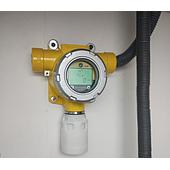
When mounted 0.15 m – 0.3 m above the floor to detect LPG, H2S, or solvent vapors, transmitters face moisture, industrial dust, and mechanical impact. Cast aluminum explosion-proof detectors rated Ex d IIC T6 and IP65/IP66—such as Prosense P-Series fixed gas detectors —handle these harsh conditions reliably with sealed housings and optional splash/dust guard accessories for the sensor head.
High-Elevation Ceiling Mounting or Centralized Monitoring Integration
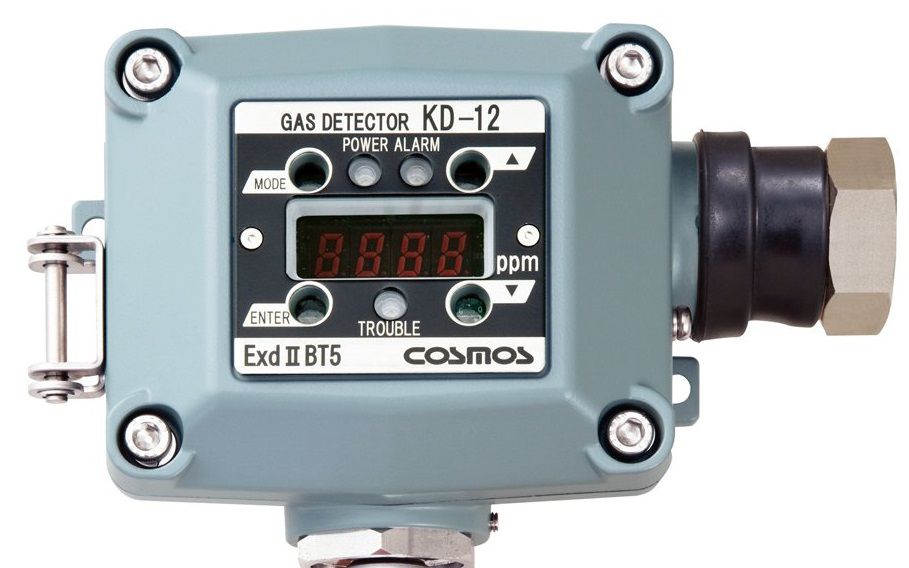
For light gas detectors (H2, CH4, NH3) mounted 0.3 m – 0.6 m below the ceiling, requiring technicians to climb scaffolding for readings or calibration consumes excessive labor. A practical approach is deploying Cosmos KD-12B fixed gas detectors transmitting 4-20mA signals to a central display panel in the control room or at eye level, paired with remote calibration tubing routed from ground level to the calibration cap for rapid maintenance without dismantling overhead units.
4. Post-Installation Verification Using Smoke Tubes and Calibration Gas
After completing mechanical and electrical installation, commissioning engineers should verify actual airflow patterns at each detector location using a neutral smoke tube while all plant exhaust fans and HVAC units operate under normal load. If smoke released from a simulated leak point drifts away without passing across the sensor head, the mounting coordinates must be adjusted prior to handover. For complete system deployment guidance, see our article on leak gas monitoring solutions for factory fire prevention
Contact EMIN today if you need consultation and support regarding the installation of equipment based on your factory layout.