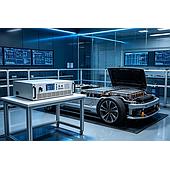
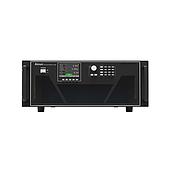
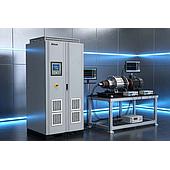
A bidirectional DC power supply can act as both a programmable DC source and an electronic load, allowing it to deliver power to a solar inverter and absorb power returned by the device under test. This makes it suitable for evaluating solar inverter behavior, MPPT operation, and systems that combine photovoltaic generation with battery storage.
For laboratory testing, its central value is the ability to simulate changing PV conditions rather than supplying only fixed DC voltage and current. It can also support energy recovery during tests where the inverter sends energy back to the test system.
Summary: A bidirectional DC power supply can simulate programmable PV I-V and P-V curves. It supports sourcing and sinking power for hybrid inverter tests. Regenerative operation can return absorbed energy to the utility grid. Programmable scenarios can improve test repeatability.
What does a bidirectional DC power supply do in solar inverter testing?
In solar inverter testing, a bidirectional DC power supply provides controlled DC input and can absorb energy from the inverter. By combining source and load functions in one system, it can reduce the need for separate instruments in tests involving bidirectional energy flow.
A solar inverter converts DC produced by PV panels into usable AC power. Its MPPT function adjusts operating parameters to seek the maximum available power as PV conditions change, so testing needs an input that can represent those changes.
| Test requirement | Relevant bidirectional capability |
|---|---|
| PV input behavior | Programmable I-V and P-V curve simulation |
| Returned inverter energy | Energy absorption and regenerative operation |
| Hybrid PV-storage operation | Power sourcing and sinking in one platform |
| Repeated scenarios | Programmability and automated test sequences |
Why is PV curve simulation important for MPPT testing?
PV curve simulation matters because a photovoltaic array has nonlinear voltage-current behavior that changes with irradiance and temperature. A fixed-output DC supply may not reproduce the changing operating point that an MPPT algorithm must track.
Programmable PV simulation can represent irradiance levels, cell temperature, panel quantity, partial shading, and multi-peak power characteristics. This gives engineers a controlled way to assess tracking behavior, stability around the maximum power point, and response when conditions change.
Which changing conditions can a bidirectional supply help reproduce?
A bidirectional DC power supply can be programmed to reproduce transient PV and system conditions that are relevant to inverter validation. Examples described for this use include passing clouds, sudden irradiance changes, temperature transitions, dynamic load changes, and grid-disturbance scenarios.
Fast response is important because modern MPPT algorithms may react within milliseconds. If the test source cannot change comparably quickly, it may be difficult to evaluate transient stability and tracking response under rapidly changing conditions.
How does regenerative operation affect solar inverter test energy use?
During regenerative operation, the supply can absorb energy from the inverter and return recovered energy to the utility grid instead of dissipating it as heat through resistive loads. This approach can reduce electricity consumption and cooling requirements during high-power or long-duration testing.
Traditional test arrangements may dissipate substantial energy as heat, particularly when tests range from several kilowatts to megawatts. The actual benefit depends on the test setup and operating conditions, but energy recovery addresses a key source of laboratory energy loss.
Note: Regenerative operation concerns energy absorbed from the device under test; it does not replace the need to define suitable PV, load, grid, and battery test conditions.
When is bidirectional power flow useful for hybrid inverter testing?
Bidirectional power flow is useful when testing hybrid solar systems that manage energy among PV arrays, batteries, and the grid. These systems require equipment that can both source and sink power while maintaining controlled operation.
One bidirectional platform may emulate PV arrays, battery charging behavior, battery discharge conditions, energy-storage interactions, and DC bus dynamics. Integrating these functions can simplify configuration compared with using multiple independent instruments.
How can automation improve solar inverter and MPPT test workflows?
Automation can execute defined test sequences across numerous operating scenarios with less manual reconfiguration. The source data identifies Ethernet, CAN, Modbus, SCPI commands, and automated test software integration as communication and programming options available on modern systems.
For development teams, automated sequences can improve repeatability, reduce human error, and speed data collection. They can also help expose design issues earlier by running repeatable variations of irradiance, temperature, load, and energy-flow conditions.
What other renewable-energy tests can use a bidirectional DC power supply?
Beyond MPPT verification, a bidirectional DC power supply can support inverter efficiency measurements at varying loads, battery storage charge-discharge evaluation, hardware-in-the-loop simulation, and long-duration cycling or stress tests. It may also be used to simulate abnormal operating scenarios for grid-compliance verification.
The appropriate test method should match the device, intended operating conditions, and validation objective. PV simulation, dynamic response, regenerative operation, and automation are complementary capabilities rather than interchangeable test results.