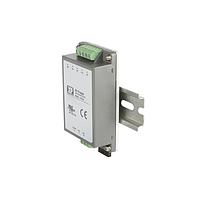
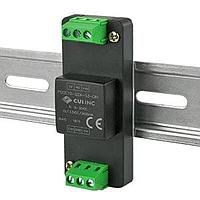
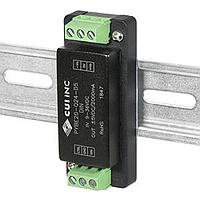
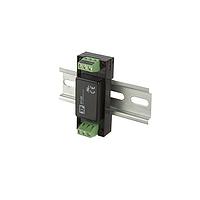
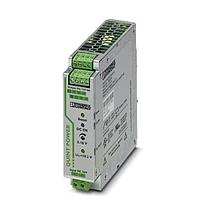
DIN Rail Mount Isolated DC/DC Converters
Stable DC voltage is critical in control cabinets, transport systems, and distributed automation panels where incoming power conditions are not always ideal. In these environments, DIN Rail Mount Isolated DC/DC Converters help convert one DC voltage level to another while adding galvanic isolation, improving system protection and supporting reliable operation across mixed loads.
This category is aimed at engineers, panel builders, and maintenance teams looking for compact power conversion solutions that fit directly onto DIN rail assemblies. Whether the application involves industrial controls, ITE equipment, railway electronics, or renewable energy-related systems, the right converter can simplify cabinet layout and provide cleaner, more controlled power distribution.
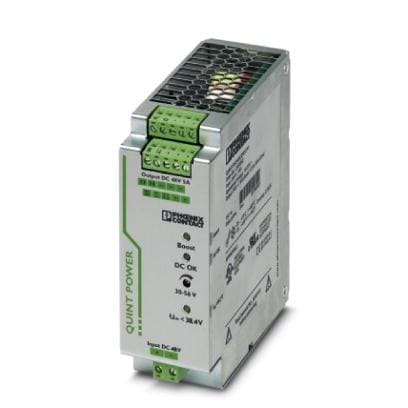
Why isolation matters in DIN rail DC/DC conversion
An isolated DC/DC converter does more than change voltage. It creates electrical separation between input and output, which can help reduce noise transfer, improve safety, and protect sensitive downstream devices from ground potential differences. In industrial environments with long cable runs, shared grounding, or multiple subsystems, this isolation is often an important design requirement rather than a nice-to-have feature.
The DIN rail format adds another practical advantage: fast, organized installation inside standard enclosures. Compared with board-level power modules, these products are easier to integrate into cabinet-based systems and are better aligned with structured industrial power architectures that may also include DIN rail power supplies and circuit protection components.
Where these converters are commonly used
This category is relevant anywhere a control system needs a different DC output than the available bus voltage. Typical examples include stepping down 48 VDC to 24 VDC for controls, generating low-voltage rails for communication devices, or isolating power for sensors, gateways, PLC-related subsystems, and signal interfaces.
The product mix in this category reflects a wide application range. Some models are suited to compact industrial and ITE installations, while others address railway or renewable-energy-related use cases where input ranges, temperature performance, and isolation characteristics become more demanding. In many projects, these converters are selected alongside backup power equipment such as UPS systems when continuity and power quality are both important.
Key selection criteria for engineers and panel builders
Choosing the right unit usually starts with the input voltage range and required output. A converter should match the nominal DC bus but also tolerate expected variation during startup, battery operation, or unstable supply conditions. Wide input range designs are especially useful in mobile, railway, and renewable applications where voltage can fluctuate significantly.
Next, review output power, output voltage type, and current capacity. This category includes lower-power options for compact electronics as well as higher-power models for more demanding loads. Engineers should also check whether the application needs a fixed output or an adjustable output, along with factors such as regulation, available mounting space, and operating temperature.
Another important point is isolation voltage. The required level depends on the electrical environment, internal architecture, and protection strategy of the system. While higher isolation is not automatically necessary in every design, it can be valuable when separating noisy power domains or supporting compliance-driven design practices.
Examples from the available range
Several products in this category illustrate how DIN rail DC/DC converters can support different power conversion needs. The Aimtec AM20E-4805S-NZ-STD is a compact isolated model designed for DIN rail mounting with a single output and 20 W power class, making it relevant for control and interface circuits that need efficient conversion from a higher DC input.
For 48 VDC systems that require a regulated 24 V output, models such as the Aimtec AM20EW-4824S-NZ-STD and AM20EW-4824S-NZ-K-STD show the value of a wide input range and DIN rail-ready form factor. Where more output power is needed, the Aimtec AM50E-4824S-NZ-STD moves up to 50 W, while products like the Bel LDN120-24, Bel LDX-C120-12, and Bel LDD240-WU point to higher-power use cases in industrial power conversion.
For lower-voltage output rails, the Aimtec AM20EW-2403SH30-NZ-STD and AM10CW-4812S-NZ-STD demonstrate how this category also supports compact loads that require regulated, isolated outputs in smaller wattage classes. These examples are useful for understanding the breadth of the category rather than as one-size-fits-all recommendations.
Brands commonly considered in this segment
Buyers evaluating DIN rail power components often compare solutions across established power brands based on enclosure compatibility, electrical performance, and long-term support. In broader industrial power projects, companies such as PHOENIX CONTACT, Delta Electronics, Inc., MEAN WELL, Omron Automation and Safety, and TDK-Lambda are frequently part of the discussion for panel-based power design.
Within the current product examples, Aimtec and Bel are especially visible, covering compact and higher-power isolated converter options for different voltage architectures. This gives engineers flexibility when balancing footprint, power level, isolation requirements, and application fit across industrial, ITE, railway, and energy-related systems.
How these converters fit into a broader industrial power architecture
A DIN rail DC/DC converter is usually one part of a larger cabinet-level power strategy. In a typical setup, upstream AC/DC conversion or centralized DC distribution feeds multiple branches, and isolated converters are then used to create dedicated rails for controls, communication equipment, field interfaces, or sensitive electronics.
This layered approach can improve fault isolation and make troubleshooting easier. It also helps designers separate noisy loads from critical low-power circuits. In some installations, additional equipment such as industrial control transformers or conditioned distribution components may be used depending on whether the system starts with AC mains or a DC source.
What to check before ordering
Before selecting a converter, confirm the actual input voltage window, startup behavior, steady-state load, and any peak current demand on the output side. It is also worth checking cabinet temperature, airflow limitations, and whether the installation will be exposed to vibration, transport conditions, or wide ambient changes.
For B2B procurement, documentation clarity and application match are often more important than simply choosing the highest wattage model. A well-matched converter can improve serviceability, reduce integration risk, and support cleaner power segmentation inside the panel. Reviewing the intended application class, mounting constraints, and output behavior in context will lead to a better fit than comparing power ratings alone.
Conclusion
DIN rail mounted isolated DC/DC converters play a practical role in modern industrial power design by combining voltage conversion, electrical isolation, and enclosure-friendly installation. They are especially useful in systems that need clean DC distribution across control, communication, and automation subsystems.
If you are comparing models in this category, focus on input range, output requirements, isolation level, environmental conditions, and the wider cabinet architecture. That approach will make it easier to narrow the range and choose a converter that suits the electrical and mechanical demands of the application.
Get exclusive volume discounts, bulk pricing updates, and new product alerts delivered directly to your inbox.
By subscribing, you agree to our Terms of Service and Privacy Policy.
Direct access to our certified experts