N-Type Temperature Sensor
High-temperature measurement often demands more than a general-purpose sensor. In applications where stability, oxidation resistance, and long service life matter, N-Type Temperature Sensor solutions are often considered for demanding process environments, test systems, and industrial heat applications.
This category focuses on N-type thermocouple-based sensors used where reliable temperature feedback is important for control, monitoring, and equipment protection. Compared with other sensing technologies, this thermocouple family is commonly selected when users need a practical balance between rugged construction and dependable performance at elevated temperatures.
Where N-type temperature sensors fit in industrial measurement
N-type thermocouples are widely used in environments that involve furnaces, thermal processing, machine heating zones, exhaust systems, and general industrial temperature monitoring. Their role is straightforward: convert temperature differences into a measurable electrical signal that can be read by indicators, controllers, PLC input systems, or data acquisition equipment.
Within a broader temperature sensing setup, these sensors are typically chosen when the installation requires a robust probe design, resistance to harsh conditions, and compatibility with process fittings or terminal heads. If the application is more general-purpose or uses different sensing principles, users may also compare options in industrial temperature sensors or compact solutions such as board mount temperature sensors.
Common construction styles in this category
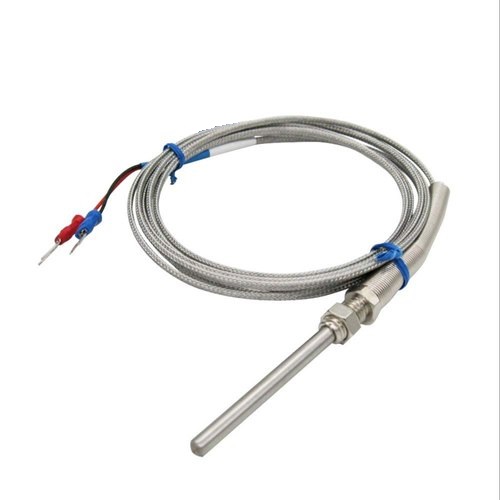
The products shown in this category are mainly mineral insulated thermocouples. This construction is widely used in industrial sensing because it combines a metal sheath with insulated thermoelement wires, helping the probe withstand vibration, mechanical stress, and elevated temperatures while remaining suitable for fixed installation.
Several head styles appear in the range, including standard heads, industrial heads, and miniature heads. These housing options affect how the sensor is terminated, wired, and integrated into the field installation. Process fitting versions are also relevant where the probe must be mounted securely into a vessel, pipe, chamber, or heated assembly.
Examples from the available range
This category includes examples from Sterling Sensors, with multiple probe lengths and head configurations to suit different mounting depths and connection preferences. For instance, the Sterling Sensors TMNPIN6MM150005N, TMNPIN6MM300005N, TMNPIN6MM500005N, and TMNPIN6MM01M005N represent mineral insulated thermocouples with a standard head and process fitting in progressively longer insertion lengths.
Users needing a different terminal arrangement can also look at models such as the Sterling Sensors TMBHIN6MM150005B, TMBHIN6MM300005B, TMBHIN6MM500005B, TMBHIN6MM01M005B, and TMBHIN6MM02M005B with industrial head construction, or the Sterling Sensors TMMHIN6MM500005M, TMMHIN6MM01M005M, and TMMHIN6MM02M005M with miniature head design. These examples illustrate how the category supports varying installation space, cable entry, and maintenance requirements rather than serving only one fixed sensor format.
How to choose the right N-type sensor
Selection usually starts with the mechanical side of the application. Probe diameter, insertion length, sheath style, and mounting arrangement all need to match the process. A short probe may suit compact equipment or shallow immersion points, while longer lengths are often needed for ducts, tanks, ovens, or deeper thermowells.
The next consideration is termination style. A standard or industrial head can be useful when field wiring needs more protection and easier access, while a miniature head may help where space is limited. It is also important to confirm system compatibility at the instrument side, especially if the sensor will be connected to a temperature controller, transmitter, or monitoring system designed around a specific thermocouple input type.
Comparing N-type sensors with other temperature sensing options
Not every temperature measurement task requires the same sensing technology. N-type thermocouples are typically relevant for higher-temperature industrial applications, but other sensor categories may be better suited for lower-temperature control, compact electronics, or cost-sensitive monitoring points. For example, users evaluating resistance-based or semiconductor-style sensing may also review a thermistor sensor or an NTC-type temperature sensor depending on the measuring range and response requirements.
It is also common to compare N-type with other thermocouple families. In many facilities, K-type sensors are already widely used, so specifiers may assess response characteristics, environmental conditions, and lifecycle expectations before standardizing. That is why category-level comparison is often just as important as the individual product specification.
Typical applications and integration considerations
In practical use, these sensors are often installed in heating systems, process lines, test rigs, thermal equipment, and industrial machinery where temperature must be measured continuously. A mineral insulated probe with the correct head and fitting can simplify installation and improve repeatability by placing the sensing junction in a controlled, consistent position.
For reliable results, users should review mounting depth, sheath exposure, wiring path, and environmental protection around the connection head. The sensor itself is only one part of the measurement chain; overall performance also depends on the receiving instrument, cable routing, electrical noise conditions, and the thermal behavior of the process point being measured.
Why this category is useful for specification and sourcing
Rather than presenting one generic sensor style, this page brings together N-type configurations that are relevant for industrial buyers, maintenance teams, panel builders, and OEMs. The available examples make it easier to compare probe lengths, head styles, and mounting approaches within the same sensing family.
For organizations building or maintaining high-temperature systems, that can shorten the path from requirement to shortlist. Whether the priority is a compact head, a more traditional field termination, or a process-ready mineral insulated assembly, this category provides a focused starting point for selecting a suitable N-type sensing solution.
Choosing a temperature sensor is ultimately about matching the sensing principle and mechanical design to the real process conditions. If your application involves elevated temperatures, industrial installation requirements, and thermocouple-based measurement, this N-type range offers a practical foundation for narrowing down the right sensor format before moving to detailed product-level evaluation.
Get exclusive volume discounts, bulk pricing updates, and new product alerts delivered directly to your inbox.
By subscribing, you agree to our Terms of Service and Privacy Policy.
Direct access to our certified experts