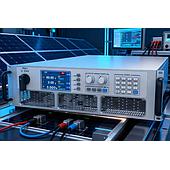
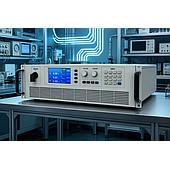
A benchtop programmable DC power supply is generally appropriate for embedded development, prototype bring-up, educational work, and basic functional testing. A lab-grade unit becomes more relevant when accuracy, low noise, fast recovery from load changes, calibration traceability, or dependable automated testing are central requirements.
The right choice starts with the device under test: its maximum voltage and current, sensitivity to noise, expected load transients, and whether tests must run remotely or repeatedly.
Summary: Benchtop supplies are commonly used for routine development and functional tests. Lab-grade instruments typically provide tighter accuracy, lower ripple and noise, and faster transient response. Check output headroom, protection settings, and USB or LAN connectivity before selecting a unit.
What is a programmable DC power supply?
A programmable DC power supply is a bench instrument that provides adjustable DC output and can be controlled digitally. It can set voltage and current limits from the front panel or through interfaces such as USB, LAN, GPIB, or RS-232.
Digital control supports repeatable test sequences, including voltage ramps, holds, and steps. It can also support output-data logging and the simulation of changing power profiles, such as voltage droop or battery discharge behavior.
What is the practical difference between lab-grade and benchtop programmable DC power supplies?
Lab-grade supplies typically prioritize measurement performance, low output disturbance, response speed, and integration into controlled test environments. Benchtop units generally focus on accessible operation for everyday engineering tasks.
| Selection factor | Benchtop / prosumer | Lab-grade |
|---|---|---|
| Voltage accuracy | Typically ±0.1% to ±0.5% | Typically ±0.01% to ±0.05% |
| Ripple and noise | Typically 2–15 mV rms | Typically 0.5–2 mV rms |
| Transient response | Typically 1–10 ms | Typically 50–500 µs |
| Connectivity | USB, sometimes LAN | USB, LAN, GPIB, and RS-232 may be available |
| Calibration traceability | Rarely included | May include traceable calibration documentation |
These ranges are general comparisons, not specifications for every model. The product datasheet remains the appropriate place to verify performance and available interfaces.
Which output voltage and current range should be selected?
Select a supply according to the highest voltage and current the application will require, with reasonable capacity above the normal operating point. The source guidance suggests rated maximum output of about 1.5× the typical operating point to avoid selecting a unit that is only just adequate.
For low-voltage digital work involving microcontrollers, sensors, or IoT devices, 0–30 V and 0–5 A may be sufficient. Motor drivers and power electronics may require 60–150 V and 10–30 A, while higher-power applications can call for 300 V or more and 20–100 A.
Why do ripple, noise, and transient response matter?
Ripple and noise describe unwanted AC content on the DC output, commonly expressed in mV rms or mV peak-to-peak. This can affect RF and analog circuits, ADC measurements, and sensitive sensors or amplifiers.
Transient response describes how quickly output voltage recovers after a sudden load change, such as a microcontroller waking from sleep or a motor starting. A slower response can create voltage deviations that may reset or disturb sensitive devices.
Linear-regulated supplies are described as having inherently lower noise but greater weight, heat, and lower efficiency. Switch-mode supplies are more compact and efficient, though their output noise may be higher; the actual ripple specification should be checked for the intended model.
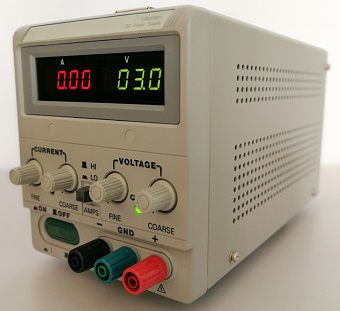
When is a benchtop programmable DC power supply enough?
A benchtop unit is usually a practical fit for embedded firmware development, prototype bring-up, educational labs, maker projects, and basic functional testing. In these situations, the application may not require the tightest accuracy, lowest noise, or fastest transient recovery.
Choose based on the required output range and number of channels, rather than assuming a higher-grade instrument is necessary. Multiple rails may require multiple channels or a suitable multi-output configuration.
When should a lab-grade power supply be considered?
A lab-grade supply is more suitable for precision component characterization, semiconductor I-V work, noise-sensitive RF or analog testing, and automated production test equipment. These applications can depend on tighter output control, lower noise, and repeatable operation.
It may also be appropriate when compliance work requires traceable calibration or when instrument downtime has a significant operational cost. Confirm the required calibration documentation and protection behavior for the specific application.
Which protection and remote-control features should be checked?
Check for overvoltage protection (OVP), overcurrent protection (OCP), and overtemperature protection (OTP). Reverse-polarity protection can also be important when testing battery-powered devices.
For automated testing, USB or LAN can support modern PC-based workflows. GPIB and RS-232 may still matter in legacy or specialized environments, while SCPI support can help standardize scripted control across compatible instruments.
How can buyers make a final selection?
Start with voltage, current, and channel count, then assess whether the device under test is sensitive to noise or load changes. Next, confirm the need for remote control, programmable protection thresholds, calibration documentation, and the available bench or rack space.
For routine work, a capable benchtop instrument may meet the need. For precision, compliance-oriented, low-noise, or production automation tasks, a lab-grade programmable DC power supply can better match the testing requirement.