Rotary Evaporators
Efficient solvent removal is a routine requirement in chemical, pharmaceutical, food, environmental, and research laboratories. When the process needs controlled evaporation under reduced pressure, Rotary Evaporators become a practical choice for concentrating samples, recovering solvents, and preparing extracts without exposing materials to unnecessarily harsh thermal conditions.
This category brings together benchtop and larger-capacity systems used in laboratory and pilot-scale workflows. The available range supports applications from small-batch R&D to higher-throughput evaporation tasks, with options that differ in flask size, condenser orientation, lift type, control interface, and operating convenience.
Where rotary evaporators fit in the lab workflow
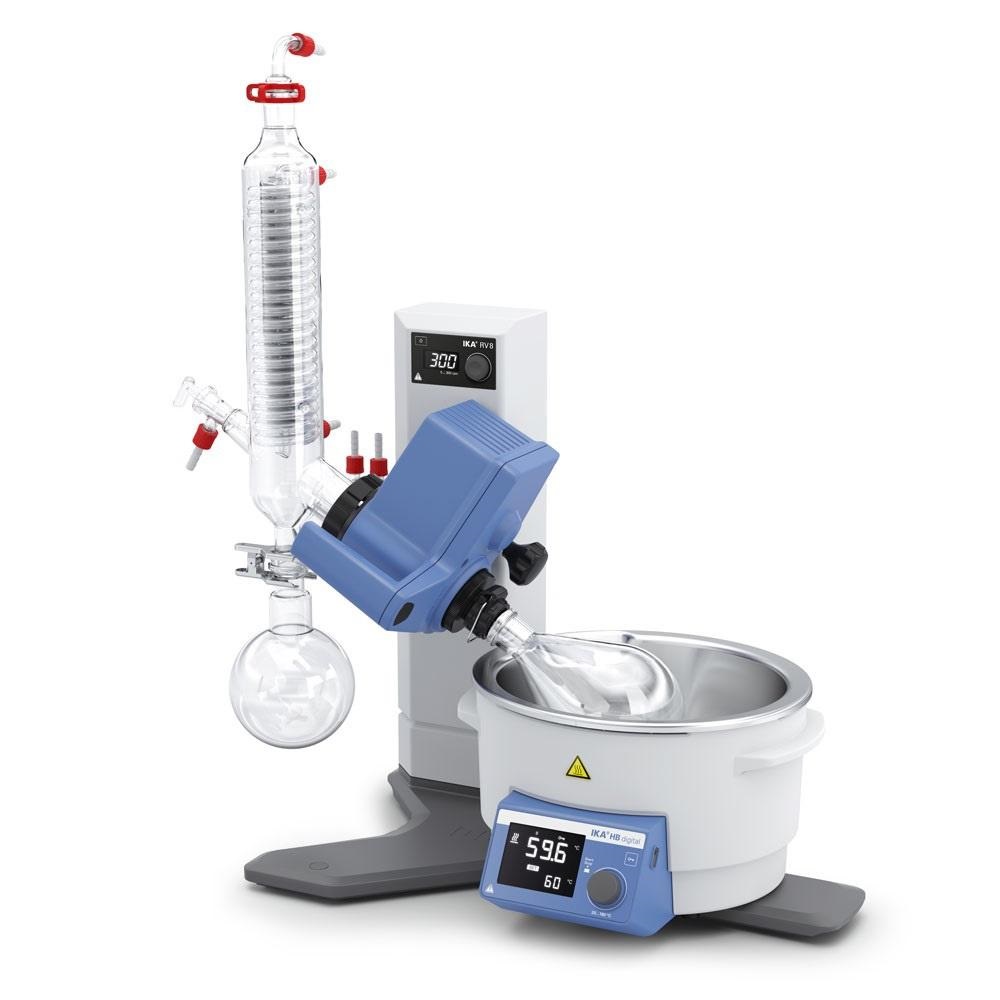
A rotary evaporator is designed to remove volatile solvents by combining rotation, heating, vacuum, and condensation. Rotation spreads the sample into a thin film over the inner wall of the flask, which improves heat transfer and helps evaporation proceed more evenly. At the same time, reduced pressure lowers the boiling point of the solvent, making the process gentler for heat-sensitive materials.
In day-to-day use, these systems are often selected for concentration after extraction, solvent exchange, purification steps, and sample preparation before further analysis. In a broader lab setup, rotary evaporation is commonly paired with handling and support equipment such as lab carts and trolleys when moving glassware, baths, or larger vessels safely between work areas.
Key differences across the category
Not every lab needs the same evaporation capacity or level of automation. Smaller systems are typically suitable for routine analytical or preparative work, while larger units are better aligned with pilot-scale processing or repeated solvent recovery in production support environments. Choosing the right format usually starts with expected flask volume, solvent load, and how often the equipment will be used.
Condenser design is another important point. Vertical and diagonal condensers each support efficient vapor condensation, but the preferred configuration can depend on available space, operator preference, and the nature of the workflow. Heating bath range, rotation speed, digital control, and manual versus motorized lift also influence how comfortably the equipment fits into a specific lab routine.
Representative systems in this range
The category includes compact laboratory models as well as higher-capacity units. For smaller to medium-scale tasks, products such as the DaiHan DH.WEV01001V and DH.WEV01001L provide digital control in a compact format, while the DH.Eva0005 PREMIUM adds a wider operating structure with electric lifting and adjustable immersion angle. These types of systems are typically considered for general solvent removal, sample concentration, and routine distillation work.
For users requiring more throughput, the DaiHan DH.WEV01005, DH.WEV01010, and DH.WEV01020 extend working capacity from 5 L to 20 L class equipment. At the upper end, the DH.WEV01050 addresses larger-scale evaporation duties where condenser performance, receiving volume, and lifting arrangement become more critical to daily operation.
Other examples in the category include LabTech EV400 series models such as EV400NH, EV400N, and EV400NVAC, which differ in lift configuration, display, and control features. WITEG also appears with diagonal and vertical configurations, giving buyers another useful comparison point when evaluating layout, footprint, and preferred condenser orientation.
How to choose the right rotary evaporator
The first selection factor is usually working volume. A lab processing small sample quantities may prioritize compact dimensions and straightforward operation, while a team handling larger extract batches or repeated solvent recovery cycles may need higher flask capacity and stronger emphasis on condenser efficiency and bath performance. It is also worth considering future scale-up rather than choosing only for immediate demand.
The second factor is control and handling. Digital displays, PID temperature control, programmable settings, and motorized lift mechanisms can improve repeatability and reduce operator effort, especially when the equipment is used frequently. If the process involves a variety of solvents, a system with more flexible control logic may support easier method development and safer operation under changing vacuum and temperature conditions.
Another practical consideration is installation environment. Benchtop space, utility availability, power supply, and compatibility with the rest of the evaporation setup all matter. In some laboratories, rotary evaporators are part of a broader preparation area that may also include supporting equipment from DaiHan or adjacent lab tools for sample handling and pre-treatment.
Benchtop versus larger-capacity systems
Benchtop rotary evaporators are often preferred in R&D labs, university facilities, quality control areas, and application laboratories where sample sizes are modest and flexibility is important. These systems are generally easier to place in limited space and are well suited to routine concentration, solvent removal after synthesis, or preparative sample treatment.
Larger-capacity units become more relevant when evaporation volume increases and process efficiency starts to affect turnaround time. In these situations, users typically pay closer attention to condenser surface, flask handling, lift travel, bath construction, and serviceability. The transition from a 1 L or 5 L class unit to 10 L, 20 L, or 50 L systems is less about simple scale and more about workflow stability, operator safety, and process consistency.
Brand and configuration considerations
This category features products from recognized laboratory equipment manufacturers, including DaiHan, LabTech, and WITEG. Buyers may also be researching broader evaporation and laboratory process ecosystems from manufacturers such as IKA or Buchi, especially when comparing control philosophy, glassware preferences, or integration with existing lab standards.
That said, the most suitable model is not determined by brand name alone. For many B2B buyers, the better comparison is based on flask capacity, condenser arrangement, lift type, display and control format, heating bath range, and how well the unit matches the intended solvent recovery or concentration task. A clear process requirement usually leads to a more reliable purchasing decision than focusing only on headline specifications.
Applications commonly supported by this category
Rotary evaporators are widely used in analytical preparation, botanical extraction, chemical synthesis, pharmaceutical development, and general solvent recovery. They are especially valuable when a process benefits from lower-pressure evaporation to reduce thermal stress on dissolved compounds or when concentration needs to be completed with good repeatability.
In practical terms, the equipment can support post-extraction concentration, solvent switching before downstream processing, purification support, and routine removal of volatile solvents after reaction or washing steps. The exact configuration will depend on throughput, solvent type, temperature sensitivity, and the level of operator control required in the application.
Finding a practical fit for your process
The right rotary evaporator should match the scale of your work, the solvents you handle, and the level of control your team needs in daily operation. A compact unit may be ideal for routine laboratory tasks, while a larger digital system with greater capacity and more advanced handling features may be the better fit for heavier process demands.
By comparing capacity, condenser style, lift mechanism, and control options across this category, buyers can narrow the selection to equipment that supports both current lab requirements and future workflow growth. A well-matched system helps improve evaporation efficiency, supports safer solvent handling, and makes sample preparation more consistent over time.
Get exclusive volume discounts, bulk pricing updates, and new product alerts delivered directly to your inbox.
By subscribing, you agree to our Terms of Service and Privacy Policy.
Direct access to our certified experts