The third-generation Micsig MOIP Series optical isolation probes are developed based on proprietary analog-digital hybrid laser modulation technology and a fully optically isolated fiber architecture, providing an accurate, safe, and efficient measurement method for power electronics engineers.
Technical barriers in testing three-phase inverters
Three-phase inverters are the core structure for converting DC to AC, using Space Vector Pulse Width Modulation (SVPWM) control to generate a rotating magnetic field. During operation, the system faces five major challenges that traditional measurement devices often fail at:
First, the safety risk of measuring DC bus voltages up to thousands of volts at suspended nodes. Second, the ability to capture fast switching events at the nanosecond scale for accurate component stress assessment. Third, the requirement for absolute noise immunity to accurately reproduce the gate signal waveform in a strong EMI environment. Fourth, avoiding load effects that cause changes in parasitic circuit parameters. Finally, the requirement to maintain high accuracy over long periods without being affected by thermal drift or requiring manual calibration.
Current differential probes, with their limited bandwidth below 200MHz and poor isolation capabilities, can no longer keep up with the actual switching speeds of SiC and GaN components, resulting in measurement errors exceeding 30% and severely distorted waveforms.
Breakthroughs from ADHOMT technology and fiber optic isolation architecture
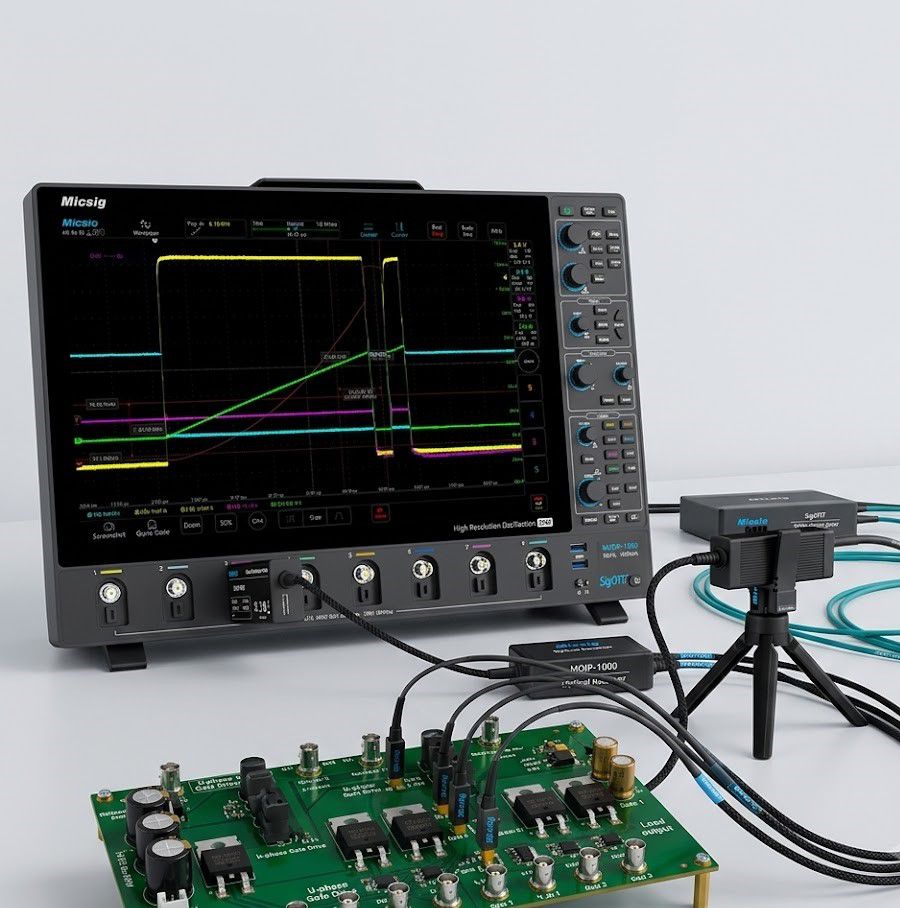
The Micsig MOIP Series fundamentally addresses these issues by integrating a hybrid analog-digital laser modulation system and a comprehensive fiber optic isolation architecture. This technology completely eliminates the high-voltage path between the measuring device and the test circuit, providing isolation withstand capability up to 85kV, ensuring safety for both the user and the measuring device.
The device's common-mode noise suppression is impressive: 128dB at 100MHz and a stable 108dB at 1GHz. This ensures that small signals such as the Miller plateau are not obscured by background noise, allowing engineers to clearly observe the actual switching behavior of the components. With an analog bandwidth of up to 1GHz, the MOIP Series captures the 5ns switching of SiC MOSFETs without generating buzzing or signal edge rounding, ensuring 1% accuracy within half the bandwidth.
In particular, ADHOMT technology eliminates thermal drift, allowing the device to be ready for measurement immediately after connection without warm-up time or recalibration. This is a key factor in ensuring consistency for extended reliability tests and 24/7 production line testing.
Empirical effectiveness in system measurement and optimization
Experimental data on 5kW inverter systems using 100kHz SiC MOSFETs show a significant difference when comparing the Micsig MOIP Series with traditional differential probes.
When measuring the gate signal of the upper bridge branch, while the differential probe is severely affected by noise due to high dv/dt, resulting in a large background noise waveform and jitter, the MOIP Series produces a stable and clear waveform. For a dead time measurement of 1.2μs, the MOIP Series' 4-channel synchronization capability with minimal time deviation allows for precise determination of the switching sequence. Applying this accurate measurement data to compensate for dead time reduced the 5th and 7th harmonic content to below 1%, while improving the output voltage ripple by 30%.
The Micsig MOIP Series is not just a simple measurement tool, but a paradigm shift, allowing engineers to directly observe the internal behavior of electrical circuits. This enables accurate identification of hidden faults such as overvoltage, actuator abnormalities, or timing deviations, ensuring optimal safety and performance for next-generation inverter designs.
For more details on technical configurations and integration solutions, please contact EMIN's expert team for complete documentation.
Contact us via website: emin.vn
or Fanpage: https://web.facebook.com/thietbido/