
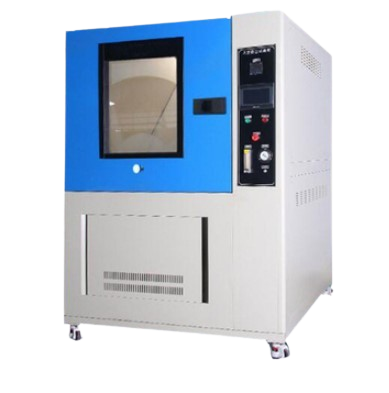
PEGO PG-SC-1000 IP5/6X Dustproof Test Chamber (1000*1000*1000)
Working dimension(mm): 1000*1000*1000
Working power: AC 380V±10%, 50Hz
Temperature range: RT~+70℃
Temperature evenness: ≤2℃
Temperature fluctuation: ≤±0.5℃
wire diameter of metal net: 50μm
Wire interval: 75μm
Airflow velocity: ≤ 2.5m/s
Time range: 1S~999H (adjustable)
Vibration time: 1S~999H (adjustable)
Dust concentration: 2~4kg/m3
Sand and dust: talcum powder, dry powder, portland cement
paste
Power socket for EUT: IP66, 220V/16A
Circulatory system: Dust recycling
Working condition
Temperature:15℃~35℃, humidity:≤85%R.H.
Configuration: Observe window equip with window wiper, lamp
Power supply: 2KW, AC220V±10%, 50Hz
Dust chamber is designed according to the standards of GB/T10485-2007, GB2423.37-2006 test L, GB208-2008, IEC60529 (IP code), GB7001-1986 and etc..
Dust chamber is for IP5X and IP6X testing, the power shall be able to pass through a square-meshed sieve the nominal wire diameter of which is 50μm and the nominal width of a gap between wires 75 μm.
The dust chamber is controlled by 7 inch touch screen and PLC system. The interior of the cabinet is equipped with lighting and power supply, which can be used for live dust-proof test of the sample to simulate a more realistic use environment. There is a mesh sample support plate inside the box for Dust recycling, it is made of stainless steel and has a load capacity of 50KG. Operation video: https://youtu.be/xEe--St0Yzo
IP5X dustproof test chamber: the protection is satisfactory if the power has no accumulated in a quality which may interface the correct operation and cause harmful to equipment.
IP6X dustproof test chamber: the protection is satisfactory if no deposit of dust is observable inside the enclosure at the end of the test
Get exclusive volume discounts, bulk pricing updates, and new product alerts delivered directly to your inbox.
By subscribing, you agree to our Terms of Service and Privacy Policy.
Direct access to our certified experts