
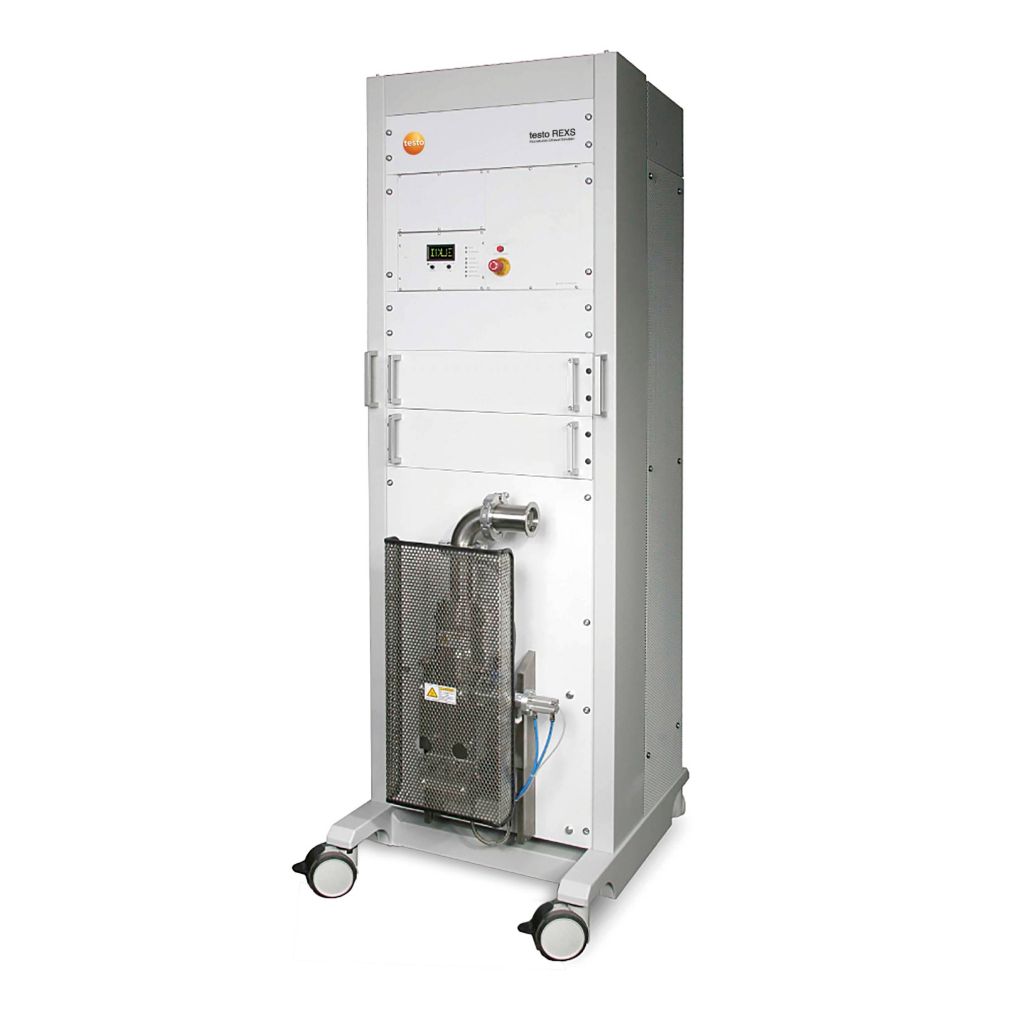
TESTO REXS Reproducible EXhaust Simulator (Soot Generator)
Aerosol: Soot nano-particles produced in the combustion process
Particle mass produced: From 1.5 g/h at 80 nm particle diameter to 2.5 g/h at 110 nm.
Number concentration of particles: 107–108 particles/cm3
Particle size:
- Monomodal logarithmic distribution with a standard deviation of approx. 1.5 to 1.7 for particle sizes between 30 to 60 nm
- Monomodal distribution with a standard deviation of approx. 1.8 to 1.9 for particle sizes between 60 to 120 nm
Output flow testo aerosol: 300 to 700 IN/min at different particle diameters, approx. 150 IN/min in standby mode
Counter-pressure: Up to 500 mbar over atmospheric pressure
Morphology: Similar to diesel soot
Calibration: Gravimetric analysis of aerosol filter samples SMPS size distribution analysis
Gas supply specifications:
• C3H8 (propane), purity 99.95 % (Class 35), up to 2 lN/min at 5 bar
• N2 (nitrogen), purity 99.999 % (Class 50), up to 2 lN/min at 5 bar
• Compressed air, dry (< 2% rel. humidity at +23 °C, dewpoint ca. -28 °C)
Installation:
• Mobile 19" rack
• Lockable casters
• Holding brackets for 3 compressed air cylinders (10 litres each)
• Aerosol output position adjustable
• Notebook and accessory compartments
Get exclusive volume discounts, bulk pricing updates, and new product alerts delivered directly to your inbox.
By subscribing, you agree to our Terms of Service and Privacy Policy.
Direct access to our certified experts