The explosion of microchip technology and sub-3-nanometer chip manufacturing processes requires an unprecedented level of environmental control. In semiconductor cleanrooms, a single microscopic dust particle or a tiny toxic gas leak is enough to ruin an entire wafer batch worth millions of dollars. This vital requirement is accelerating a complete transition from traditional mechanical pressure gauges to digital pressure sensors and electronic pressure gauges.
Technical Limitations of Mechanical Pressure Gauges in Ultra-Clean Environments
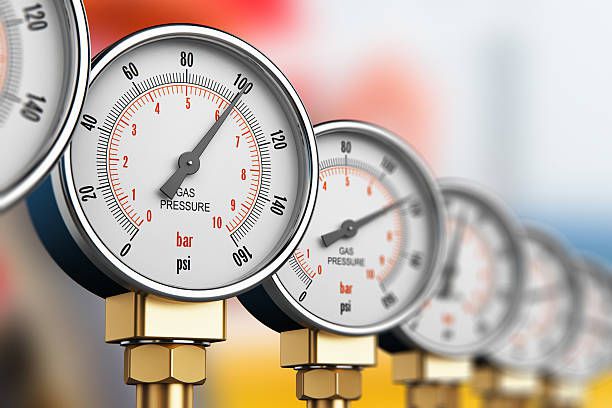
Traditional Bourdon tube pressure gauges, which once played a dominant role in industrial utility gas systems, have now revealed critical vulnerabilities when applied to semiconductor manufacturing environments. Their mechanical structure—consisting of internal gears, springs, and moving linkages—unintentionally creates dead spaces where moisture, impurities, or chemical residues can accumulate from ultra-clean gases such as silane, ammonia, or corrosive gases used in etching processes.
Furthermore, prolonged mechanical friction leads to material fatigue, zero-point drift errors, and the risk of micro-leaks at threaded connections. In Ultra-High Purity (UHP) gas systems, these flaws can contaminate the entire raw material input of the semiconductor production line.
Shift Toward Digital Sensors and Electronic Pressure Gauges
To resolve contamination issues and precision challenges, M&E design engineers are rapidly shifting toward digital pressure sensors and diaphragm-seal electronic pressure gauges. These devices utilize measurement diaphragms made of high-grade alloys or stainless steel treated with electropolishing technology to achieve ultra-low surface roughness, completely eliminating particle adhesion and impurity accumulation.
Instead of conventional threaded joints that are prone to leakage, modern UHP gas piping systems utilize orbital welding connections combined with high-end digital pressure gauges—such as the Wika CPG1500—for high-precision on-site pressure checks. These offer intuitive digital displays and completely eliminate reading errors caused by mechanical needle parallax.
Real-Time Monitoring and Automation System Integration
In smart factories, pressure monitoring goes far beyond reading local pipeline displays. Modern smart pressure sensors feature embedded microprocessors that enable automatic ambient temperature compensation and transmit digital data to SCADA control centers via high-speed industrial communication protocols.
The system can automatically detect early pressure anomalies in reaction chambers, warning of potential vacuum pressure drops or pipeline blockages before costly line shutdowns occur. Eliminating mechanical signals allows the entire process gas supply chain to be managed in a closed loop through centralized software.
Calibration Standards and Periodic Equipment Verification
The shift from mechanical to digital systems also requires changes in the maintenance and calibration procedures of measurement infrastructure. Because parameters in semiconductor plants have extremely tight tolerances, pressure sensor accuracy checks cannot be performed using ordinary hand pumps.
Maintenance technicians typically utilize high-end portable pressure calibration stations to generate standard pressures and perform cross-calibration directly on-site. Maintaining the reliability of electronic sensors through standardized calibration procedures ensures absolute stability across all rigorous gas and vacuum systems in the fab.