How does octane rating explain why octane is faster?
This is a measure of the octane rating's resistance to knocking when compressed inside an engine cylinder. The technical nature of the octane rating.
Meaning of the parameters: A higher octane rating means the fuel is more compressible before spontaneous combustion.
Practical effects: Using gasoline with the appropriate octane rating helps the engine run smoothly, optimizes performance, and protects spark plugs and pistons from damage caused by premature detonation.
What is the octane rating of E10 gasoline?
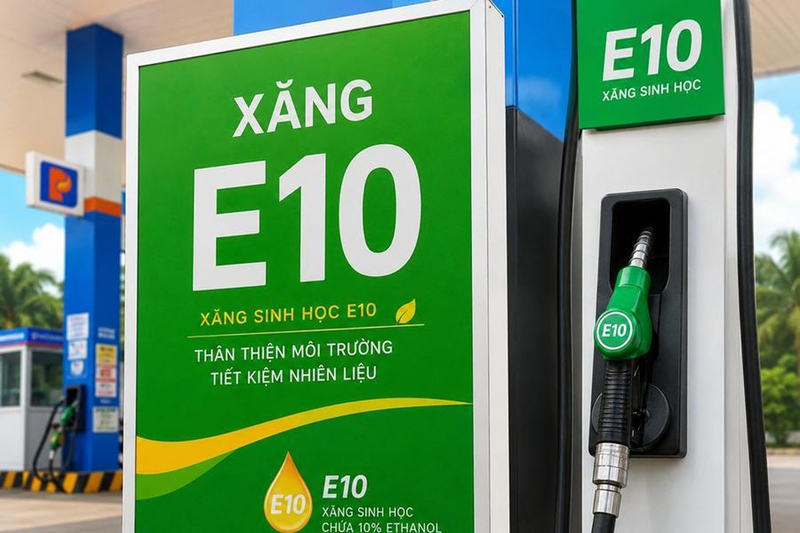
E10 gasoline is produced by blending 90% base gasoline and 10% bioethanol. The actual octane rating of this fuel typically reaches 93.7 RON. The added ethanol helps to increase the anti-knock index compared to regular gasoline.
E10 gasoline is suitable for newer cars and motorcycles manufactured from 2009 onward that are equipped with electronic fuel injection (EFI/FI) systems. These vehicles typically use fuel lines, seals, and gaskets designed to withstand ethanol-containing fuels.
The use of E10 is encouraged because ethanol can help reduce certain harmful emissions due to its cleaner combustion characteristics. It can also reduce dependence on fossil fuels, as ethanol can be produced from renewable feedstocks such as sugarcane, corn, and cassava. Another advantage is its lower cost compared with conventional gasoline, making E10 an attractive fuel option for both consumers and the transportation sector.
Why do older RON meters give inaccurate results for E10 gasoline?
Ethanol possesses superior dielectric properties compared to hydrocarbon compounds. Older measuring devices that scan samples using capacitance are easily misled by inaccurate readings. These devices often produce erroneous results, with fluctuating numbers, misrepresenting the true quality of the fuel.
The hygroscopic nature of bioethanol poses a significant risk. Leaky storage tanks allow the fuel to absorb moisture from the air. Separation occurs, causing the ethanol and water to settle at the bottom of the tank, potentially damaging the vehicle's engine. Technicians need tools for rapid detection to identify risks early.
Why Can the Same Fuel Tanker Produce Different Test Results ?
One important factor to consider when testing E10 is sample homogeneity. If a sample is collected from only one location, the result may not accurately represent the entire volume of fuel in the tank. Variations can occur due to transportation, storage conditions, or localized water contamination.
Ethanol has a higher affinity for water than the hydrocarbon components of gasoline. When the amount of water entering the fuel exceeds the mixture's water-holding capacity, a separate water–ethanol phase may form. The National Renewable Energy Laboratory (NREL) has reported that this can occur in fuel systems when sufficient water is present, particularly when temperatures fluctuate or fuels with different ethanol concentrations are mixed.
For field testing, samples can be collected from the top, middle, and bottom of the tank and the results compared. If there is a significant difference between sampling points, technicians should further inspect the tank condition, blending history, and potential water contamination rather than relying solely on the average value.
This sampling approach provides an additional layer of quality control. The testing equipment does not simply answer the question, “Does the sample meet the specification?” It can also help identify non-uniformity throughout the fuel batch.
Octane Rating Is Not the Only Quality Parameter for E10
Knock resistance is an important characteristic of gasoline, but E10 quality cannot be evaluated based on RON alone. Ethanol content also affects several other fuel properties, including oxygen content, water absorption, and storage stability.
RON and MON are not the same measurement. RON is determined under relatively mild test conditions, while combining RON and MON allows the Antiknock Index (AKI) to be calculated using the following formula:
AKI = (RON + MON) / 2
ASTM methods use both RON and MON to characterize the antiknock performance of fuels for applications involving spark-ignition engines.
For quality control systems, clearly stating whether the reported value is RON, MON, or AKI on the test report helps prevent incorrect comparisons between different test methods or between markets that use different conventions for reporting octane ratings.
When an E10 RON result shows unexpected fluctuations, both the testing equipment and reference sample should be checked before concluding that there is a problem with the fuel. Sample temperature, the condition of the test chamber, sample volume, sensor cleanliness, and sampling procedure can all affect measurement repeatability.
A quick verification procedure can begin by testing a reference or control sample with a known value. If the instrument produces stable results with the control sample but shows significant variation when testing E10, the investigation should focus on the characteristics and condition of the fuel. Conversely, if the control sample also shows deviations, the instrument, calibration status, and measurement conditions should be checked again.
Correcting index discrepancies using the Samyon QX-D meter
The Samyon QX-D testing deviceis a suitable choice for blending laboratories. It features built-in software with algorithms for analyzing ethanol-containing gasoline, such as E93 or E97.
E10 gasoline samples are automatically processed by the QX-D sensor, which compensates for dielectric errors and displays a standard RON value.
Pouring the sample into the chamber activates the dielectric error compensation mode. The device eliminates interference from ethanol molecules to provide a realistic RON result around 93.7. Blending engineers utilize this feature to measure at three different locations on the tanker truck to assess the uniformity of the blend.
See more: What criteria determine the quality of E10 gasoline?
Water infiltration detection using the Shatox SX-300 device.
Mobile testing at ports or warehouses should prioritize the Russian Shatox SX-300
machine for high efficiency thanks to its volumetric resistivity scanning feature. Standard E10 gasoline has a stable and fixed resistivity range.
Moisture in storage tanks causes water to adhere to alcohol molecules, leading to a sharp drop in resistivity. The machine's screen immediately warns, allowing businesses to stop shipments in time.
The device assists in scanning and extracting the percentage of ethanol present in samples. Gas stations can easily detect suppliers with substandard alcohol content. Users connect a USB cable to a computer to load a specific database for the Vietnamese market, increasing the reliability of subsequent field measurements.
Choose the right equipment:
For laboratories or blending plants, the Samyon series is preferred for cost optimization. Its algorithm smoothly handles dielectric noise from alcohol, providing quick RON readings. Mobile inspection teams or warehouse inspections are well-suited to the Russian Shatox series, thanks to its robust chassis. The device is highly sensitive to tank contamination and fraudulent blending practices. Please visit our Fuel Measurement and Analysis Equipment category to view the full product range and select the model that best suits your operational needs.