Temperature testing involves subjecting the product to a predetermined sequence of varying temperatures to assess the performance limits of the entire structure. The product is continuously cycled between very cold and very hot environments over a specified period.
A temperature range of -40°C to 150°C is widely used for various product categories. Testers determine the specific temperatures and number of cycles based on the material properties and the product's intended operating environment.
Why is the -40°C to +150°C range used for many products?
This temperature range spans from extreme cold to high heat conditions frequently encountered by industrial components and materials during actual operation or accelerated life testing.
The critical factor lies in the cycling between these two temperature extremes, rather than just the specific temperature values themselves. A component might withstand each temperature level in isolation yet fail after repeated cycling, as its internal materials do not expand and contract at the same rate.
Consider a circuit board, which contains copper, epoxy resin, fiberglass, solder, and semiconductor components. Each material reacts differently to temperature fluctuations. Over repeated cycles, stress gradually accumulates at solder joints, bonding points, or the interfaces between material layers.
Electronic components and circuit boards
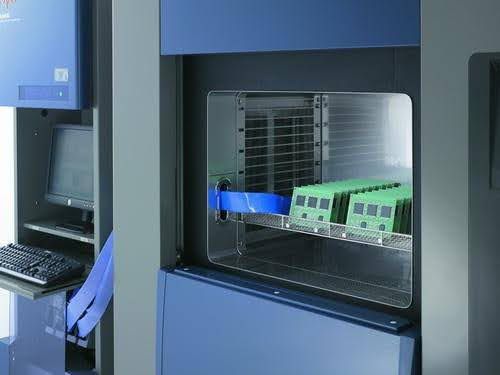
PCBs, PCBAs, ICs, capacitors, resistors, sensors, and electronic modules are common subjects of thermal shock testing.
A multilayer circuit board is composed of various materials. Copper layers, substrate materials, insulating layers, solder joints, and surface-mount components may all react differently to temperature fluctuations. These differences can generate repetitive stress with each cycle.
Following the test, engineers typically evaluate the integrity of:
+ Solder joint connections
+ Circuit trace continuity
+ Encapsulation integrity
+ Inter-layer bonding within the PCB
+ Component electrical parameters
For these test samples, a temperature range of -40°C to +150°C is sufficient to meet many requirements for assessing the thermal fluctuation resistance of electronic components and assemblies.
Automotive electronic modules, sensors, and components
Vehicles on the road are subjected to constantly fluctuating temperatures due to seasonal changes, weather conditions, and their proximity to the engine. A control module, sensor, or electrical connector may undergo numerous thermal cycles alternating between heat and cold throughout its service life.
Thermal shock testing assesses whether these components remain functional after repeated exposure to rapid temperature swings. Solder joints may be compromised, housing materials subjected to stress, and interfaces between dissimilar materials prone to weakening over time.
Products typically requiring this testing include ECUs, sensors, connectors, lighting assemblies, and various other vehicle electronic modules. For electric vehicles, specific components and battery packs must also be evaluated for thermal resilience, though the test parameters and number of cycles depend on the specific product design and applicable technical requirements.
It is important to note that not all battery tests are thermal shock tests; safety and performance evaluations typically employ different methodologies and temperature ranges in accordance with industry-specific standards.
Plastics, rubber, and multi-layer bonded materials
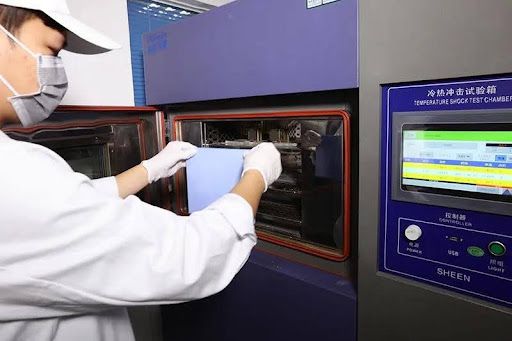
Thermal shock testing is also used to evaluate products other than electronic components.
Assemblies involving plastic attached to metal, coatings applied to a substrate, or rubber materials bonded to other structures can all experience stress caused by differential thermal expansion. After multiple cycles, the bonded interface may exhibit cracking, delamination, or deformation.
For these types of materials, the focus is not solely on whether the product suffers catastrophic failure. Changes in adhesion, shape, elasticity, or protective capabilities can also reveal the impact of thermal cycling.
Related article on electronic components: What types of damage does thermal shock cause to electronic components?
Coatings, adhesives, and protective materials
A coating may adhere well at room temperature but degrade after repeated temperature cycles.
When a coating and its substrate have different rates of thermal expansion, the interface between the two materials is subjected to cyclic stress. A similar situation can occur with bonding adhesives or thermal interface materials.
Testing helps evaluate the ability of these materials to maintain their bond, particularly when the product operates in environments with frequent temperature fluctuations.
The -40°C to +150°C range is wide, but the full extent is rarely utilized
The temperature range of a test chamber indicates the temperatures the machine is capable of generating, but this does not imply that every product must be tested across the entire range. A specific test might utilize only a portion of this range, depending on the applicable standards and evaluation objectives.
In practice, different types of samples require specific high and low temperature targets, varying dwell times at each temperature level, and distinct transition rates and cycle counts.
Therefore, selecting a test chamber should not be based solely on whether the machine can reach a particular temperature. The machine's specifications must be evaluated against the actual testing conditions required by the product.
Select the chamber capacity based on the size and number of samples
Electronic components, sensors, and small modules do not require excessively large test chambers. However, for large component assemblies or when testing multiple samples simultaneously, a chamber with greater volume is necessary to accommodate them.
For medium-sized samples, the KOMEG KTS-100A is a model worth considering, operating within a temperature range of -40°C to +150°C. If more space is required, higher-capacity versions within the same product line are available.
Ultimately, the most important factor is ensuring compatibility between the temperature range, chamber volume, sample dimensions, and testing conditions.
Conclude
A thermal shock chamber with a range of -40°C to +150°C can be used to evaluate a wide array of products susceptible to temperature fluctuations—ranging from PCBs, electronic components, sensors, and automotive modules to plastics, rubber, coatings, and multi-material bonded structures.
The value of the test lies not merely in subjecting the product to extreme temperatures, but in assessing its ability to maintain structural integrity, connections, and performance characteristics after repeated cycling between different temperature zones.
Therefore, when selecting a thermal shock chamber, the temperature range is only one factor to consider. Chamber capacity, transfer conditions, sample quantity, and specific test method requirements must also be taken into account to determine the optimal configuration.