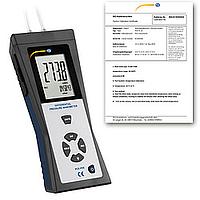
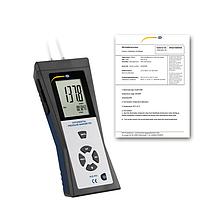
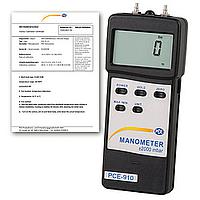
Manometers
Accurate pressure reading is essential when you need to verify airflow, balance HVAC systems, check filter performance, or compare pressure between two points in a process. In these applications, manometers remain one of the most practical tools for fast, reliable differential pressure measurement across maintenance, commissioning, and industrial troubleshooting work.
This category brings together handheld and application-focused instruments used for air, gas, and selected liquid pressure measurement, depending on the model design. Whether the task involves duct static pressure, air velocity with a Pitot tube, or hydronic differential pressure checks, the right instrument helps technicians capture clearer data and make better field decisions.
Where manometers are commonly used
Manometers are widely used in HVAC testing, cleanroom verification, building services, laboratory environments, and industrial maintenance. A typical use case is measuring differential pressure across filters, coils, fans, and ducts to assess system condition or confirm that airflow performance is within the expected range.
They are also valuable for balancing ventilation systems and checking pressure drop in air handling equipment. In hydronic systems, specific handheld models can be used to compare pressure across circuits and support diagnostic work where flow and resistance need to be evaluated together.
Different instrument types within this category
Not every manometer serves the same purpose. Some models are designed primarily for low-pressure air and airflow work, while others are built for higher-pressure hydronic applications. Understanding that difference is important when choosing an instrument for field use.
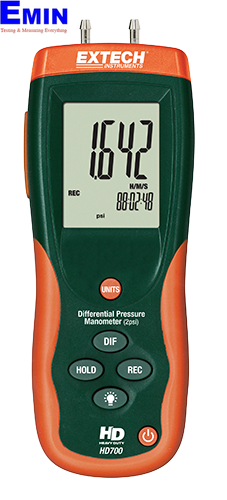
For example, the FLUKE FLUKE-922 Airflow Meter/Micromanometer combines airflow and micromanometer functions for ventilation-related checks. The EXTECH HD750 Differential Pressure Manometers is suited to differential pressure measurement in a broader portable format, while several Dwyer models in this category are oriented toward HVAC balancing and hydronic pressure testing.
Examples of manometers for airflow and HVAC balancing
Airflow verification often depends on measuring pressure and converting it into velocity using accessories such as Pitot tubes. This is why many field technicians choose instrument kits designed specifically for duct testing and fan performance checks rather than using a general-purpose meter alone.
Within this category, examples include the Dwyer 400-5-S-KIT and Dwyer 400-5-L-KIT for air velocity measurement, as well as the Dwyer 400-23-KIT and Dwyer 400-10-KIT for applications requiring a higher pressure range. For users who need a broader view of related portable instruments, it can also be helpful to explore pressure, temperature & humidity monitors used in environmental and mechanical system checks.
Portable differential pressure options for field diagnostics
When the main requirement is fast differential pressure comparison between two points, a handheld digital model is often the most efficient choice. These instruments are useful for service teams working on filters, ducts, ventilation branches, burners, or general air-side performance verification.
The EXTECH HD750 offers a portable differential pressure solution with multiple engineering units, while the FLUKE FLUKE-922 is well suited to airflow-related diagnostic work where pressure and air movement are closely linked. If your application focuses more specifically on general-purpose portable vacuum or low-pressure field measurement, you may also want to review portable vacuum pressure instruments for adjacent use cases.
Manometers for hydronic pressure measurement
Some jobs require more than low-pressure air readings. In water-based heating and cooling systems, a technician may need to compare pressure across components or sections of piping in order to support balancing, troubleshooting, or maintenance analysis. That is where hydronic differential pressure manometers become relevant.
The Dwyer 490A-4, Dwyer 490A-5, and Dwyer 490A-6 are examples of handheld hydronic differential pressure manometers available in different pressure ranges. Because these instruments are intended for a different pressure environment than typical air-side HVAC checks, users should match the meter range, wetted compatibility, and connection requirements to the actual system being tested. For related fluid-power applications, the hydraulic meter category may also be relevant.
How to choose the right manometer
The first selection point is the pressure range. Low-pressure duct and filter measurements require a different instrument than hydronic differential testing. Choosing a range that is too high can reduce sensitivity for small readings, while choosing too low a range may limit the instrument’s usable application window.
The second point is the measured medium and task. Air velocity and HVAC balancing work may require a meter that supports Pitot tube use or integrated airflow functions. For general troubleshooting, portability, display clarity, engineering units, and field accessories may matter more. Where application conditions vary widely, many buyers compare this category alongside broader manometer options before narrowing to a specific model type.
Brands and selection context
This category includes products associated with recognized names in pressure measurement and portable diagnostics, including Dwyer, FLUKE, and EXTECH. Each brand is often chosen for slightly different field preferences, such as HVAC balancing, airflow diagnostics, or general portable pressure measurement.
Beyond product brand, the most important factor is still application fit. A technician checking duct pressure in a ventilation system does not need the same instrument as an engineer measuring hydronic differential pressure at much higher levels. Selecting by real operating conditions will usually deliver better results than selecting by brand alone.
Practical buying considerations for B2B users
For industrial buyers, maintenance teams, and contractors, a manometer is not just a standalone device but part of a measurement workflow. Consider how the instrument will be used in the field: whether it needs to travel between sites, integrate with hoses or Pitot tubes, withstand routine service work, or support repeatable checks across multiple assets.
It is also worth considering whether your team needs one specialized meter or a mix of instruments for different pressure ranges and media. A compact differential pressure meter may be ideal for ventilation checks, while a dedicated hydronic model is better suited to water-based systems. Reviewing the intended measurement environment before purchase will help narrow the category quickly and reduce mismatch.
Choosing from this manometer range becomes easier when you start with the actual measurement task: airflow, low-pressure differential checks, or hydronic pressure comparison. By focusing on range, medium, and application method, buyers can identify instruments that fit real maintenance and testing needs more effectively.
Get exclusive volume discounts, bulk pricing updates, and new product alerts delivered directly to your inbox.
By subscribing, you agree to our Terms of Service and Privacy Policy.
Direct access to our certified experts