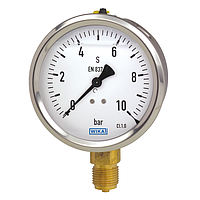
Pressure Gauge
Accurate pressure indication is essential in maintenance, utilities, process control, HVAC systems, and industrial testing. When operators need a clear visual reference at the point of use, a Pressure Gauge remains one of the most practical instruments for tracking system condition, checking line pressure, and identifying abnormal operating behavior before it becomes a larger problem.
This category brings together pressure gauges used across a wide range of measurement tasks, from low-pressure air and gas monitoring to standard line pressure applications. Whether the requirement is a simple local indicator or a gauge for more sensitive differential measurement, the right selection depends on pressure range, media compatibility, mounting style, and the level of reading accuracy needed in the field.

Where pressure gauges are commonly used
Pressure gauges are found in compressed air systems, pumps, filters, cleanrooms, ventilation systems, gas distribution, hydraulic circuits, and general industrial machinery. In many installations, they provide the fastest way to verify whether equipment is operating within its intended window, making them valuable for both routine inspection and troubleshooting.
Different applications call for different gauge types. Standard analog models are often chosen for simple visual monitoring, while low-range and differential pressure designs are better suited to airflow, duct pressure, filter condition, and room pressurization tasks. For users comparing related instrument types, categories such as manometers and pressure, temperature & humidity monitors may also be relevant depending on the measurement method and installation environment.
Understanding the main selection criteria
A suitable gauge is not chosen by range alone. Buyers typically start with the pressure type, such as standard line pressure or differential pressure, then review the connection size, process medium, dial visibility, and expected accuracy. In industrial environments, ease of reading and long-term stability are just as important as the nominal scale.
For example, low-pressure differential gauges are often selected in Pa, kPa, or in H2O ranges to detect small pressure changes across filters, fans, or enclosures. Connection details such as 1/8" NPT Female matter for installation compatibility, while dial size affects readability from a control panel or equipment frame. If the process involves vibration, pulsation, or harsher media, users may also compare gauge construction and wetted material considerations before ordering.
Typical gauge formats in this category
This category includes both conventional pressure gauges and more specialized differential designs. A general-purpose pressure gauge indicates pressure relative to the surrounding atmosphere and is widely used for pumps, pipelines, tanks, and pneumatic systems. Differential pressure gauges compare two points in a system, which makes them useful for monitoring pressure drop, airflow resistance, and pressure balance between zones.
In practical use, differential analog gauges are especially common in HVAC and air handling applications because they provide a direct visual indication without requiring external power. For users evaluating nearby product groups, vacuum pressure portable instruments may be more appropriate for mobile diagnostics, while hydraulic meter solutions are better aligned with hydraulic circuit measurement.
Representative products for low-pressure and differential measurement
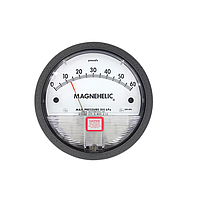
Several featured models in this category illustrate the range of applications covered by Dwyer pressure gauges. The Dwyer 2000-60PA and Dwyer 2300-60PA are examples of very low-range differential gauges intended for small pressure changes, where visibility of subtle variation is more important than high-pressure capability. These types of ranges are commonly associated with airflow verification, filter monitoring, and room pressure checks.
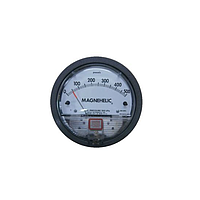
For broader measurement spans, models such as the Dwyer 2000-300PA, Dwyer 2000-500PA, Dwyer 2000-750PA, and Dwyer 2000-1KPA extend the usable range while maintaining a 4-inch dial format that supports quick reading in industrial settings. The Dwyer 2003 and Dwyer 2010, scaled in in H2O, are also relevant where imperial units remain standard in HVAC and building systems.
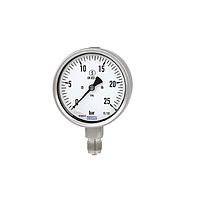
This category also includes more conventional pressure gauge examples such as the WIKA 232.50, a standard analog pressure gauge format suited to line pressure indication. Together, these examples show that pressure gauge selection is often driven by the operating medium, the expected pressure level, and whether the goal is to monitor a single pressure point or a pressure difference across equipment.
How to choose the right pressure range
Range selection has a direct effect on both readability and service life. If the selected scale is too high, small changes are difficult to see. If it is too low, the gauge may be exposed to frequent overpressure or operate too close to its maximum limit, which can reduce measurement quality over time.
For low-pressure ventilation or clean air applications, ranges such as -30 to 30 Pa, -50 to 50 Pa, or 0 to 60 Pa can help operators detect subtle system changes. For larger pressure drops or more robust airflow systems, ranges such as 0 to 300 Pa, 0 to 750 Pa, 0 to 1 kPa, or 0 to 1.5 kPa may be more appropriate. In process and utility systems, a standard pressure gauge with bar or psi scale can be the better fit when the application is not focused on differential measurement.
Practical considerations for installation and operation
Beyond the scale itself, installation details influence usability. Mounting orientation, process connection type, and gauge location all affect whether readings remain reliable and easy to interpret. A gauge mounted where operators can clearly see the dial during normal rounds is generally more useful than a technically suitable instrument placed in a difficult or unsafe location.
Media compatibility should also be reviewed carefully, especially for gas service or when the system contains anything other than air and non-combustible compatible gases. Buyers should confirm whether the gauge is intended for the actual process fluid, expected temperature conditions, and any pressure excursions that may occur during startup or fault conditions. In maintenance-heavy facilities, choosing a gauge with a durable housing and a clear dial face can also simplify routine inspection.
Brands and product ecosystems
This category is supported by well-known instrumentation and measurement brands including Brooks Instrument, Cole parmer, Dwyer, Fluke (Calibration), Jumo, OMEGA, WIKA, YOKOGAWA, Additel, and JONNESWAY. In practice, not every brand serves the same measurement need in the same way. Some are more often associated with calibration and test workflows, while others are commonly selected for installed field instrumentation and local indication.
For many buyers, the decision starts with the application rather than the brand name alone. A low-pressure room monitoring point, for example, may lead to a differential analog gauge, while a mechanical line-pressure indication point may call for a more conventional analog pressure gauge body and connection format. Looking at the broader measurement ecosystem can help ensure the selected instrument fits the job, the process, and the maintenance routine.
Choosing with confidence
A well-matched pressure gauge improves visibility into system behavior without adding unnecessary complexity. The most effective choice usually comes from balancing pressure type, range, accuracy, connection, and application environment rather than focusing on one specification in isolation.
If you are comparing low-pressure differential models, standard analog pressure gauges, or related pressure measurement instruments, this category provides a practical starting point for narrowing down options. Reviewing the operating range and installation context first will make it much easier to identify the most suitable gauge for your process, equipment, or facility.
Get exclusive volume discounts, bulk pricing updates, and new product alerts delivered directly to your inbox.
By subscribing, you agree to our Terms of Service and Privacy Policy.
Direct access to our certified experts