Data center protection relay testing should confirm that each protection function detects a simulated abnormal condition, operates at its approved setting, and trips the intended breaker in the intended sequence. The key applications described here are UPS transfer verification, transformer overcurrent calibration, switchgear coordination, and diesel generator protection checks.
Testing must be planned around the active power path and verified field documentation. Before injecting signals, compare CT ratios, relay settings, and wiring with the applicable setting sheet and as-built drawings.
Summary: Verify UPS output behavior during a simulated input loss. Check pickup, reset ratio, and timing for overcurrent relays. Confirm downstream switchgear protection operates before upstream backup. Test generator overcurrent, reverse-power, and ground-fault functions with the generator isolated.
What does data center protection relay testing verify?
Protection relay testing verifies whether a relay detects a fault condition and sends the correct trip command within its intended setting and timing. In a data center, this applies to relays associated with UPS systems, transformers, generators, and switchgear sections, where incorrect operation can unnecessarily enlarge the affected outage area.
Controlled secondary injection applies voltage or current to relay secondary terminals to check relay logic, pickup, and timing without energizing the primary circuit. Primary injection instead tests the full path from the CT primary through wiring to the relay, making it relevant when validating CT ratio, polarity, and wiring integrity during commissioning or after CT or wiring work.
How is UPS transfer time verified during a simulated mains failure?
UPS transfer verification measures the interval from an input-voltage loss to recovery of the UPS output. A relay test set or programmable AC source can simulate the input event, while a high-speed oscilloscope records the output waveform.

For a representative test, the UPS should be under load and downstream IT operations should be notified. Record T₀ when the input falls below the configured threshold and T₁ when output returns to within the selected nominal-voltage tolerance; transfer time is calculated as ΔT = T₁ − T₀.
| UPS verification item | Value described in the source |
|---|---|
| Online UPS transfer-time target | Under 10 ms |
| Input-loss simulation duration | 100–500 ms |
| Suggested test loading | No load, 50% load, and 100% load |
| Output recovery reference | Within ±5% of nominal voltage |
How are transformer overcurrent relay pickup and reset checked?
Transformer overcurrent testing uses controlled current injection into the relay CT secondary circuit to compare pickup, reset, metering, and operating time with the protection setting sheet. The relay should be out of service, its trip output disconnected, and CT circuits isolated before connections are made.
For pickup, begin below the setting, such as 90%, and increase current gradually until operation occurs. Record the operating current, repeat the measurement, and compare the result with the approved setting; the source describes a pickup error target of ±5%.
For reset behavior, reduce current after pickup and record the reset current. The reset ratio is K = Ire / Iop, where Ire is reset current and Iop is operating current; the stated acceptable range is 0.85–0.95.
| Overcurrent relay check | Criterion described in the source |
|---|---|
| Pickup-current error | Within ±5% of setting |
| Reset ratio | 0.85–0.95 |
| Definite-time error | Within ±10% |
| Metering deviation | Within ±1% |
Why is reset ratio important in overcurrent protection testing?
The reset ratio indicates how far current must fall after relay pickup before the relay returns to its normal state. A ratio that is too low may leave a circuit de-energized after a temporary fault, while a ratio that is too high may cause unstable behavior close to the pickup threshold.
Testing the ratio separately from pickup helps distinguish an operating-threshold issue from a reset-behavior issue. The source identifies 0.85–0.95 as the expected range for the described procedure.
How does switchgear cascade testing confirm selective coordination?
Switchgear cascade testing confirms that the relay nearest a simulated fault operates first and that the upstream relay remains a time-delayed backup. This selectivity limits the outage to the smallest practical section of the electrical system.
With the breaker truck in the test position and the breaker open, inject the test signal at the downstream relay and monitor both downstream and upstream relay contacts. In the described two-stage example, the fault current is set to 1.2 times the downstream Stage I setting.
Coordination is correct when T_downstream is shorter than T_upstream, with a stated interval of at least 0.1–0.2 s. If the upstream relay operates first or at the same time, the protection sequence should be reviewed against the approved settings and retested.
What should be checked on a diesel generator protection relay?
Generator protection verification can cover overcurrent, reverse power, and ground-fault elements by injecting simulated current and voltage into the relay circuits while the generator is shut down and its output breaker is disconnected. Trip contacts can be monitored to confirm that the intended protection output operates.
Overcurrent pickup and timing follow the same basic approach used for transformer relay checks. For reverse power, apply forward real power first to confirm that the relay does not operate, then adjust the phase relationship to produce reverse power and record the operating value and time.
For zero-sequence ground-fault testing, use the relay’s designated zero-sequence input and confirm whether the setting references 3I₀ or I₀. The source states that pickup errors for overcurrent, reverse power, and zero-sequence functions should remain within ±5% of the setting, with a reset ratio of 0.85–0.95.
How should a relay test set be selected for data center work?
Select a relay test set based on the protection functions and relay inventory that must be verified, rather than portability alone. Three-phase outputs are relevant for feeder relays, while six-phase capability is relevant to differential and generator protection applications described in the source.
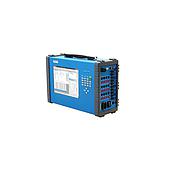
Other stated selection factors include output range, support for relay test libraries, XRIO or RIO configuration-file import, and portability for constrained electrical rooms. The Kingsine KFA320 is described in the source as a six-phase relay test set with 0.05% output accuracy, a library of more than 500 relay templates, and a 3.8 kg portable form factor.