This article provides a comprehensive overview of the causes, signs, and proper procedures for checking and replacing capacitors, helping your water heaters, ceiling fans, and air conditioners operate reliably and more energy-efficiently.
What is a starting capacitor, and what is its role in a single-phase motor?
Single-phase motors operate on 220V alternating current; however, this current alone generates only an oscillating magnetic field, which is insufficient to make the rotor spin on its own. The capacitor serves to create the necessary phase shift to generate a rotating magnetic field, enabling the motor to start and run.
Single-phase motors typically utilize two types of capacitors:
+ Start Capacitor: Operates only during the startup phase, generating high torque to rapidly spin the rotor. Once the motor reaches stable operation, the start capacitor disconnects from the circuit. Common applications include water pumps, single-phase motors, and air conditioners.
+ Run Capacitor: Operates continuously while the motor is running, ensuring stable, quiet operation and energy efficiency. Common applications include ceiling fans, Senko fans, and pedestal fans.
If the start capacitor is weak, the motor lacks the force to start; if the run capacitor fails, the motor will overheat, vibrate, and experience a significantly shortened lifespan. If the value of either capacitor is incorrect, the entire system will be subjected to an overload.
Why do capacitors burn out silently, often going unnoticed?
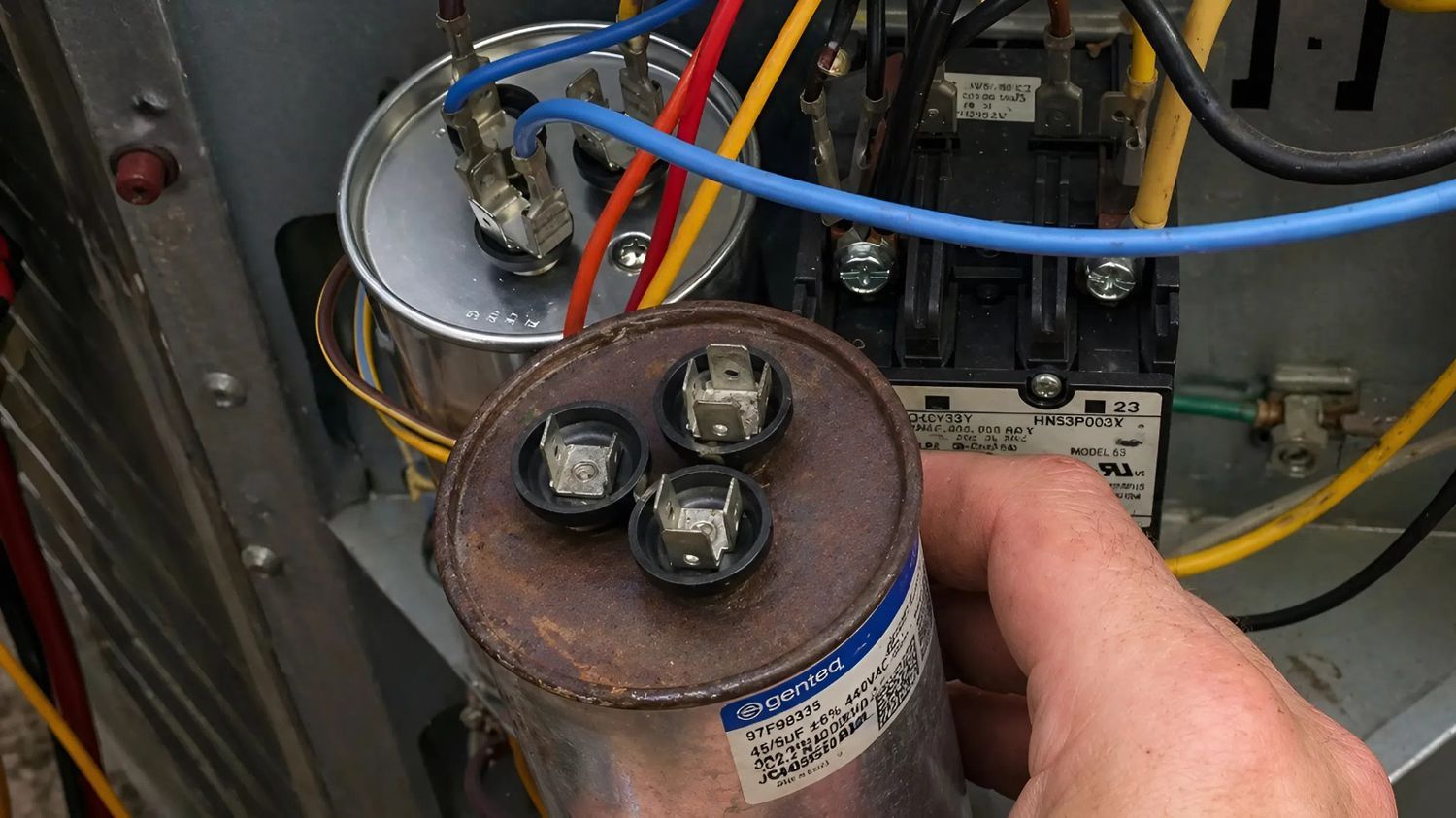
According to the experience of many electricians, most failed starting capacitors do not explode or emit smoke immediately; instead, their capacitance gradually decreases over a long period. Externally, the capacitor appears normal, but internally, it has significantly deteriorated. The four most common causes are:
1. Fluctuating voltage
Fluctuations in the residential power supplyc particularly in rural or densely populated areas frequently expose starting capacitors to voltage surges. Each sudden voltage spike damages the capacitor's internal insulation and reduces its lifespan.
2. High temperatures, poorly ventilated space
Many water pumps and ceiling fans house their capacitors in sealed enclosures lacking heat dissipation vents. Temperatures reaching 70 to 80°C cause the internal dielectric film to dry out rapidly, resulting in a loss of capacitance.
3. Poor-quality capacitors, incorrect actual values
Low-quality or "floating" market components often display a higher value than their actual rating for instance, a capacitor labeled as 10µF might measure only 6 to 7µF. When installed in a motor, this forces the equipment to operate under overload conditions, leading to overheating, vibration, and burnout after a short period of use.
4. Incorrect wiring or oxidized wires
Replacing a capacitor without following the wiring diagram, connecting it with reversed polarity, or using oxidized wires can all result in poor contact and localized heating, causing the capacitor to deteriorate more rapidly.
See related article: Not every one knows how to test a capacitor using a multimeter.
6 signs that a motor run capacitor is about to fail or is internally shorting out
Recognizing the following signs early allows you to replace the capacitor in time before the motor burns out completely.
- Water pump hums but fails to pump water: A faulty pump start capacitor prevents the motor from generating sufficient starting torque; you will typically hear a humming sound followed by the unit automatically shutting down.
- Ceiling fan spins slowly, produces weak airflow, or wobbles: A weak run capacitor causes the fan to spin sluggishly or fail to turn at all, even on the highest speed setting.
- Air conditioner is on, but the compressor (block) does not run: A weak start capacitor prevents the compressor from starting; the unit hums continuously before shutting down automatically.
- Swollen capacitor or slight oil leakage: Visual inspection reveals a bulging top, oil leakage, or discoloration—signs of overheating that require immediate replacement.
- Capacitor heats up abnormally fast during operation: Increased leakage current causes rapid heating, sometimes accompanied by a faint burning odor.
- Actual capacitance drops below 70%: Using a multimeter to measure across the terminals, if the reading is less than 70% of the value printed on the capacitor body, it must be replaced immediately.
Quick check tip: Try replacing it with a new capacitor of the same rating. If the appliance runs powerfully and starts up quickly again, the old capacitor was faulty.
Consequences of continuing to use a start capacitor that has silently failed
Many people assume that if a capacitor is weak but the machine still runs, immediate replacement isn't necessary; however, this mindset can easily lead to costly repairs down the line.
Motor overload and winding burnout: The motor struggles to start, causing current levels to spike and the windings to overheat rapidly. Over time, the insulation burns out, and the motor loses its magnetic properties. Rewinding costs typically range from 300,000 to 800,000 VND, or even more depending on the motor's power rating.
Doubled power consumption: The appliance continues to operate but runs sluggishly and generates excess heat. In the case of air conditioners, the compressor must run continuously to maintain the desired temperature, increasing monthly electricity consumption by approximately 20–30%.
Risk of capacitor explosion or short circuits: A faulty capacitor can leak electricity or explode when subjected to a sudden current surge, potentially damaging the circuit board or the starting relay.
By trying to save a few tens of thousands of VND on a capacitor replacement, many people end up spending millions to replace the motor, the compressor, or even the entire ceiling fan unit.
How to check, replace, and select a start capacitor with the correct rating
Use a multimeter with a µF (microfarad) range. Fully discharge the capacitor before measuring, then measure across its two terminals.
Compare the measured value with the rating printed on the capacitor's body. If the measured value is less than 70% of the rated value, the capacitor is weak or has suffered silent failure and needs replacement.
How to select a new capacitor with the correct specifications:
- Accurately read the specifications on the old capacitor, including the capacitance (µF) and voltage rating (V).
- Choose a new capacitor with a capacitance equal to or up to approximately 10% higher than the original value.
- Prioritize a voltage rating of 400V to 450V for better load handling and durability, especially for water pump start capacitors and air conditioner capacitors.
- Avoid capacitors with excessively low voltage ratings, as they are prone to swelling or exploding when exposed to high currents.
Notes when replacing capacitors
- For ceiling fans, choose a compact, round-cased run capacitor that fits easily inside the fan canopy.
- For single-phase motor start capacitors, securely tighten the terminal connectors to prevent wires from coming loose due to vibration.
- After replacement, run the unit for 2–3 minutes and gently touch the capacitor body; it should feel only slightly warm. If it is abnormally hot, the polarity may be reversed, or the capacitor's actual rating may be incorrect.
Frequently Asked Questions
1. Is a faulty start capacitor dangerous? Yes. A faulty start capacitor not only causes the motor to run weakly and consume excess power, but if left unaddressed, it can also lead to burnt windings, compressor failure, or a short-circuited start relay.
2. How often should the start capacitor be checked? It should be inspected periodically about once every six months or immediately if the appliance shows signs of weak performance, makes a buzzing sound, or overheats.
3. What is the difference between a start capacitor and a run capacitor? A start capacitor operates only during the startup phase and then disconnects from the circuit, whereas a run capacitor operates continuously while the machine is running to stabilize the motor and improve energy efficiency.
What are the most recognizable signs that a start capacitor is failing? A water pump that buzzes but fails to pump water, a ceiling fan that spins weakly or wobbles, and an air conditioner that is turned on but has a compressor that fails to start are the three most common and easily identifiable signs.
Conclude
A start capacitor costs only a modest amount, yet if a failure goes undetected, the consequences can range from a burnt-out motor or a damaged compressor to a ceiling fan ceasing to function. Periodically checking the capacitor and replacing it with a genuine unit of the correct rating is the simplest way to ensure the appliance starts powerfully, runs quietly, saves energy, and enjoys a longer lifespan.