A power outage lasting only a fraction of a second or a few seconds often goes unnoticed by operators, yet it is sufficient to trigger a PLC reboot, cause variable frequency drive faults, lead to sudden line stoppages, or disrupt product flow. The primary challenge is that the incident has often concluded before an engineer can arrive on-site to investigate.
This is why many factories choose to install power quality analyzers for continuous monitoring. Instead of attempting to diagnose the root cause after operations have returned to normal, the entire event is captured as data and waveforms, serving as a record for subsequent analysis.
Why is it so difficult to identify the cause of short-term power outages?
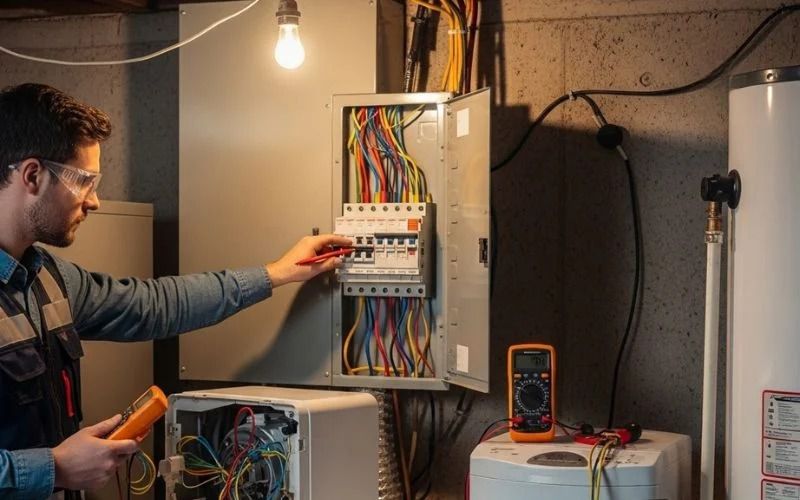
A momentary power outage may last only a few electrical cycles, yet its consequences can manifest across various pieces of equipment; in some cases, only a single variable frequency drive might report a fault, while in others, an entire production line could come to a simultaneous halt.
Visual inspection yields little information, as power is restored almost immediately. Detecting traces of the event within the electrical cabinet is also difficult without data recorded precisely when the incident occurred.
This is the gap that power analyzers are designed to fill. These devices continuously monitor voltage and current, automatically capturing the full sequence of events the moment an anomaly is detected.
How do you set up a power analyzer?
Typically, engineers install current clamps and voltage leads at the main electrical panel or at locations where faults frequently occur.
Once connections are complete, the device is configured with event-recording thresholds. For instance, the unit can automatically save data when the voltage drops below a preset value or during a complete power outage lasting a specified duration.
Certain models, such as the FLUKE-1773 or Hioki PQ3198, also allow for the recording of waveforms immediately before and after an event. This enables engineers not only to identify the time of the outage but also to visualize the entire sequence of events leading up to it.
How does the recorded data help distinguish the causes?
The three-phase voltage drops to zero simultaneously
When the voltage across all three phases is simultaneously lost and then restored after a few cycles, it typically indicates that the cause originates from the power supply side.
In this scenario, the current data shows virtually no significant fluctuation prior to the power loss. This phenomenon is often associated with utility switching operations, transient faults on the line, or source transfer processes.
The current surges before the voltage drops
Another easily recognizable characteristic is a sudden surge in current immediately preceding a sharp drop in voltage.
This phenomenon typically occurs during a short circuit, a fault, or an overload at a specific load. The protection system activates, causing a circuit breaker or relay to cut off power in order to safeguard the equipment.
Simultaneously comparing voltage and current allows engineers to quickly narrow down the specific group of devices requiring inspection, rather than having to check the entire production line.
Voltage surge occurs before the device restarts
Some incidents do not result in a total power outage but still cause PLCs, industrial computers, or variable frequency drives (VFDs) to reboot.
Upon reviewing the data, engineers may detect very brief voltage spikes occurring immediately before the equipment reports an error. This is a common sign of transient overvoltage or the effects of a lightning strike.
It is very difficult to identify this cause based solely on external observations.
Data helps not only to identify the root cause but also to prevent the recurrence of incidents
After each event is recorded, all data can be saved for comparison across different timeframes.
If voltage drops occur repeatedly at the same time of day or on the same load branch, the technical team gains a basis for analyzing trends, rather than simply addressing isolated incidents.
Over time, the accumulated data also aids in assessing power quality, planning maintenance, and identifying areas requiring upgrades before production operations are impacted.
Brief power outages lasting only milliseconds can halt an entire production line and require significant time to restore. Power quality analyzers capture the full sequence of an event voltage, current, and waveforms providing a clear basis for identifying the root cause and determining the appropriate corrective action. EMIN offers various power analyzer models, such as the Fluke 435 II, designed to meet the needs of power monitoring, continuous data logging, and fault analysis in industrial environments.