High-precision benchtop multimeter, suitable for a wide range of demanding applications. R&D teams typically need accuracy, resolution, flexible functions, and visibility into changing readings; QA teams need repeatable procedures, useful speed, and records; automated test equipment (ATE) needs dependable remote control and wiring integration.
The right instrument is the one whose measurement capability and workflow fit the station’s actual decisions. Compare accuracy by the required function and conditions, then confirm that speed, logging, interfaces, terminal access, documentation, and safety information support the intended process.
Summary: R&D prioritizes accuracy and observation of small changes. QA prioritizes repeatability, throughput, and traceable records. ATE prioritizes interfaces, SCPI behavior, rear terminals, and stable remote operation.
What makes a bench DMM different from a handheld DMM?
A bench digital multimeter is intended for controlled lab, production, and software-driven test workflows where display detail, stability, logging, and connectivity matter. A handheld multimeter remains useful for field checks, troubleshooting, and quick electrical confirmation.
A bench instrument can consolidate common functions such as voltage, current, resistance, capacitance, frequency, diode, continuity, and temperature measurement. Function availability alone is not enough: buyers should review accuracy for every function that affects a pass/fail or design decision.
Which bench DMM priorities matter most in an R&D lab?
R&D labs should emphasize accuracy, resolution, measurement flexibility, and reading visibility. These needs support work on voltage references, regulator outputs, sensor boards, analog offsets, and investigations where the behavior is not yet known.
Higher resolution can help reveal drift and small signal movement, but it must be considered with accuracy, noise, stability, and the measurement setup. Shielding, grounding, lead quality, integration time, and source stability can affect the usefulness of low-level measurements.
Trend displays, histograms, statistics, and logs are valuable when a single reading does not show the full behavior. They can help identify warm-up drift, slow sensor settling, or changes during thermal stress.
Why do QA teams need a different bench DMM selection approach?
QA teams need an instrument that supports repeatable decisions across operators, shifts, and batches. Consistent setups, clear display states, defined limits, fixture-ready wiring, and operator training can be as important as the measurement specification itself.
Speed should be assessed under realistic settings. A high maximum readings-per-second figure may depend on a particular mode or reduced resolution, so the useful speed is the speed that still provides sufficient confidence for the quality limit.
Logging and data transfer can support traceability and reduce manual entry. The station should define whether it needs local storage, PC export, LAN-based transfer, centralized capture, or a combination of these methods.
What should an ATE system require from a bench DMM?
ATE selection should focus on remote interfaces, SCPI command behavior, rear terminals, triggering, and connection stability. In an automated rack, a DMM operates alongside power supplies, loads, switches, fixtures, software, and data records, so front-panel convenience may be secondary.
USB can suit a local PC-controlled station. LAN can suit shared or networked stations, while RS-232, RS-485, and GPIB may remain relevant for industrial or legacy controller environments. Compatibility with the existing software and communication architecture should be confirmed before purchase.
SCPI support can reduce the effort to configure measurements, set ranges, trigger readings, and retrieve data. A short proof-of-concept script that repeats the intended sequence and records errors over time is a practical way to assess integration risk.
When are front and rear terminals important on a bench DMM?
Front terminals are convenient for manual measurements, while rear terminals are better suited to fixed wiring, fixtures, and rack systems that should not be disturbed between tests. Rear wiring can reduce accidental lead movement and simplify cable management in repeated production or automated measurements.
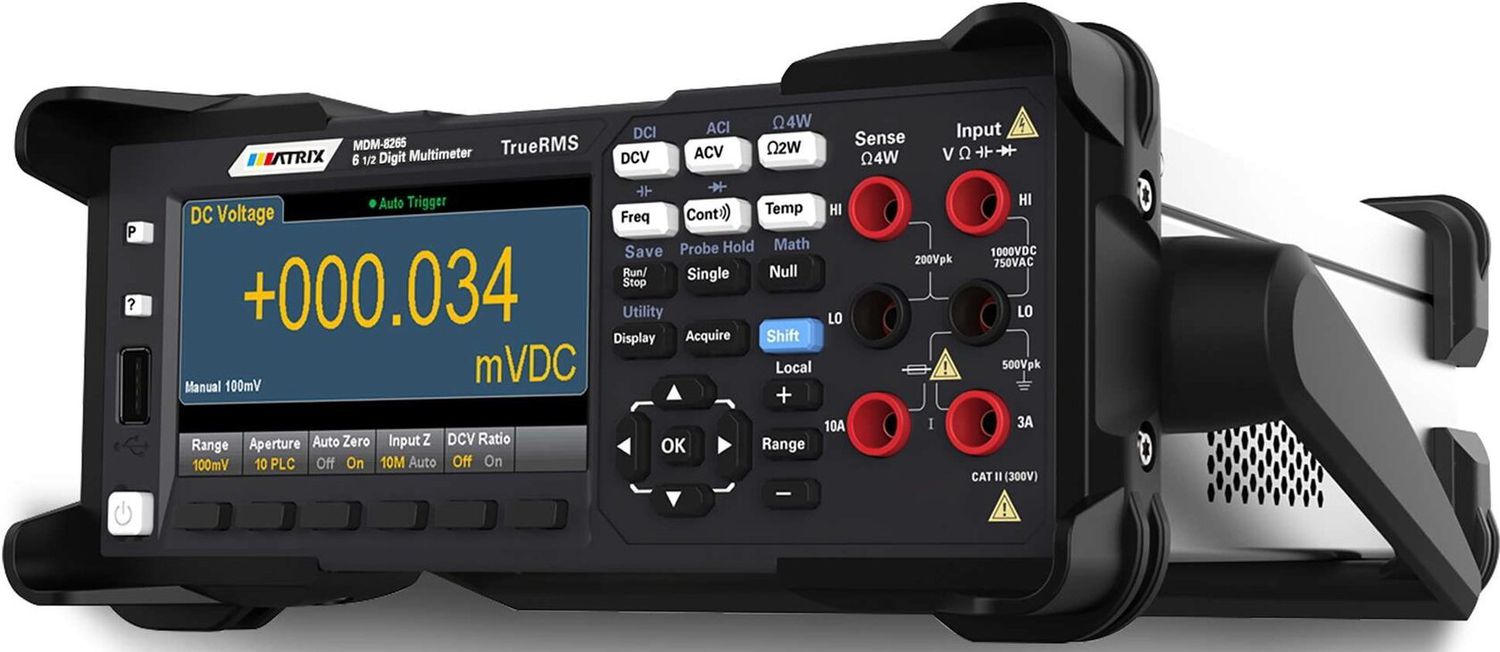
The MATRIX MDM-8200 series is presented in the supplied product information as a 6.5-digit bench DMM series with front and rear input options, multiple interfaces, high-speed readings, and SCPI control. These characteristics can be relevant where one instrument supports both manual and automated work.
How should R&D, QA, and ATE requirements be compared?
The same bench DMM feature can have different importance depending on the station. Use the following comparison as a requirement-setting guide rather than treating every priority as equally important.
| Selection factor | R&D priority | QA priority | ATE priority |
|---|---|---|---|
| Accuracy and resolution | Very high | High | Medium to high |
| Measurement speed | Medium | High | High |
| Data logging and statistics | High | High | Medium |
| Display and local controls | High | Medium | Low |
| Interfaces and SCPI | Medium | Medium | Very high |
| Rear terminals | Medium | Medium | Very high |
How can procurement teams score a bench DMM before purchase?
A weighted scorecard keeps teams from choosing only by digit count, price, or a single headline specification. The weights below reflect the supplied requirements model and should be reviewed by operators, engineers, and software personnel for the actual station.
| Evaluation factor | R&D weight | QA weight | ATE weight |
|---|---|---|---|
| Accuracy and resolution | 25% | 20% | 15% |
| Measurement speed | 10% | 20% | 15% |
| Function coverage | 15% | 10% | 10% |
| Data logging and statistics | 15% | 20% | 10% |
| Remote interfaces and SCPI | 10% | 10% | 30% |
| Safety and input protection | 10% | 10% | 10% |
| Warranty and documentation | 15% | 10% | 10% |
What buying mistakes should teams avoid?
Do not select a DMM by digit count alone. A 6.5-digit display can be useful when small changes and tighter tolerances matter, but its value depends on the full accuracy expression, noise, stability, calibration considerations, and setup quality.
Do not postpone software review until after purchase. Teams should confirm interface requirements, command documentation, driver needs, timing behavior, and data handling with the people who will operate or automate the station.
Do not overlook documentation, input limits, grounding rules, fuse information, warranty terms, calibration guidance, and service arrangements. These details affect long-term operation as well as initial procurement.
Note: Match accuracy and resolution to the smallest measurement difference that affects the decision, allowing for uncertainty, calibration interval, and ambient conditions.