There are many types of clamp meters on the market, but Fluke is always a name that many people trust thanks to its brand and quality. Among them, Fluke 323 and Fluke 324 are often put on the scale for comparison because they belong to the same segment. So what are the similarities and differences between these two models? EMIN will show you below.

CAT Safety Rating
When choosing a clamp meter, the CAT safety rating often affects the price of the product. The higher the CAT rating, the safer the device is when working in high voltage environments.
The Fluke 323 and Fluke 324 are designed to operate reliably even in harsh conditions, with a CAT III 600V and CAT IV 300V safety rating. This makes them suitable for a wide range of applications, from residential to industrial electrical systems.
True RMS technology
True RMS clamp meters provide accurate AC current and AC voltage measurements even on non-linear signals. Both the Fluke 323 and Fluke 324 are equipped with this feature, ensuring accurate measurements even under less than ideal signal conditions.
In addition, these two devices can measure both sine and non-sine waves, providing improved accuracy compared to many other clamp meters on the market.
Measure current
If you need to measure AC current, the Fluke 323 and Fluke 324 are both good options, capable of measuring up to 400A. Both devices work by measuring the current flowing through a wire without direct contact, making testing faster and safer. However, if you are looking for a device that can measure DC current, this is not the optimal choice.
Voltage
The Fluke 323 and Fluke 324 can measure AC and DC voltages up to 600V, which is enough for a wide range of applications, from residential to industrial. However, if you need to measure frequency, these two devices will not meet your needs due to the lack of this feature.
Most of the features of the Fluke 323 and Fluke 324 are quite similar, but there is one important difference: the Fluke 324 has a built-in temperature measurement, allowing you to check the temperature of the environment or electrical equipment right on the same device. Meanwhile, the Fluke 323 does not have this feature. If your work requires frequent temperature measurements, the Fluke 324 will be the better choice.
About Capacitance
If you need to measure capacitance, the Fluke 324 is a better choice. It can measure from 0-100 µF and up to 1000 µF, making it a quick way to test components like capacitors in a circuit. The Fluke 323, on the other hand, lacks this feature, making it more limited in some applications.
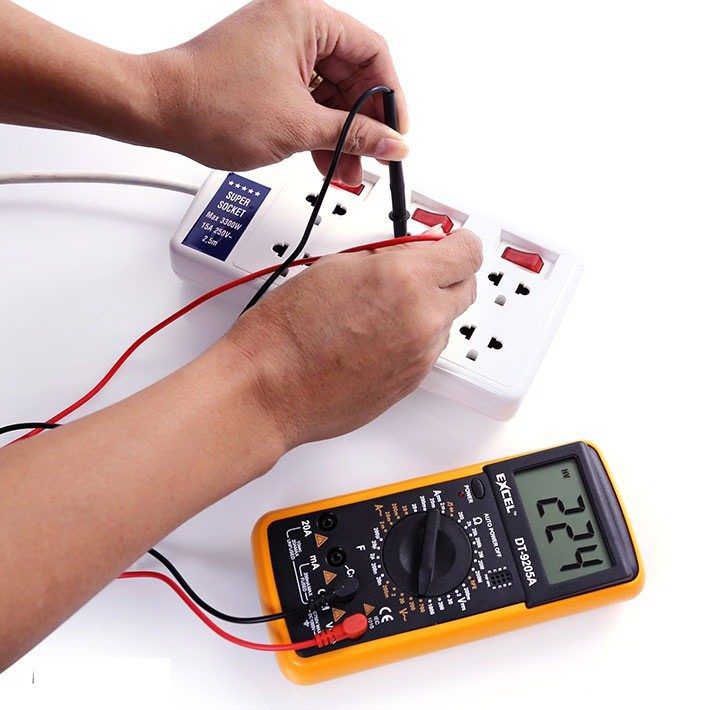
The Fluke 323 is small, making it easier to work in tight spaces. The bright backlight helps work better in low-light conditions. The Fluke 324 also has a slim design with a similar backlight, but has the advantage of measuring both temperature and capacitance, expanding the device's range of applications.
Currently, the Happy March promotion program, Hunting for sales with Fluke is still taking place. Please quickly refer to "International Promotion of Happiness" HAPPY MARCH, HUNT FOR SALE WITH FLUKE" for a chance to hunt for a super cool multimeter to measure diodes safely!