An analog multimeter needle moving backward while measuring voltage is commonly caused by reversed polarity on a DC source or selecting the wrong measurement function. This behavior is a normal response of the meter movement and does not necessarily indicate a fault.
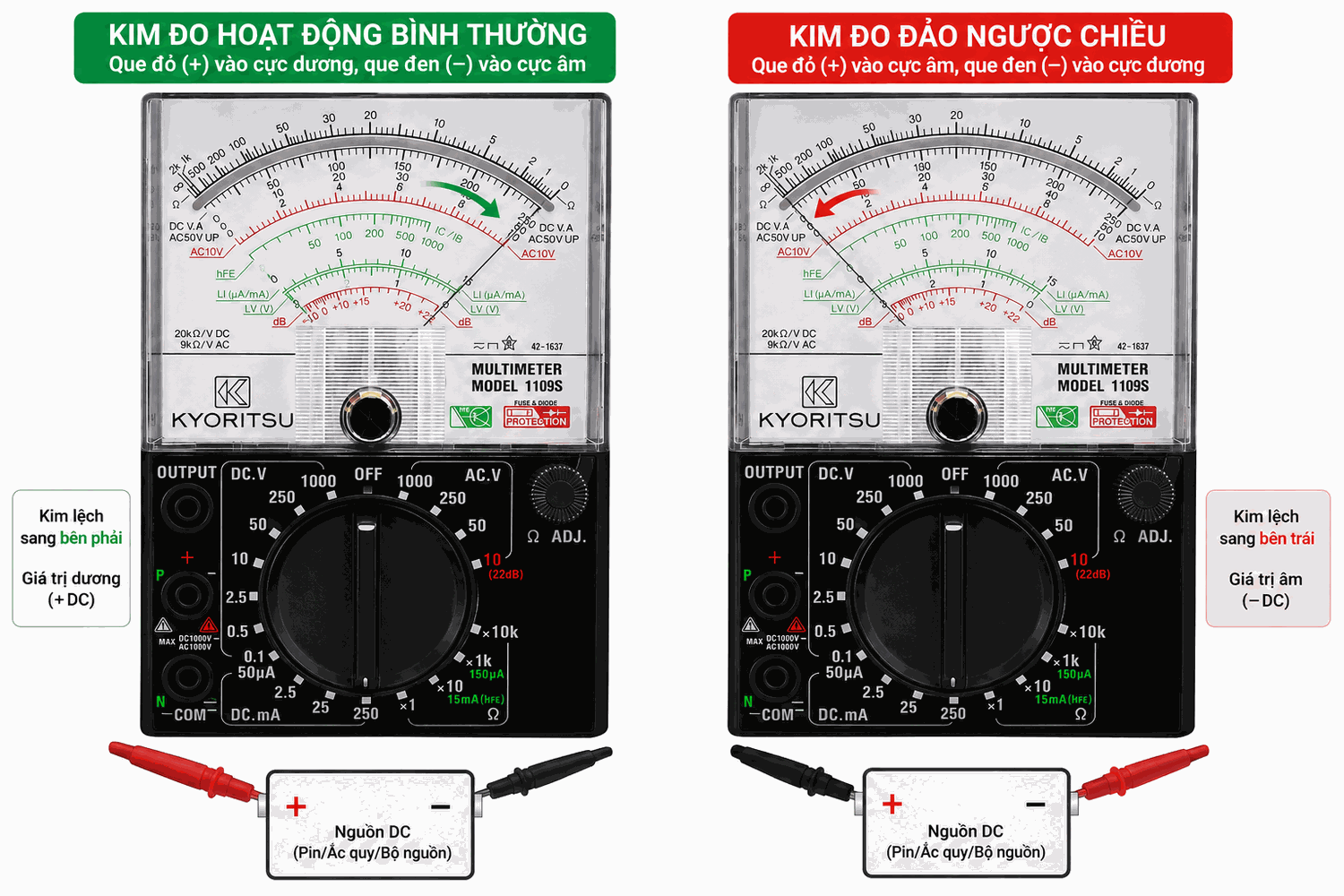
In an analog multimeter, the direction of needle deflection depends on the direction of current flowing through the moving coil. When the current reverses, the electromagnetic torque also reverses, causing the needle to move toward the left. To protect the movement, manufacturers incorporate a mechanical stop at the beginning of the scale to limit the needle travel under reverse-current conditions.
Reversed polarity is the most common cause
DC voltage measurements require correct polarity. If the red probe is connected to the negative terminal and the black probe to the positive terminal, the current flowing through the PMMC (Permanent Magnet Moving Coil) movement reverses direction, causing the needle to deflect backward.
This is commonly observed when measuring batteries, rechargeable batteries, DC power supplies, or control circuits with an analog multimeter. Simply reconnecting the probes with the correct polarity will restore normal needle operation.
Switching power supplies and PWM circuits can cause abnormal needle movement
Electronic circuits that use Pulse Width Modulation (PWM), such as switching power supplies (SMPS) and variable frequency drives (VFDs), produce pulsed output voltages that change very rapidly.
Because the analog meter movement has mechanical inertia, it cannot respond instantaneously to these rapid voltage transitions. As a result, the needle may vibrate, twitch, or oscillate briefly before settling at its final position.
This behavior reflects the response limitations of the analog meter movement rather than a malfunction of the multimeter.
Check the Zero adjustment before assuming the meter is faulty
If the needle does not rest exactly at the Zero mark before measurement, the error will affect the entire measurement range.
The offset may result from mechanical shock, vibration during transportation, or wear of the meter movement over time. Before measuring low voltages, the mechanical Zero adjustment should be checked and corrected to eliminate initial measurement error.
Figure: Reverse needle deflection on an analog multimeter during voltage measurement.
The measurement environment can also affect needle movement
Unlike a digital multimeter, an analog multimeter relies on a magnetic measuring mechanism and is therefore more sensitive to external magnetic fields.
If the meter is placed near a large power transformer, an electric motor, or a strong permanent magnet, the external magnetic field can influence the moving coil and shift the needle's equilibrium position.
Although the resulting error is usually negligible in routine voltage measurements, it can become significant when measuring millivolt-level signals or performing calibration.
For this reason, analog multimeters used in calibration laboratories are typically kept away from transformers, motors, and other sources of strong magnetic fields.
When should the multimeter be inspected or calibrated ?
If the needle moves backward only when the test leads are connected with reversed polarity or when measuring pulsed power sources, the meter is generally operating normally.
However, if the needle fails to return to Zero, sticks during movement, oscillates continuously, or produces inaccurate readings on all measurement ranges, the return spring, PMMC movement, and internal protection circuitry should be inspected.
For multimeters that have been in service for many years, periodic calibration is recommended to maintain measurement accuracy.