In aerobic microbial cultivation and biomass fermentation processes, cell growth rates are determined not only by the nutrient composition of the culture medium but, more fundamentally, by the availability of dissolved oxygen. As the volume of culture broth in an Erlenmeyer flask increases, the liquid film creates greater resistance to the natural diffusion of oxygen from the headspace into the bulk liquid. At this point, a laboratory shaker plays a critical role in promoting phase-to-phase mass transfer, converting mechanical kinetic energy into improved oxygen transfer efficiency.
Many laboratory engineers make the mistake of focusing solely on rotational speed, measured in revolutions per minute (RPM), while overlooking two critical physical parameters: shaking amplitude and the resulting centrifugal force. Understanding the relationship between these dynamic factors is key to establishing the appropriate operating conditions for orbital shakers.
The Physical Principles of Oxygen Mass Transfer and Surface-Limitation Phenomena
Oxygen transfer from the air into a liquid culture medium through its free surface follows Fick's law of diffusion. The overall mass transfer coefficient is directly influenced by the interfacial surface area and the thickness of the stagnant liquid film adjacent to the gas–liquid interface. When the shaker operates, its orbital motion generates fluid flow and turbulence inside the flask, continuously mixing the liquid and reducing the thickness of this diffusion boundary layer.
However, mixing efficiency varies depending on the shaker configuration. If the shaking amplitude is too small, the culture broth moves gently across the bottom of the flask, producing a relatively uniform sloshing motion without sufficiently disrupting the surface tension in the central region. Conversely, when the shaking amplitude is increased (for example, from 10 mm to 25 mm or 30 mm), the orbital motion generates centrifugal forces that push the liquid up the flask walls, forming a vortex or funnel-shaped flow pattern. A larger amplitude significantly increases the instantaneous gas–liquid interfacial area while also raising the surface velocity, allowing oxygen molecules to diffuse more effectively into the liquid at a substantially higher transfer rate.
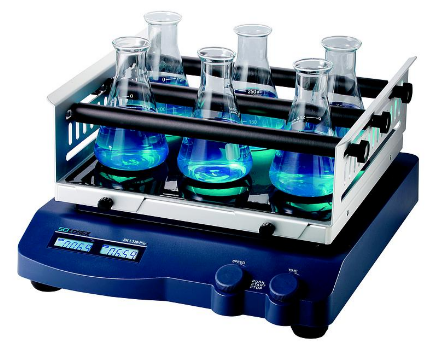
Optimizing Rotational Speed, Shaking Amplitude, and Culture Volume
In practical operation of a microbial incubation system, the combination of rotational speed and shaking amplitude must remain within the physiological tolerance limits of the cells. Increasing rotational speed to raise the oxygen transfer rate (OTR) and meet the respiratory demands of bacteria or fungi during the exponential growth phase also causes centrifugal forces to increase significantly.
If a large shaking amplitude is combined with excessively high rotational speed in an overfilled flask, the liquid may be thrown outward abruptly, causing strong mechanical impacts against the flask walls or excessive foaming. The resulting high shear forces can damage the cell membranes of sensitive microbial strains, reducing cell viability. Conversely, reducing the rotational speed to protect the cells while using an excessively small shaking amplitude can cause a substantial decline in OTR. This may lead to localized oxygen depletion, slower microbial growth, and the accumulation of harmful metabolic by-products, such as ethanol or abnormal levels of organic acids.
Therefore, researchers should compare the actual working volume of the Erlenmeyer flask with the equipment's orbital specifications. For dedicated orbital shakers, a larger orbital diameter is generally preferred for culture flasks with capacities of 500 mL or more. This helps maintain stable vortex formation without requiring rotational speeds that could place excessive loads on the motor.
Out-of-Phase Motion and the Risk of OTR Reduction
One mechanical phenomenon that is often overlooked but can directly affect experimental results is phase lag. When a shaker operates at high speeds beyond the critical resonance range of the liquid, the sloshing motion inside the flask may no longer remain synchronized with the rotation of the shaker platform. Instead, the liquid motion may lag behind or develop opposing flow patterns within the flask.
Under these conditions, rather than forming a continuous vortex that promotes oxygen absorption, the liquid may circulate chaotically in localized patterns. This can cause a sudden reduction in the gas–liquid interfacial area and a significant drop in OTR, even when the motor is operating at full power. To prevent this, technicians should follow recommended operating guidelines for sample volume, which typically should not exceed 20–30% of the total Erlenmeyer flask capacity, while selecting a shaking amplitude appropriate for the viscosity of the culture medium.
A thorough understanding of oxygen mass transfer principles enables laboratories to optimize equipment configurations, from versatile orbital shakers to specialized shaking incubators. This helps ensure high reproducibility across biomass cultivation batches, from laboratory-scale experiments to pilot-scale production.