mmon Communication Interface Guide
In industrial and test environments, equipment communication is often built around a few familiar interfaces. Each one has its own strengths, limits, and typical use cases. Choosing the right interface can affect setup speed, distance, control flexibility, and how easily devices work together in a system.
This guide summarizes the main communication interfaces mentioned by OWON and explains when each one is commonly used.
Main communication interfaces
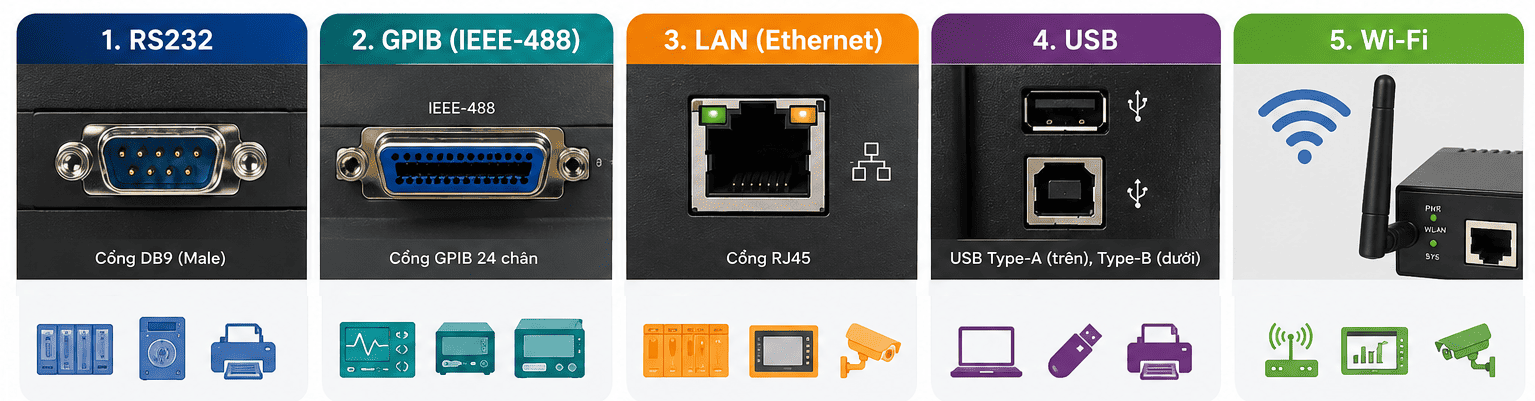
RS232
RS232 is a simple serial communication option. It can be implemented with a standard null or straight serial cable, depending on the equipment requirements. The cable cost is low, which makes it practical in some setups.
At the same time, RS232 has limits. Its transmission speed is slow, and it is not suitable for long-distance communication. Consumer PCs have gradually removed this interface, so it is now used more often in industrial computers and certain communication equipment.
GPIB
GPIB is designed to connect multiple instruments and build an automatic test system. Its best-known advantage is the ability to link a number of devices on one bus, which is useful in laboratory and production environments.
However, the communication rate is low and it is commonly used for control commands rather than high-speed data transfer. Ordinary PCs and IPCs do not commonly include GPIB, so a dedicated control card and drivers are usually needed before communication can begin.
LAN
LAN, commonly known as Ethernet, is widely embedded in modern equipment. It supports flexible networking, multi-point communication, and high-speed transmission. When routers or switches are used, transmission distance is not limited in the same way as direct point-to-point links.
In instrument and system integration work, many engineers choose LAN for controlling instruments through the network port. It is often the recommended option when a system needs stable networking and scalable device control.
USB
USB is one of the most commonly used interfaces for connecting computers and devices. It can support communication and power supply at the same time, which makes it very practical in many setups.
USB is available in several versions, including USB 1.0, USB 2.0, and USB 3.0. It also supports different protocol types depending on the application, such as device-to-PC communication or mass storage. In instruments, the standard A and B type plugs and sockets are the most common connector style.
Wi-Fi
Wi-Fi provides wireless communication without a physical line connection and is characterized by fast transmission speed. Many instruments and devices now include built-in Wi-Fi interfaces based on 802.11 wireless networking.
Devices can connect through a wireless router or a smartphone Wi-Fi hotspot. They can also connect directly in AP mode, which allows communication without needing an external Wi-Fi network.
OWON notes that the XDS series oscilloscope is available with Wi-Fi communication as an option and supports Wi-Fi AP and Wi-Fi STA modes. According to the source material, these interfaces allow real-time control and waveform display through an app or software, and they can support a device control system managed through OWON software.
How to choose the right interface
The right interface depends on the communication needs of the application.
- If high communication speed is not required, long-distance communication is not needed, and there is only one host and one instrument, a serial port can allow measuring to start more quickly.
- If you need to connect a calibration source, signal generator, and other instruments at the same time, and they all provide GPIB interfaces, switching the device to GPIB can help form a small network.
- If you want a flexible and commonly recommended connection method, Ethernet is a practical choice. Short-range communication can be handled by directly connecting a twisted pair to an IPC or laptop, while longer-distance communication can be supported with a switch to control multiple instruments from one host.
Practical takeaway
There is no single interface that fits every application. RS232 is simple and low cost, GPIB is useful for multi-instrument test setups, LAN is strong for networked control, USB is convenient for general device connection, and Wi-Fi adds wireless flexibility. The best choice depends on the equipment, the required distance, the control method, and the overall system layout.
For industrial communication and electronics manufacturing environments, understanding these differences helps teams build systems that are easier to control, expand, and maintain.
The source article positions OWON’s communication options in the context of instrument control and waveform viewing. That makes the guide especially relevant for users evaluating interfaces for test and measurement workflows, where operational convenience and system integration matter as much as the connection itself.