Is my rooftop installation safe, or would it ignite a fire and burn my house? Is my ground installation properly done, or will a fire destroy my investment? Can I sleep loudly or should I worry? Probably most of the owners of PV systems have these doubts.
Solar energy is electric power, and as any electric power, it can be unsafe. A primary cause of solar PV fires is electrical arcing occurring anytime there is a compromise of the electrical system's wiring or connections. The risk for arcs to occur increases over time. This can be attributed to the normal “wear and tear” that a solar PV system is subjected to, making system maintenance a priority. There are many factors that contribute to this condition:
- Corroded cables and connections (cables rubbing against vegetation or roof, birds/rats/insects, saltiness);
- Loose wiring;
- Improper cable support;
- Etc.
IEC/EN 62446 requires the installation to be tested and certified by qualified solar installers. Only professional licensed solar installers using the right measuring instruments can grant the PV installation to be fully complying with the safety guidelines, so safe.
At the beginning of the PV era, the array output voltage used to be up to 600V DC. This benchmark was replaced by 1,000V DC about a decade ago. Now it is surpassed by the new standard 1,500V DC. Voltage increases to higher values, such as 2,000V DC, are unlikely due to the significant cost to develop products specifically designed for high-voltage use. In fact, the IEC considers 1,500V as the low-voltage limit.
1,500V DC systems are the present and the future
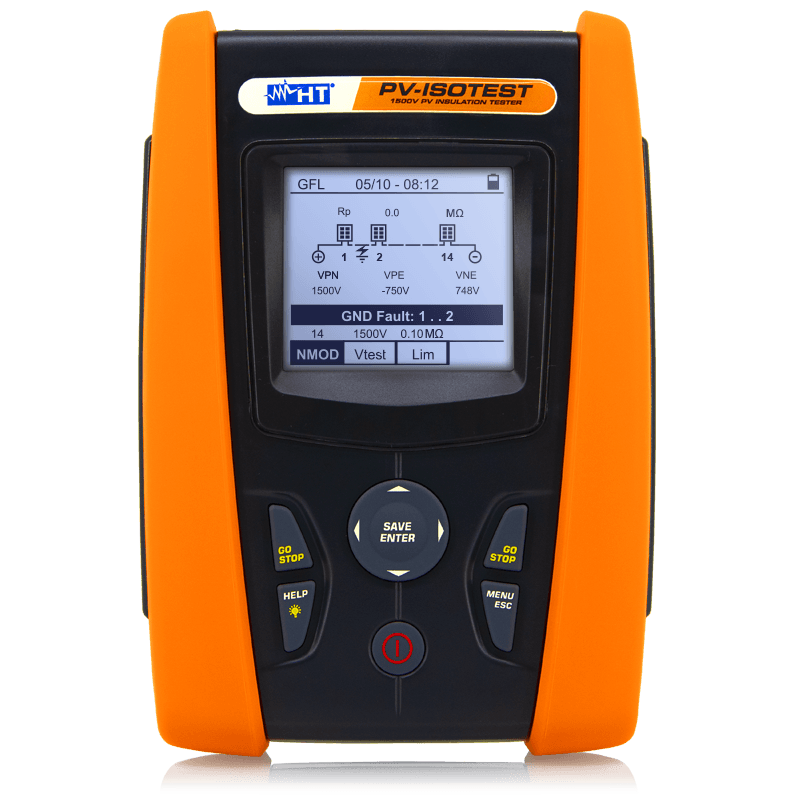
HT is proud and honored to introduce PV-ISOTEST is the first and only solar installation tester specifically designed to test the safety of PV installations up to 1,500V. According to IEC/EN 62446, PV-ISOTEST measures the insulation resistance of the whole installation at once by generating up to 1,500V DC, and by withstanding the voltage generated by the installation under test, regardless of its dimension and power generated. This means no need for external devices such as expensive DC-rated switches, the safety of the user while carrying out measurements, no need to section combiner boxes to perform the test string by string, so lots of time saved. PV-ISOTEST also measures polarization index (PI) and dielectric absorption ratio (DAR) to assess the quality of the insulation. PI and DAR are particularly important when measuring the insulation of long cables in operation for many years. In fact, the insulation resistance value may change over the years due to electrical and mechanical stresses, creating an increase in leakage currents. PI is a ratio of the megohms after 10 minutes divided by the megohms after 1 minute, DAR is the ratio of the megohms at 1 minute divided by the megohms at 30 seconds. High values of PI and DAR mean good or even excellent insulation conditions.
To cut troubleshooting time, PV-ISOTEST is provided with an innovative Ground Fault Locator function, indicating the user which module has a poor insulation to the ground across the string tested. This allows the user to immediately identify the poorly insulated module for further replacement.
PV-ISOTEST also measures the continuity of the protective/equipotential conductor, as required by IEC/EN 62446.
These features make PV-ISOTEST the first and only solar installation tester able to test the safety of PV installations up to 1,500V. PV-ISOTEST beats the (unexisting) competition, another must have made by HT for every professional PV installer.
More information about PV-ISOTEST is available here Several video tutorials are available on YouTube