For full functionality of this site it is necessary to enable JavaScript.
EMIN.VN
0

What Is Amplification? How Does It Support Spectrum Analysis and Radio Frequency?

2025年11月25日 16時14分24秒

Have you ever wondered how tiny signals can be boosted to power a wide range of modern electronic devices? Power amplification helps you understand how signals are utilized in the fields of spectrum analysis and radio frequency (RF).


Amplification technique in signal processing

Amplification is the process of increasing the amplitude of an electronic signal without losing its fundamental properties. This allows the signal to retain its original content while having a larger amplitude, making it easier to process, transmit, or measure. The Power amplifier TekBox TBLNA-110M-50 enables weak signals to be amplified to levels more easily handled by spectrum analyzers or radio receivers.

A key aspect of amplification is balancing signal boost with limiting added noise. The DC-Coupled technology in the TekBox TBLNA-110M-50 reduces input noise, preserving the amplified signal's near-original state. This is crucial in spectrum analysis for accurately identifying frequency components in the signal. DC-coupled amplifiers inherently reduce low-frequency noise and offset, improving signal fidelity as compared to AC-coupled approaches, which can introduce capacitive coupling limitations or increased complexity.
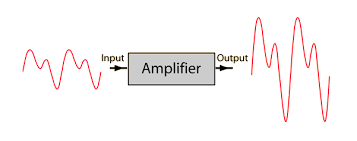
Amplification technique

How to support for amplification in spectrum analysis and radio frequency

In spectrum analysis systems or radio frequency measuring devices, amplification is not merely increasing signal amplitude but also helps measure and analyze very low-level signals. Amplifiers raise small signals to a level where measurement devices like spectrum analyzers can accurately read and analyze them. This is particularly useful for analyzing frequency components in radio waves, allowing detection of weak signals that are masked or unwanted frequency interferences.

Moreover, amplification in spectrum analysis circuits helps detect and measure harmonic distortion and intermodulation, thus improving the performance of radio systems and transmission.

Power amplifier TekBox TBLNA-110M-50

Conclusion

Amplification is the process of boosting signal amplitude to help weak signals become strong enough for accurate processing and analysis, especially important in spectrum analysis and radio frequency. This technique not only strengthens the signal but also preserves fidelity, enabling detection of weak signals and unwanted noise, thereby improving signal transmission quality and measurement reliability.

相关新闻

Application of Thermal Imaging Technology in Electrical System Diagnostics and Troubleshooting
2026年10月03日 09時41分48秒

In industrial plant operations and energy infrastructure, issues such as overload, short circuits, or performance degradation frequently stem from increased contact resistance, material wear, or electromechanical anomalies. The application of thermal imaging cameras allows for non-contact infrared radiation measurement, converting thermal energy into an intuitive color map to detect anomalies early while the system is operating under load.

 61 Diagnosing and Eliminating Vibration to Extend Machinery Lifespan
2026年10月02日 16時40分40秒

Loosening or wear never happens overnight; it always stems from minor degradations over time. If the maintenance team waits until mechanical noise is emitted or bearings overheat before intervening, the production line already faces the risk of unexpected downtime and massive repair costs.

Decoding and Resolving Power Quality Issues
2026年10月02日 16時08分19秒

Continuous operation pressure in modern manufacturing plants places severe demands on low-voltage power distribution systems. The dense presence of non-linear loads—such as large variable frequency drives (VFDs), electric arc furnaces, and power converters—generates complex distorted currents.

获取优惠更新

获取专属批量折扣、批发价格更新和新产品通知,直接发送到您的邮箱。

订阅即表示您同意我们的服务条款和隐私政策。

快速支持

直接联系认证专家