The causes of performance degradation are not recorded quantitatively
A slight drop in flow rate, fluctuating pressure, or an abnormal increase in power consumption does not necessarily stem from the pump impeller or the piping; the cause often lies in the shaft's rotational speed.
A reduction in speed of just a few dozen revolutions per minute (RPM) below the design specification can significantly alter pump efficiency a difference that is often imperceptible to the naked eye or undetectable by the sound of the motor alone. Consequently, RPM measurement is a standard procedure in pump maintenance for factories, water supply stations, and HVAC systems.
The significance of the RPM parameter when comparing drive systems
Beyond simply indicating whether the shaft is rotating quickly or slowly, comparing the RPM reading against manufacturer specifications reveals whether the motor is achieving its rated speed, whether belts or couplings are slipping, if the gearbox is maintaining the correct gear ratio, if the variable frequency drive (VFD) is outputting the set frequency, and whether the pump is operating at its design duty point.
A drop in speed while the load remains constant is a signal that the entire drive system should be inspected before a major failure occurs.
Refer to the following for more details: Does Measuring RPM Help Calculate Conveyor Belt Speed (m/min)?
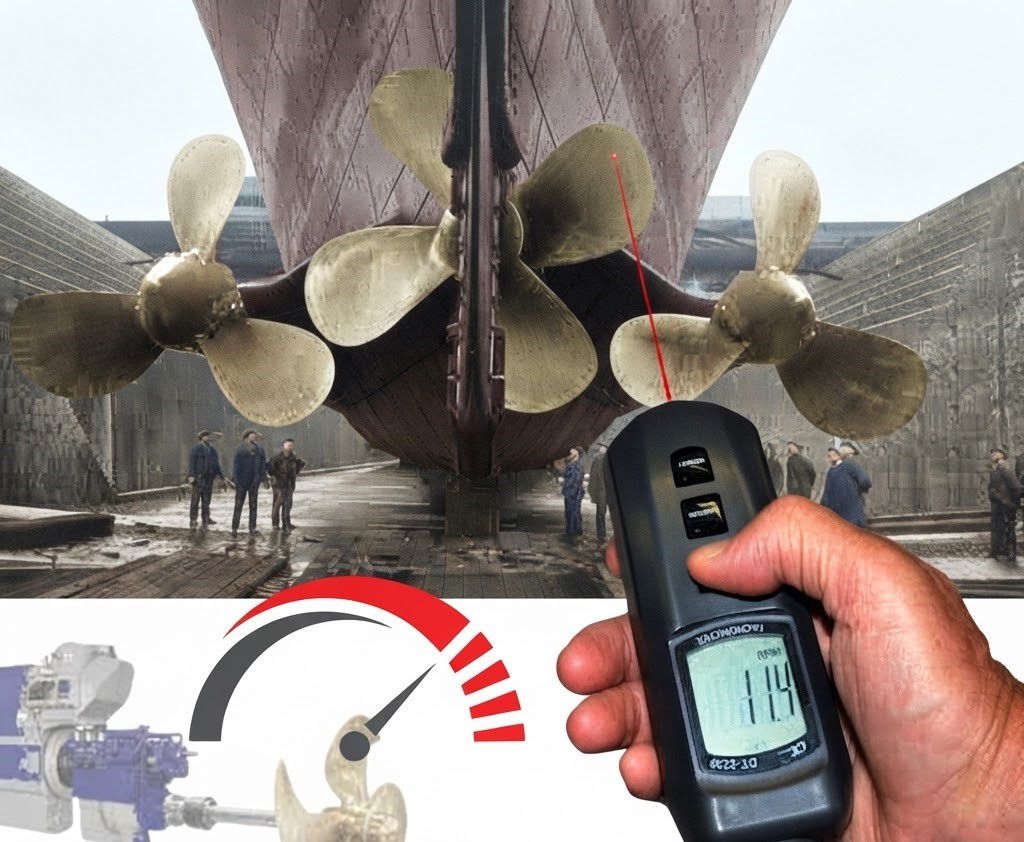
Common methods for measuring pump shaft speed
Laser measurement (non-contact) is the most widely used method. A small piece of reflective tape is applied to the shaft or coupling; the device emits a laser beam and captures the reflected signal to calculate revolutions per minute (RPM). Since it does not require physical contact with the rotating component, this method is safe and particularly suitable for high-power or high-speed pumps. Many tachometer models from brands like Extech, Lutron, and Testo support this mode.
Contact measurement is used when laser access is obstructed. In situations where the shaft is hidden or ambient light is too intense for the laser to function effectively, a rubber tip or pointed probe is attached to the device and placed directly against the center of the rotating shaft. While highly accurate, this method should only be used when there is sufficient clearance to operate safely.
Stroboscopic measurement is a non-contact method that requires no reflective tape. The principle behind the stroboscope is fascinating: when the light's flashing frequency matches the shaft's rotational speed, the shaft appears stationary to the observer. By reading the frequency displayed on the device, the RPM can be determined without the need for reflective tape or physical contact with the machine. This is a common choice for production lines where operations cannot be halted for inspection.
Comparison of laser measurement and contact measurement
Laser measurement is suitable when the shaft is easily accessible and reflective tape can be applied, as it offers rapid measurement and minimal risk. Contact-based probes are better suited for locations that are difficult to view or where a laser beam cannot be projected. Some modern models integrate both modes into a single device.
Measure pump shaft speed without stopping the machine
Laser tachometers enable measurements to be taken without stopping the machinery. By simply applying reflective tape and taking readings from a safe distance, operators can perform measurements without dismantling drive assemblies or cutting power, allowing the production line to continue running normally throughout the process. This is why non-contact methods are increasingly favored in predictive maintenance.
Criteria for selecting a tachometer
Key factors to consider when selecting a device include: support for both laser and contact measurement; an RPM range compatible with the pump's operating speed; a laser measurement distance suited to actual workplace conditions; data storage capabilities for periodic monitoring; and included accessories such as rubber tips, pointed tips, and reflective tape. For routine inspections involving motors, fans, compressors, and pumps, a device integrating both measurement modes offers greater convenience than one limited to a single method.
EMIN offers a wide range of tachometers for industrial pump maintenance and inspection, spanning non-contact laser models, contact models, and combination units. Depending on the rotational speed, installation location, and operating conditions of specific pump systems, EMIN’s technical team can recommend the optimal solution to ensure measurements are fast, accurate, and safe.