Medical protective clothing testing helps manufacturers, laboratories, and quality teams assess whether a garment’s construction and material characteristics align with its intended application. Protective garments may be used in routine medical work, surgical settings, patient-contact situations, emergency response, or designated areas. Because uses differ, testing should begin with a clear definition of the garment type, material, construction, and required performance criteria.
What is included in medical protective clothing testing?
Medical protective clothing can be categorized by use, service life, and material. Examples include daily work garments, surgical clothing, isolation clothing, and protective clothing for emergency or special-area use. Products may also be disposable or reusable, and made from woven or nonwoven materials.
These distinctions matter because they affect the evaluation plan. A quality-control review can first confirm the product’s stated structure, model, and specification. It can then examine the garment and its material for the performance properties relevant to the intended protective function. A complete assessment is not limited to a single test: it combines visual inspection, material measurements, and, where applicable, hygiene-related indicators.
Appearance, construction, and specification checks
Appearance quality inspection is a basic starting point. Protective clothing should be dry, clean, and free of mildew. The surface can be checked for visible defects such as adhesion, cracks, holes, or other damage that could affect use or handling.
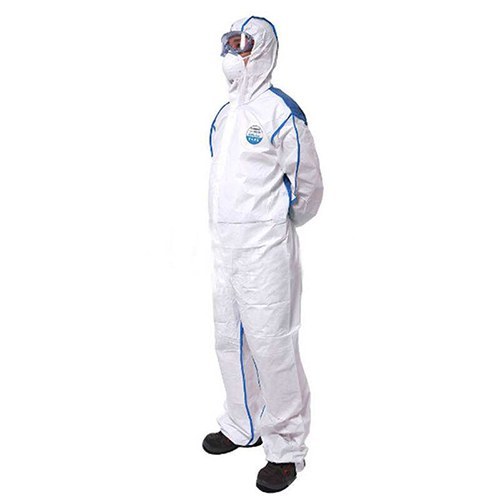
Construction review verifies whether the product matches its defined structure and specification. Medical protective clothing may include a hooded top and pants, and production can involve cutting, stitching, elastic application, and bonding. Examining seams, joins, closures, and elasticized areas helps identify whether the finished garment is consistently assembled. This step also provides context for later performance testing, since a material result alone may not describe the integrity of the finished item.
Liquid barrier properties
Liquid barrier properties are among the central areas in medical protective clothing testing. The source evaluation items include resistance to seepage, drenching capacity, resistance to synthetic blood penetration, surface moisture resistance, water impermeability, moisture penetration, and water level. These assessments address how the material surface and garment barrier respond when exposed to liquid-related conditions.
Testing should distinguish between different kinds of liquid performance rather than treating them as interchangeable. For example, surface moisture resistance concerns how liquid behaves on the exterior surface, while synthetic blood penetration resistance addresses a specific penetration challenge. Water impermeability and moisture-related measurements provide additional information about the material’s barrier behavior. The applicable method and acceptance criteria should be selected according to the product’s intended use and relevant requirements.
Mechanical strength and filtration evaluation
Breaking strength and elongation at break are used to evaluate how a material responds to tensile loading and extension before failure. These properties can support an assessment of material robustness during wear, handling, and garment production. Results should be interpreted together, as strength and elongation describe different aspects of mechanical behavior.
Filtration efficiency is another listed testing item. When this characteristic is applicable to the protective clothing design or material, it can be included in the evaluation plan alongside barrier and mechanical tests. Recording the sample identity, conditioning approach, test method, and observed results supports traceability and makes it easier to compare batches under a consistent procedure.
Flame retardancy and electrostatic properties
Flame retardant performance may be evaluated where the garment’s use environment calls for this consideration. Antistatic performance and static decay performance are also listed as protective clothing test items. These evaluations address electrostatic behavior, which should be considered separately from liquid resistance or tensile properties.
A practical quality-control program defines which of these characteristics are relevant before samples are tested. This avoids applying a broad checklist without regard to the garment’s intended application. It also helps laboratories document why each test was selected and how results will be reviewed.
Skin irritation, microbiological indicators, and residue
Additional evaluation areas can include skin irritation, microbiological indicators, and ethylene oxide residue. The listed microbiological indicators include total bacterial colony count, coliforms, Pseudomonas aeruginosa, Staphylococcus aureus, hemolytic streptococcus, and total fungal colony count. These items focus on cleanliness, biological control, or residual substances rather than the physical strength of the material.
For reliable medical protective clothing testing, organizations can use a structured sequence: identify the garment category and specification; inspect appearance and construction; select barrier, mechanical, filtration, flame, and electrostatic tests as applicable; then include skin, microbiological, or residue evaluations when required. This approach creates a clearer record of product quality and supports consistent inspection decisions across production batches.