The type of tube is the first parameter that must be determined before selecting a rotor. This is followed by considerations such as rotational speed, centrifugal force (RCF), the number of tubes to be processed in a single run, and temperature control capabilities.
0.2 ml to 2 ml tubes for small-volume biological samples
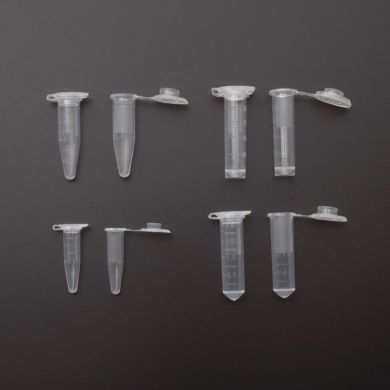
Microcentrifuge tubes come in common capacities of 0.2 ml, 0.5 ml, 1.5 ml, and 2 ml. The 1.5 ml and 2 ml tubes are typically used in DNA/RNA extraction, protein processing, and small-volume sample preparation, whereas 0.2 ml tubes are more commonly associated with PCR procedures.
Small sample volumes allow rotors to achieve high centrifugal forces without requiring a large footprint. The Hettich MIKRO 185 (available at EMIN) accommodates 24 tubes (1.5/2 ml) and reaches a maximum speed of 13,300 rpm. The Hettich MIKRO 220 increases capacity to 60 tubes (1.5/2 ml) and reaches 18,000 rpm.
The DLAB D1524R offers a more flexible configuration, supporting rotors for 24 tubes (1.5/2 ml), 36 tubes (0.5 ml), PCR tubes, and 5 ml tubes, with a maximum speed of 15,000 rpm and a maximum RCF of 21,380 × g. Laboratories specializing in small-volume sample processing should carefully consider the tube capacity per run and the maximum RCF, rather than focusing solely on RPM speed.
5 ml to 15 ml tubes are comonly used for blood, cell, and microbiological samples.
Capacities of 5 ml and 15 ml accommodate sample volumes larger than those of microtubes while still falling within the benchtop centrifuge category. 5 ml tubes are commonly used for biological sample processing and diagnostic testing. 15 ml tubes often referred to as Falcon tubes are widely used in cell culture, microbiology, and the separation of components from liquid samples.
The Hettich EBA 200 (available from EMIN) features an 8-position rotor for 15 ml tubes, a maximum speed of 6,000 rpm, and a maximum RCF of 3,461 × g. The EBA 200S model supports 8 × 15 ml tubes with speeds reaching up to 8,000 rpm.
For laboratories requiring flexibility in tube types based on specific protocols, the HERMLE Z 207 A is an excellent option; its compatible rotors and adapters allow the unit to process a wide range of tube sizes, including 1.5/2 ml, 5 ml, 7 ml, 15 ml, and 50 ml.
50 ml tube for larger sample volumes
50 ml tubes are commonly used for cell culture, processing large volumes of biological samples, pellet separation, or procedures requiring the recovery of large sample volumes after centrifugation. Common designs include conical and round bottoms; the appropriate choice depends on the sample type, the method used to collect the pellet, and the rotor being utilized.
The Hettich EBA 280 features a 6 × 50 ml rotor with a maximum speed of 6,000 rpm. The HERMLE Z 207 A also offers a 6 × 50 ml rotor configuration, with a maximum RCF of 4,427 × g. For centrifuges equipped with versatile adapter systems, a single rotor can accommodate various tube types; for instance, the DLAB A6 50P rotor can hold either six 50 ml tubes or six 15 ml tubes.
The specific type of tube required should be determined before selecting a rotor, as tubes with the same 50 ml capacity can still differ in bottom design and actual dimensions.
100 ml – 300 ml tubes for workflows requiring the processing of larger sample volumes
As sample volumes increase, 100 ml, 200 ml, or 300 ml tubes become more suitable for processes requiring the handling of large sample quantities in a single batch. The Hettich ROTOFIX 32 A supports a 4 × 100 ml configuration, while the Hettich UNIVERSAL 320 and UNIVERSAL 320R can accommodate a 4 × 200 ml rotor.
For even greater capacity requirements, the LabTech 1696R II can utilize either a 6 × 250 ml fixed-angle rotor or a 4 × 1,000 ml swing-out rotor, depending on the configuration. Larger capacities are typically associated with larger rotor radii; consequently, when comparing two centrifuges operating at the same RPM, the generated RCF values can differ significantly.
Ultracentrifuge tubes for separations requiring extremely high RCF
Ultracentrifuge tubes are specialized consumables typically used for separating viruses, organelles, proteins, or DNA fragments.
While capacities generally range from a few milliliters to several tens of milliliters, the ability to withstand centrifugal force is the most critical factor. Tube material, rotor design, RCF limits, and sample characteristics must all be considered when making a selection.
When processing sensitive biological samples, it is also important to account for the heat generated during high-speed operation. The article "Why do brushless centrifuges generate less heat?" provides a detailed analysis of the role of BLDC motors in reducing friction and minimizing heat accumulation around the drive system.
Should you choose the machine based on the type of pipe being used, or choose the pipe based on the machine?
Since the laboratory already has established protocols and specific tube types, it is best to start with the tubes currently in use. From there, the operator can determine the compatible rotor, the number of tubes per run, and the required RCF.
Processing a variety of sample types requires a more flexible configuration. The HERMLE Z 206 A is an ideal choice for laboratories that frequently switch between 1.5/2 ml, 5 ml, 15 ml, and 50 ml tubes by using the appropriate rotors and adapters. For protocols requiring high centrifugal force, RPM should not be considered the sole parameter; at the same speed of 10,000 rpm, two rotors with different radii will generate different RCF values. Therefore, the RCF value typically provides a more accurate indication of the force exerted on the sample.
Select a centrifuge suitable for the type of tube being used
The tube type determines the rotor, while the rotor dictates the capacity, sample quantity, and achievable RCF range. Therefore, selecting a centrifuge should begin with your specific workflow requirements rather than simply seeking the device with the highest specifications.
EMIN offers centrifuge models compatible with a wide range of tube sizes from 0.2 ml, 1.5/2 ml, 5 ml, 15 ml, and 50 ml up to large-capacity rotors. When selecting equipment, you can provide details such as the tube type, sample volume, number of tubes per run, and desired RCF or RPM to identify the appropriate rotor configuration.