A common source of confusion is that both scales yield results ranging from 0 to 100. Based on the numerical values alone, one might assume that 80A and 30D differ merely in their degree of hardness. However, this interpretation is incomplete, as the two scales utilize different indenters and applied forces.
Consider a rubber gasket as an example: the surface compresses noticeably under the indenter, making the Shore A scale suitable for assessing the material's hardness. If the same measurement method were applied to a rigid engineering plastic, the indentation would be minimal, and the result would fail to accurately reflect the material's relevant properties. This is precisely why the Shore D scale is better suited for harder materials.
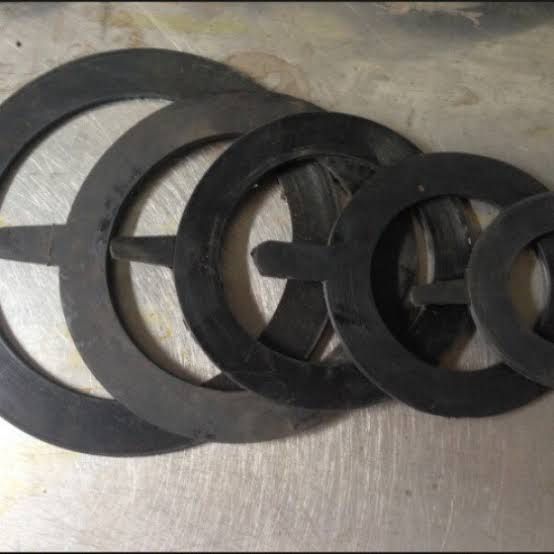
Shore A is commonly used to measure rubber, silicone, and elastomeric materials
The Shore A scale is widely used in the manufacturing of rubber, soft plastics, and products that must retain their elasticity after being subjected to force.
Common materials include:
+ Soft rubber
+ Rubber gaskets and seals
+ Silicone
+ Rubber belts
+ Rubber bands
+ Soft PVC
+ Various other elastomeric materials
The Shore A scale ranges from 0A to 100A. The higher the value, the more resistant the surface is to indentation by the measuring probe.
For instance, consider two types of rubber used for gaskets: one rated at 50 Shore A and the other at 70 Shore A. These materials will feel different in terms of hardness when compressed, stretched, or installed in a sealing application. Consequently, the measured value serves as a benchmark for verifying whether the material meets the product's specifications.
Shore D is for harder materials
A piece of rigid plastic feels completely different from soft rubber; when the indenter makes contact with the surface, the resulting deformation is minimal. This is precisely the category of materials for which the Shore D scale is designed.
Some common examples include:
+ Rigid PVC
+ PE
+ PP
+ PA
+ POM
+ Engineering plastics
+ Plastic wheels
+ Rigid plastic pipes
The Shore D scale also ranges from 0D to 100D. The difference lies in the design of the indenter and the applied force: the Shore D indenter is shaped for hard surfaces and exerts greater pressure than the Shore A indenter. Simply put, Shore A is used for materials that undergo noticeable compression, whereas Shore D is intended for materials that are more resistant to deformation.
Articles on Hardness:
How Do Rockwell, Brinell, and Vickers Differ? Choosing the Right Hardness Testing Method
Surface Hardness Testing with Novotest Technology
How do Shore A and Shore D probes differ?
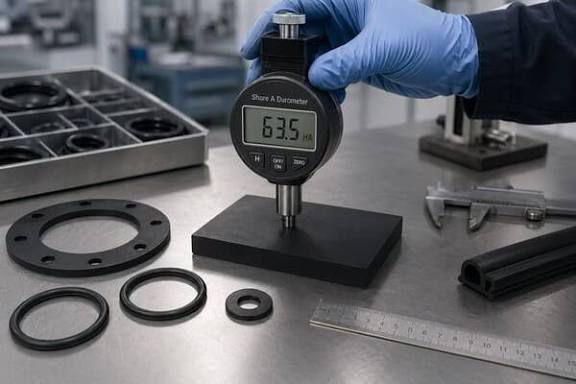
This is the key factor distinguishing the two measurement methods. The Shore A indenter is shaped to interact with soft, elastic materials; when placed against a rubber or silicone surface, it creates a specific degree of indentation, which the device uses to determine the hardness value.
In contrast, the Shore D method employs a sharper indenter combined with greater applied force. This configuration ensures a distinct response when testing harder materials cases where the Shore A method would be unsuitable.
Consequently, applying different scales to the same material can yield vastly different interpretations. To obtain meaningful test results, one must first identify the material category and determine which scale applies to the relevant technical specifications.
What is 95 Shore A equivalent to on the Shore D scale?
This is a common question when measurement results fall near the upper end of the Shore A scale.
The two scales have an overlapping range of values; certain materials exhibiting very high Shore A hardness may fall within the lower range of the Shore D scale. However, there is no fixed formula for converting Shore A values to Shore D.
This is due to the specific characteristics of the materials involved. Two samples with identical Shore A hardness ratings do not necessarily behave the same way when subjected to a Shore D indenter.
If technical specifications require results in Shore D, the most appropriate approach is to measure directly using Shore D equipment. This ensures the results accurately reflect the testing method mandated by the standard or technical documentation.
Why might the same type of plastic require two different measurement methods?
Flexible PVC used for cables, hoses, or coatings possesses properties quite distinct from rigid PVC, which is used for pipes, sheets, or technical components. Similarly, certain high-hardness rubber grades may approach the range where the Shore D scale becomes more appropriate.
Consequently, when receiving a new material sample, technicians often need to review information regarding the material type, product specifications, and testing standards before commencing measurements.
This step is particularly crucial for quality control (QC) when comparing the hardness of different batches. If a previous batch was tested using the Shore A scale while a subsequent one used Shore D, the resulting values cannot simply be compared side-by-side to determine which batch is harder.
When should Shore A be used, and when should Shore D be used?

What is the difference between Shore A and Shore D hardness testers?
At first glance, the different models appear quite similar, but the probe at the base of the device is designed for two distinct groups of materials. If the work primarily involves rubber, silicone, gaskets, or elastomeric materials, a Shore A durometer is the more suitable choice.
For samples made of rigid plastics, engineering plastics, or other high-hardness materials, a Shore D durometer should be used.
If a workshop needs to test a variety of materials, it is worth considering acquiring both scales to ensure each sample is tested using the appropriate method. This approach also facilitates the QC department's task of comparing results against the technical specifications for each product.