Multi-Loop Controllers
Coordinating several temperature or process points from one device can simplify panel design, reduce wiring complexity, and make everyday operation easier for maintenance and production teams. In applications such as ovens, thermal processing lines, environmental chambers, and multi-zone equipment, Multi-Loop Controllers are often chosen when a single control point is no longer enough.
On this page, you can explore controllers designed for handling multiple inputs or zones while supporting common industrial signal types. These products are relevant for users who need centralized monitoring, repeatable control logic, and a practical way to scale from a simple process panel to a more structured control architecture.
Where multi-loop controllers fit in industrial control
A multi-loop controller is used when several related variables must be tracked or managed together instead of through separate standalone instruments. This is common in equipment with multiple heating zones, several sensor points, or staged process steps where operators benefit from seeing multiple channels in one place.
Compared with single-loop devices, this approach can improve visibility across the process and support more consistent operation. If your application only needs one control loop, a dedicated PID controller may be more appropriate, while systems with several zones often benefit from a consolidated multi-channel solution.
Typical applications and control scenarios
These controllers are commonly considered for multi-zone temperature control, ramp-and-soak profiles, and process monitoring across several sensor locations. Examples include heat treatment equipment, plastics processing, packaging machinery, test systems, and laboratory setups where multiple channels must be reviewed together.
Some applications focus mainly on display and sequencing, while others require active output control, alarm handling, or communication with a supervisory system. In broader machine architectures, multi-loop devices may work alongside items such as a limit controller for additional over-temperature protection or shutdown logic.
Input flexibility matters in real installations
One of the main selection criteria is input compatibility. Many industrial users need support for thermocouples, RTDs, DC voltage, or current signals because real-world systems often combine temperature sensing with process transmitters or analog references.
Several featured models from Dwyer illustrate this well, with universal input support for thermocouple, RTD, voltage, and current signals in a DIN rail format. This type of flexibility can reduce the need to standardize every field device around one sensor technology, which is especially useful during retrofits or phased upgrades.
Examples from the featured product range
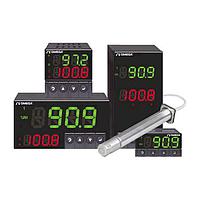
The Dwyer SCD series shown here includes compact DIN rail PID temp/process controllers with RS-485 Modbus ASCII/RTU communication and different output styles. Within that family, models such as the SCD-1033 and SCD-2033 use relay-based output arrangements, while versions like the SCD-1053 or SCD-2053 provide current output options, and the SCD-1063 or SCD-2063 offer linear voltage output configurations.
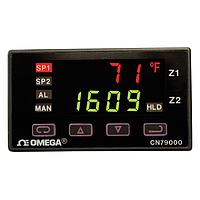
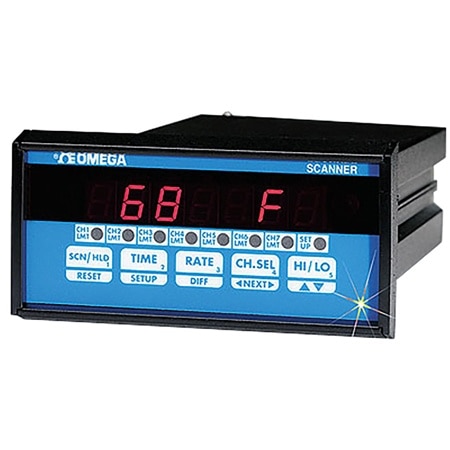
For applications centered on multiple zones and programmable profiles, selected OMEGA controllers in the CN1504 and CN1507 series provide 4-channel or 7-channel capability with ramp-and-soak functionality. Models such as the CN1504TH-2 and CN1507TH-2 are particularly relevant where several temperature points need to be followed in a coordinated sequence rather than as isolated measurements.
How to choose the right multi-loop controller
Start with the number of channels or zones you need today, then leave room for future expansion if the process is likely to grow. A 4-channel unit may suit compact equipment, while a 7-channel controller can be a better fit for larger thermal systems or test rigs with multiple measurement points.
Next, check the required signal types, output method, mounting style, and supply power. Some installations need relay outputs for simple switching, while others require analog current or voltage output for interfacing with drives, actuators, or downstream control hardware. DIN rail mounting may be ideal inside a control cabinet, whereas 1/8 DIN panel instruments are often preferred where front-panel visibility is important.
Communication is another important factor. If the controller needs to exchange data with a PLC, HMI, or SCADA environment, serial communication support such as RS-485 Modbus can be valuable. In more distributed control panels, it may also make sense to review related hardware such as a control enclosure to support layout, protection, and cable management.
Output types and control strategy
Not every multi-loop setup uses the same control method. Some processes are best served by relay switching, particularly in straightforward heating applications with discrete outputs. Others need analog current or voltage signals for tighter integration with proportional devices or external control elements.
There are also cases where the controller is used more for sequencing, display, or profile management than for direct final control. For example, ramp-and-soak controllers can help manage staged heating or testing recipes across multiple channels. Understanding whether you need direct loop control, supervisory coordination, or both will narrow the selection quickly.
Integration, maintenance, and long-term usability
For B2B buyers, controller selection is rarely only about channel count. Long-term usability depends on how easily the device can be wired, commissioned, documented, and serviced. Universal input capability, non-volatile memory backup, and familiar industrial communication protocols can all support easier maintenance over the life of the system.
It is also worth considering how the controller will fit into the wider control scheme. In some projects, a multi-loop unit becomes the central point for several related zones; in others, it complements separate devices such as pump control, alarm handling, or dedicated protection functions. The best choice is the one that matches the process layout rather than forcing the process to fit the instrument.
Finding a controller that matches your process
This category brings together solutions for users who need to monitor or manage several process points from a more centralized platform. Whether the priority is multi-zone temperature control, ramp-and-soak sequencing, DIN rail integration, or flexible analog and sensor input handling, the available range supports a variety of industrial panel and machine designs.
When comparing options, focus on channel count, input compatibility, output type, mounting format, and communication requirements. That approach will help you identify a multi-loop controller that fits the application cleanly today while remaining practical to support as your system evolves.
Get exclusive volume discounts, bulk pricing updates, and new product alerts delivered directly to your inbox.
By subscribing, you agree to our Terms of Service and Privacy Policy.
Direct access to our certified experts