Pump Controllers
Reliable level control is essential anywhere pumps are used to fill, drain, transfer, or protect tanks, pits, and process vessels. In many systems, the controller is the decision-making layer between the level signal and the pump output, helping operators automate start/stop sequences, alternate duty pumps, and respond to alarm conditions with more consistency than manual switching.
Pump controllers in this category are suited for industrial and commercial applications where stable pump operation, clear status indication, and integration with transmitter signals matter. They are commonly selected for level-based pump control in water, wastewater, sump, lift station, and general process environments where both single-pump and dual-pump logic may be required.
What pump controllers do in a level control system
A pump controller receives an input from a level device or transmitter, compares that signal to the configured control points, and switches one or more outputs to operate the pump. This allows the system to maintain a target level range while reducing unnecessary cycling and improving repeatability.
Depending on the application, the controller may also provide alarm outputs, local display, relay logic, or communication capability for supervisory monitoring. In more advanced setups, this makes it easier to connect level management with broader control enclosure designs and plant automation workflows.
Common configurations in this category
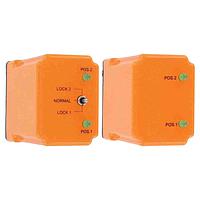
This category includes both flexible level controllers and duplex pump controllers. Flexible models are useful when the control scheme needs to work with transmitter-based inputs such as current or voltage signals, while duplex controllers are often chosen for systems that alternate between two pumps to balance runtime and extend service life.
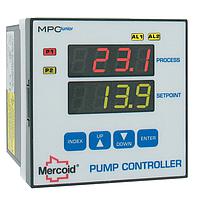
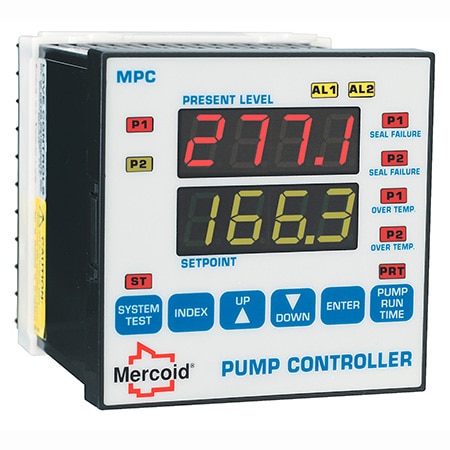
Examples from Dwyer include the MPC series for transmitter-driven level control and the DPC series for duplexing applications. Models such as the Dwyer MPC-485, MPC-232, and MPC Flexible Pump Controller support common analog input types, while Dwyer DPC-ACS and DPC-CCL focus on auto sequencing and active output indication for dual-pump arrangements.
Key selection points before you choose
The first step is to confirm the input signal type used by the level measurement device. In this category, several controllers are designed to accept 4 to 20 mA and 0 to 10 Vdc signals, which are standard in industrial level instrumentation. Matching the controller to the transmitter output avoids integration issues and helps maintain expected control accuracy.
Next, review the output and operating logic. Some applications only need simple on/off control for one pump, while others require duplexing, alternating duty, high-level alarm, or reverse/direct acting behavior. For more specialized process strategies, users comparing options may also want to review related products such as limit controllers or PID controllers where the control objective differs from straightforward pump sequencing.
Signal handling, communication, and local visibility
Many pump control applications now require more than relay switching alone. Several products in this range include LED displays for quick local reading of process values and status, which can be useful for setup, troubleshooting, and day-to-day checks in the field.
Some models also provide serial communication options such as RS485 or RS232 with Modbus support. That can be valuable when pump status or level data needs to be shared with a PLC, HMI, or remote monitoring platform. For example, Dwyer MPC-485 and MPCJR-485 variants support communication-oriented installations, while non-communication versions may be sufficient where standalone panel control is the priority.
Single-pump and dual-pump use cases
Single-pump control is often enough for basic tank filling, sump emptying, or transfer duties. In these applications, a controller typically starts the pump at one threshold and stops it at another, helping maintain the desired operating range with consistent relay action.
Dual-pump systems add flexibility in higher-demand or redundancy-focused installations. Products such as the Dwyer MPCJR series and DPC series are relevant where alternating pump lead/lag operation is needed. Features like duplexing, sequencing, and relay-based status indication can support better pump utilization and reduce uneven wear between units.
Environmental and installation considerations
Industrial pump control devices are often installed in wet, dusty, or washdown-prone areas, so enclosure protection matters. Several featured models in this category are specified with IP66 or UL Type 4X style protection, making them suitable for panel-mounted use in demanding environments when installed correctly.
It is also important to verify supply voltage, mounting format, and available panel space. For example, some controllers in this selection use a 1/4 DIN format for panel integration, while others use an octal-base style mounting approach. These practical details can be just as important as control logic when replacing an existing unit or standardizing a new panel design.
Representative products in this range
For transmitter-based level control, the Dwyer MPC Flexible Pump Controller family provides a useful reference point. Variants such as MPC-485 and MPC-232 pair flexible control behavior with communication options, while the standard MPC version suits applications that do not require a data interface.
For dual-pump level management, the Mercoid-based Dwyer MPCJR line includes options such as MPCJR-485, MPCJR-232, MPCJR-RC-485, and MPCJR-RV-485, covering different signal and communication needs. Where the focus is simpler duplex sequencing, Dwyer DPC-ACS and DPC-CCL offer an alternative approach with relay-based control and LED indication.
Choosing the right controller for long-term operation
The best fit usually depends on how the pump is being controlled, what input signal is available, and whether the site needs local indication, alarms, retransmission, or communication. A straightforward installation may only require dependable relay logic, while a larger monitored system may benefit from display feedback and Modbus-ready connectivity.
By comparing signal compatibility, number of pumps, enclosure requirements, and control strategy, buyers can narrow the selection to controllers that match both the process and the panel design. If your application revolves around level-based pump automation, this Pump Controllers category provides a focused starting point for selecting practical control hardware without adding unnecessary complexity.
Get exclusive volume discounts, bulk pricing updates, and new product alerts delivered directly to your inbox.
By subscribing, you agree to our Terms of Service and Privacy Policy.
Direct access to our certified experts