Amidst the continuous operational rhythm of a factory, rotating equipment such as motors, pumps, blowers, and gearboxes constantly bear harsh mechanical loads. Loosening or wear never happens overnight; it always stems from minor degradations over time. If the maintenance team waits until mechanical noise is emitted or bearings overheat before intervening, the production line already faces the risk of unexpected downtime and massive repair costs.
The key to breaking this reactive loop lies in accurately decoding characteristic vibration frequencies from the early stages.
Eccentricity and Centrifugal Force Corroding Rotating Shafts
Whenever the mass center of a rotating assembly fails to coincide with its kinematic rotational axis, or fan blades accumulate uneven dirt, periodically varying centrifugal forces deal continuous blows to the bearing system. This unbalance phenomenon causes the vibration amplitude to spike right at the fundamental running speed (1×" RPM" ). Concurrently, non-concentric connection between two rotating shafts produces cyclic bending forces, generating characteristic high-energy peaks at higher frequencies.
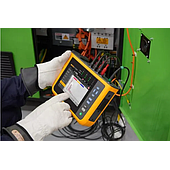
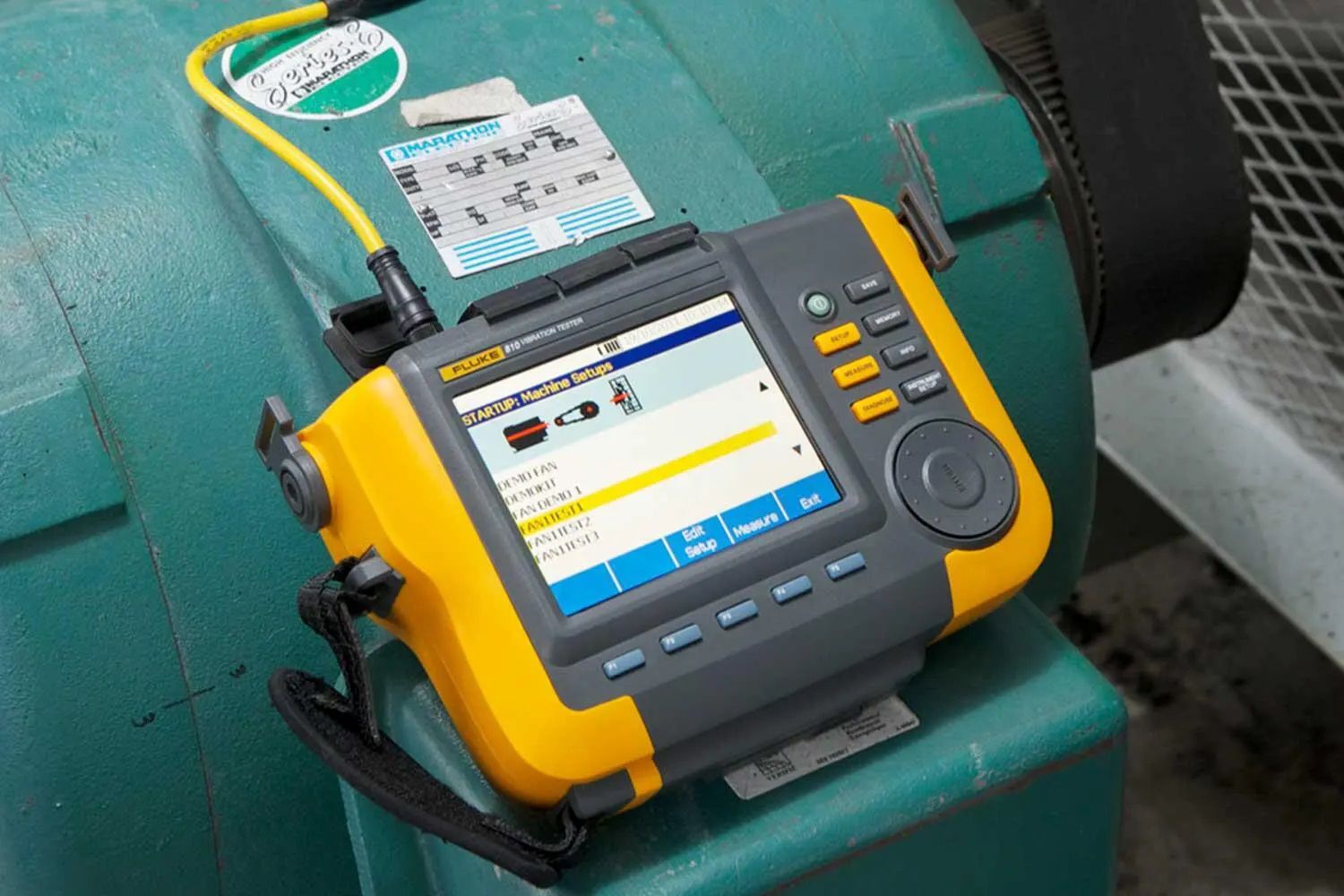
Instead of spending hours analyzing complex FFT spectra, maintenance engineers can entrust this task to the Fluke 810 smart device. The machine's automated diagnostic technology automatically identifies unbalance or misalignment faults, clearly pinpointing the damaged components along with specific corrective guidance. For installation and alignment, the elimination of angular and parallel errors is thoroughly handled by the specialized Fluke 832 laser tool with its intuitive, real-time graphical interface.
Bearing Damage and Loose Base Traps
Rolling element bearings degrading due to a lack of lubrication or hard particle contamination undergo a silent sequence of deterioration. From subsurface micro-cracks emitting high-frequency stress waves, pitting gradually spreads to the raceways and rollers before seizing the entire mechanism. Simultaneously, loose-bolted machine foundations or structural fractures create non-linear impacts, generating a train of harmonics that undermines the structural rigidity of the entire machinery system.
Early localization of these damages requires a measurement solution combining crest factor inspection and impact acceleration. The Fluke 805 FC completely eliminates hand-pressure errors through its proprietary sensor tip, simultaneously measuring overall vibration, bearing condition, and bearing temperature. All parameters are then wirelessly transmitted to mobile devices for historical storage, helping the operations team maintain comprehensive control over the health of the entire mechanical system before risks escalate into major failures.
Complex Challenges: Resonance, Gearboxes, and Belt Drives
Beyond fundamental phenomena, industrial mechanical systems frequently harbor deep technical risks that are easily overlooked during routine inspections:
Mechanical Resonance: Occurs when the machine's excitation frequency accidentally coincides with or approaches the natural frequency of the foundation, piping, or motor housing. With just a small excitation force, the vibration amplitude explodes violently, fracturing support frames in a short time. Engineers typically use impact frequency response testing to identify and shift the natural frequency out of the operating range.
Gear Mesh Faults: In heavy-duty gearboxes, tooth face wear, surface pitting, or tooth root cracking generate cyclic impact pulses according to the gear mesh frequency (GMF). Isolating sideband frequencies on the vibration spectrum helps accurately predict the timing for overhauls prior to catastrophic gear breakage.
Drive Belt Defects: Loose belts, eccentric pulleys, or uneven wear create low-frequency oscillations, causing energy slip, electrical power loss, and localized heat generation at drive shaft assemblies.
=> Register to attend the Seminar to experience Fluke vibration diagnostic equipment firsthand and exchange directly with experts at:
SEMINAR: "Early Detection & Prevention of Plant Failures, Solutions to Ensure Continuous Operation"