For full functionality of this site it is necessary to enable JavaScript.
EMIN.VN
0

How is the measuring tape used correctly?

03/05/2025 11:13:39

Have you ever wondered how to accurately measure the slope, inclination and angle of a building while still ensuring aesthetics? With the water level widely used in architecture and interior design, it has become an indispensable tool in every measurement stage. Based on practical experience and a deep understanding of customer needs, the following article will share how to use the water level correctly, helping to overcome common difficulties when measuring.

Overview of spirit level

The level is known by other names such as level, livo or balance, which can be seen a lot in the mechanical field. This tool helps to check the inclination, slope and deviation angles on many types of works, from construction to interior and exterior design. 

In the activities of measuring and checking deviation angles at works or during interior construction, people often prefer to use level bars (or straight level) and electronic level (also known as electronic angle measuring ruler). In particular, the line of electronic level rulers integrated with laser is always chosen by many technicians and acceptance teams thanks to its outstanding accuracy and convenience.

How to use a spirit level correctly

Since the level rod is the most commonly used type, in this guide, EMIN will focus on how to use a straight level. For other types of levels such as frame levels or electronic levels, the principles of use are similar. 
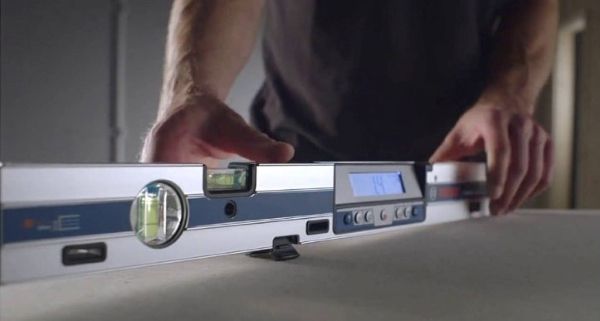
Step 1: Place the level rod on the surface to be measured. If the surface is not flat, the glass tube on the ruler will have one end higher, causing the air bubble to move towards the high end. 

Step 2: Observe the graduations on the ruler body to determine the difference between the two ends. 

Step 3: Read the incline measurement result based on the position of the air bubble relative to the graduations.

How to read a water level correctly

When measuring flatness with a spirit level, people usually gradually adjust by inserting the feeler into the gap, continuing to adjust until the air bubble is almost balanced in the middle of the spirit level tube. Then, the deviation result will be determined based on the thickness of the feeler used. 

If you want to calculate more accurately, you can apply the following method: 

1. Calculate the relative tilt: Assuming the level ruler is 500mm long and has a sensitivity of 0.02mm/m, we calculate as follows: 

- 0.02 x 2 = 0.04mm, meaning that in 1 meter, the difference between the two edges will be 0.04mm. 

2. Calculate the absolute tilt: 

- 0.04 x 0.5 = 0.02mm, meaning that the actual difference on a 500mm long ruler will be 0.02mm.

Refer to the products of the Water ruler at: https://emin.vn/thiet-bi-do-co-khi-nivo-level-do-goc-va-do-thang-nivo-level-thuoc-thuy-155/pc.html?srsltid=AfmBOoqR-zDnFyDicCJ-Pp0urdu9KKsE10LJ7KFa21ZsoR0NBHA6_t8u 

Notes when using a spirit level to ensure durability and accuracy

- Each type of level has a different design, so always read the accompanying instructions carefully to ensure correct operation, avoiding errors that affect the accuracy of the device.

- Avoid dropping the level on a hard surface, as strong impact can damage the water tube or affect the accuracy of the measurement.

- Although some models are water-resistant, you should still limit water contact with the level, especially the electronic components inside.

- If using an electronic level, turn it off when not in use to save battery. If not used for a long time, remove the battery to avoid leakage and damage.


- After each use, clean the level, store in a dry, cool place, avoid areas with high temperature and humidity to prolong the life of the device.


Hopefully with the above notes, you will use the level correctly and achieve the desired accurate measurement results.
Related News

The scent of new wood in a newly handed-over apartment: How to measure and address formaldehyde (HCHO) levels before moving in
11/14/2026 10:28:19

Many people refer to the pungent, acrid odor that emerges when opening a new cabinet as the "smell of new wood," assuming it will simply dissipate after a few days. In reality, however, what is being released could well be formaldehyde—a substance originating from the adhesives used in the pressed-wood panels—and our sense of smell is not a reliable enough gauge to determine the concentration levels present

Guide to Selecting a TCLP Toxicity Characteristic Leaching Procedure Shaker Configuration in Compliance with QCVN 07:2025/BNNMT and TCVN 9239:2012
11/13/2026 17:23:39

Regulation QCVN 07:2025/BNNMT (replacing QCVN 07:2009/BTNMT and QCVN 50:2013/BTNMT) specifies hazardous waste and sludge thresholds based on leachate concentrations. To ensure that analytical results for heavy metals and organic compounds are accepted during ISO/IEC 17025 or VIMCERTS assessments, laboratories must comply with the Toxicity Characteristic Leaching Procedure (TCLP) specified in TCVN 9239:2012, which is equivalent to US EPA Method 1311

Checking the Temperature of Paint and Coating Surfaces After Curing Using an Infrared Thermometer
11/13/2026 16:11:22

An infrared thermometer allows surface temperature measurement without direct contact, making it suitable for products coming out of curing ovens or surfaces that are difficult to access. However, to ensure reliable results for production quality control, it is important to understand the measurement principle and the factors that affect measurements on painted and coated surfaces.

Crowded Gyms and Yoga Studios: How to Manage Air Quality to Retain Members
11/13/2026 15:07:40

Around 6 or 7 in the evening, the gym becomes packed; the music drowns out the sound of heavy breathing, and the air conditioning runs at full blast behind closed doors. At first glance, everything seems fine: the room is cool, the lights are bright, and the equipment is state-of-the-art. Yet, after just a few sessions, regular members begin to feel a heavy-headedness and find themselves running out of breath more quickly eventually, they simply stop renewing their memberships. No one complains about the personal trainers or the exercise machines. The very thing that makes them feel stifled and drives them away is something entirely invisible: the air inside the room

Stay Updated with Offers

Get exclusive volume discounts, bulk pricing updates, and new product alerts delivered directly to your inbox.

By subscribing, you agree to our Terms of Service and Privacy Policy.

Quick Support

Direct access to our certified experts