Carbon dioxide (CO₂) occurs naturally in the atmosphere and is also produced by respiration, the decomposition of organic matter, and fuel combustion. Although colorless and odorless, CO₂ can accumulate rapidly and remain difficult to detect in areas with limited ventilation. For this reason, using a CO₂ gas detector is important for monitoring air conditions in enclosed spaces and helping protect worker safety.
Why Does CO₂ Increase ?
CO₂ is produced by respiration, combustion, fermentation, the decomposition of organic matter, and systems that use CO₂ gas.
In well-ventilated areas, the gas is diluted and dispersed into the surrounding air. In enclosed spaces, CO₂ can accumulate when the amount generated exceeds the rate of air exchange.
CO₂ is denser than air and may accumulate in low-lying areas, particularly where ventilation is poor. As a result, CO₂ concentrations measured near floors, pits, or other low areas may differ from those at breathing height.
How Dangerous Is High CO₂ ?
Increasing CO₂ concentrations can cause headaches, dizziness, drowsiness, difficulty breathing, and impaired responsiveness. At very high concentrations, CO₂ can cause unconsciousness and become life-threatening.
OSHA sets an 8-hour time-weighted average exposure limit for CO₂ at 5,000 ppm. NIOSH recommends a 15-minute short-term exposure limit of 30,000 ppm and an IDLH level of 40,000 ppm.
In areas where CO₂ may accumulate, a CO₂ gas detector should be used before and during work rather than relying on a single measurement.
Is Measuring Oxygen Enough ?
O₂ and CO₂ are two different parameters. An environment with a high CO₂ risk does not necessarily have to reach an oxygen level low enough to trigger an oxygen alarm before the problem is detected.
For enclosed spaces, a multi-gas detector can be used to monitor combustible gases and other toxic gases in addition to oxygen and CO₂, depending on the hazards present.
The sensor location directly affects the measurement result.
The CO₂ source, ventilation openings, airflow, and measurement height should all be considered. CO₂ concentrations may vary considerably between different locations within the same room.
In pits, tanks, or low-lying areas, placing the detector only at a higher position may fail to detect areas with higher gas concentrations.
When using a sampling system with a hose, the hose length should also be considered because the gas sample needs time to travel from the sampling point to the sensor.
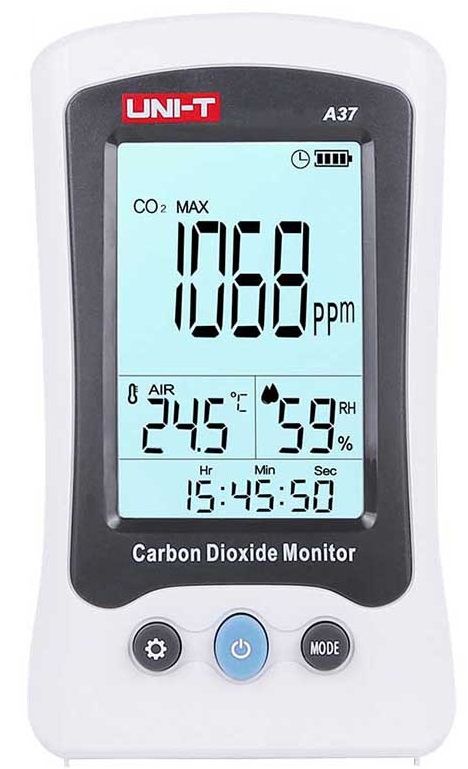
UNI-T A37 CO₂ Gas Detector
How Does a CO₂ Gas Detector Work?
Many modern CO₂ gas detectors use NDIR (Non-Dispersive Infrared) sensors, which detect CO₂ based on the gas molecule's ability to absorb infrared radiation.
The device typically displays CO₂ concentration in ppm. Some models also provide threshold alarms, data logging, or continuous monitoring.
In areas where CO₂ concentrations can change rapidly, alarm and data-logging functions can be more useful than simply checking the value at a single point in time.
When Is Continuous Monitoring Needed ?
A measurement taken at the start of work only reflects the environmental conditions at that particular time.
If the CO₂ source remains active or people are working in an enclosed space, the gas concentration can continue to change. Continuous monitoring helps identify when CO₂ levels begin to rise and allows the effectiveness of the ventilation system to be assessed.
This approach is also useful when determining suitable measurement points, alarm thresholds, and ventilation measures for enclosed spaces, dry ice storage areas, cold storage facilities, fermentation plants, and other locations where CO₂ can be generated.
What Should You Consider When Choosing a CO₂ Gas Detector ?
For offices or residential areas, a detector with real-time CO₂ display, an easy-to-read interface, and threshold alarms can be a suitable choice.
For industrial environments, other specifications should also be considered, including measurement range, accuracy, response time, data logging, alarm functions, and calibration methods.
If an area presents multiple gas hazards, a single-purpose CO₂ meter
may not provide sufficient protection. In such cases, a detector capable of measuring O₂, combustible gases, or specific toxic gases should be selected according to the conditions of the work environment.
Because CO₂ is colorless and odorless, its concentration can rise without obvious warning signs. A CO₂ gas detector provides measurable data that helps identify changes earlier and enables appropriate safety measures to be taken.