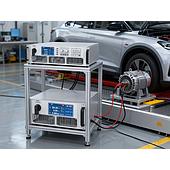
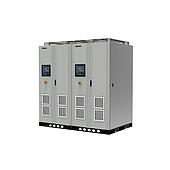
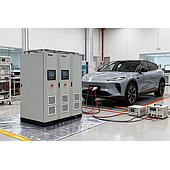
Bidirectional power supplies for battery testing combine source and sink operation in one instrument. They can supply power to charge a battery, then absorb power during discharge or regenerative events without changing to a separate device.
This integrated approach can shorten charge-discharge sequences, simplify test hardware, and support test profiles that reflect changing energy flow in applications such as electric vehicles and energy storage systems.
Summary: A bidirectional supply supports both charging and discharging. It can reduce the need for separate supplies and electronic loads. Regenerative designs can return absorbed energy instead of dissipating it as heat. The equipment also supports dynamic battery test scenarios.
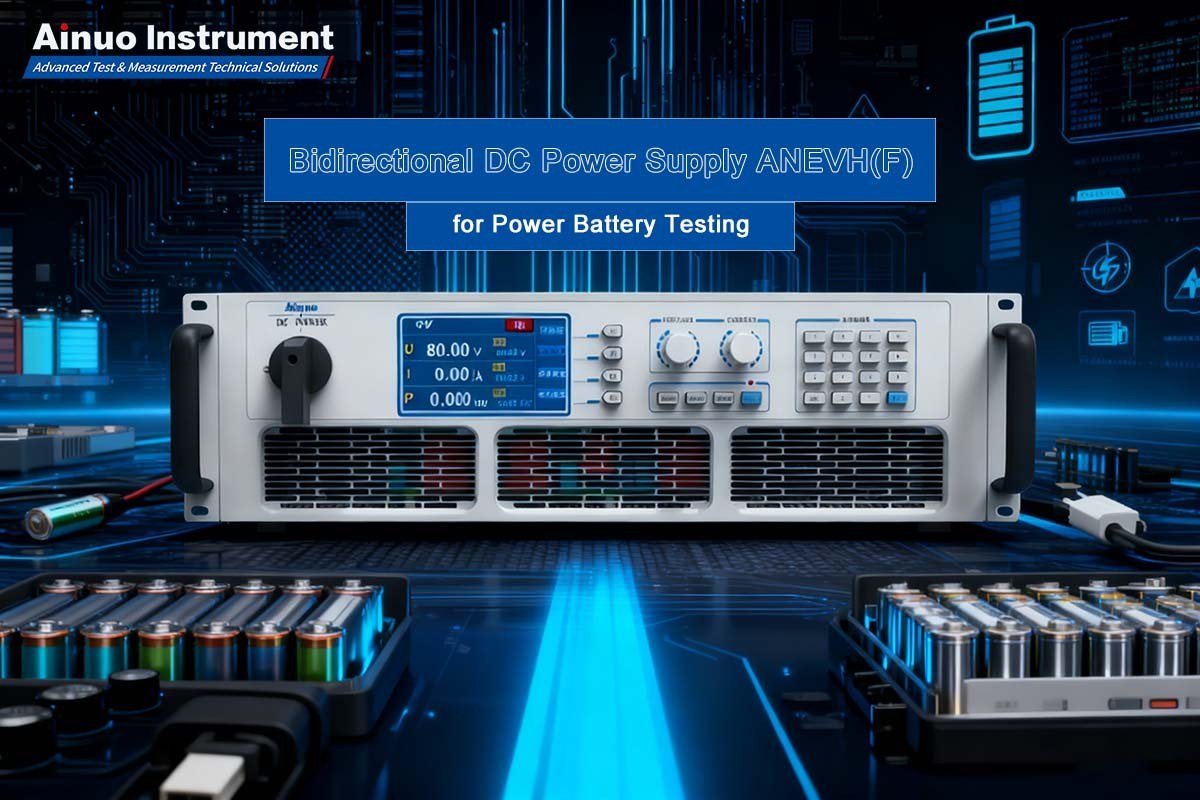
What is a bidirectional power supply in battery testing?
A bidirectional power supply is a test instrument that operates in two directions: it sources power to a battery in charge mode and sinks power from the battery in discharge mode. This lets one platform handle the two core energy-flow directions required in many battery tests.
In contrast, a unidirectional setup may require a power supply for charging, an electronic load for discharging, and external switching or relays. Combining functions in one unit can reduce wiring, rack space, and configuration complexity.
| Operating mode | Role in a battery test |
|---|---|
| Source mode | Delivers power to simulate battery charging conditions. |
| Sink mode | Absorbs power from the battery during discharge or regenerative events. |
How can bidirectional power supplies make battery testing more efficient?
They can make testing more efficient by allowing charge and discharge stages to run as one continuous sequence rather than requiring hardware changes between stages. This is useful for repeated cycling, where stopping to reconfigure instruments can interrupt the workflow.
A consolidated setup may also make a test system easier to maintain and scale. Instead of coordinating separate charging and discharging instruments, engineers can use one platform for both functions.
Why does energy regeneration matter during battery discharge?
Some bidirectional power supplies support energy regeneration, returning energy absorbed during discharge to the grid or a shared DC bus. In conventional resistive-load testing, discharged energy is typically dissipated as heat.
Returning energy can reduce heat generated by the test setup and may reduce cooling requirements. The practical benefit is especially relevant to long-duration cycling tests, where substantial energy passes through the system.
How do bidirectional power supplies support more accurate battery tests?
Battery behavior is sensitive to voltage, current, and timing, so a test system needs controlled and repeatable charge-discharge profiles. Bidirectional operation supports profiles such as constant-current charging, pulsed loads, and changing regenerative conditions within the same test flow.
Transitions between charging and discharging can otherwise introduce delays, transients, or gaps in measurement. A bidirectional system is designed to move between sourcing and sinking without manual intervention, helping maintain continuous observation across those transitions.
Which measurements are important in these tests?
Voltage, current, and power are central measurements for evaluating battery behavior during charging, discharge, and changing loads. The source material describes modern bidirectional systems as integrating high-resolution measurement capability, which can reduce dependence on external sensors.
Continuous data during transitions can help reveal behaviors such as voltage recovery or changes associated with internal resistance. Test results still depend on the selected profile and the overall test configuration.
When is a bidirectional power supply useful for realistic battery test scenarios?
A bidirectional power supply is useful when the battery must repeatedly alternate between absorbing and delivering energy. Electric-vehicle testing is one example because batteries can move between motoring demand and regenerative braking.
Energy storage is another example: a battery may absorb surplus generation and later deliver energy back to the grid. Bidirectional equipment can reproduce these two-way energy flows in a repeatable test sequence.
Can bidirectional supplies be used in hardware-in-the-loop testing?
The source material identifies hardware-in-the-loop testing as a relevant application as battery management systems become more sophisticated. In this context, the supply can respond to control signals and simulated system behavior while testing the battery and its surrounding control environment.
What should engineers consider when choosing bidirectional test equipment?
Engineers should first define the required battery test profiles, including charging, discharge, pulsed loads, regenerative events, and transition behavior. The needed test scope determines whether integrated source-sink operation and regenerative capability are relevant.
For evolving programs, modular or scalable architectures may be important because requirements can change as power levels, channels, or test configurations grow. Some bidirection DC power supply can be reconfigured or expanded, but specific capabilities should be verified for the selected equipment.
Note: Bidirectional capability describes the ability to source and sink power. Regeneration, measurement features, modularity, and available power levels can vary by system design.