A coating defect detector is used to inspect coating systems and protective primers applied to metal or concrete substrates. Areas where the coating is too thin, discontinuous, or locally missing are commonly referred to as pinholes or holidays. Although these defects can be difficult to detect with the naked eye, they can provide pathways for environmental factors to reach the substrate, potentially reducing the service life of the protective system.
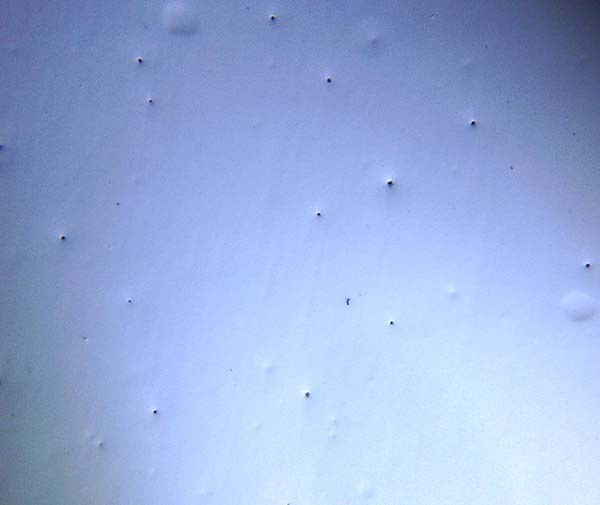
Some discontinuities are visible, while others can remain difficult to identify by eye even when surrounding dry film thickness appears adequate. Entrapped air bubbles and particulate contamination may leave small areas with little or no coating coverage. If these areas are not found and repaired, they may become points where corrosion begins beneath the coating.
How pinhole and holiday detection works
Electrical porosity detection instruments are used on cured, non-conductive coatings. The instrument applies voltage to an electrode as the operator moves it across the coating surface. When the electrode passes over a discontinuity, current can travel to the substrate below and return through a ground wire. This completes the circuit and activates the instrument alarm.
Proper grounding is a key part of the test arrangement. On a metallic substrate, the detector is grounded to an exposed area of bare metal. For high-voltage testing, grounding may also use a trailing ground wire, grounding collar, or grounding mat. On concrete, the ground wire can be attached to rebar or another permanently installed metallic ground. When no metallic ground is visible, the wire may be placed directly against an uncoated concrete surface.
Although concrete is less conductive than metal, its moisture content can provide sufficient conductivity for holiday detectors to operate. This makes porosity testing relevant to coated concrete as well as coated metal in applications such as storage tanks, pipelines, and general construction.
Choosing low- or high-voltage testing
Instrument selection depends primarily on the total thickness of the applied coating and the applicable project requirements. Low-voltage pinhole detectors, often called wet sponge detectors, are typically used for coating thicknesses up to 20 mils (500 μm). High-voltage holiday detectors, also known as spark testers, are used on coating systems with a total thickness of 8 mils (200 μm) or greater.
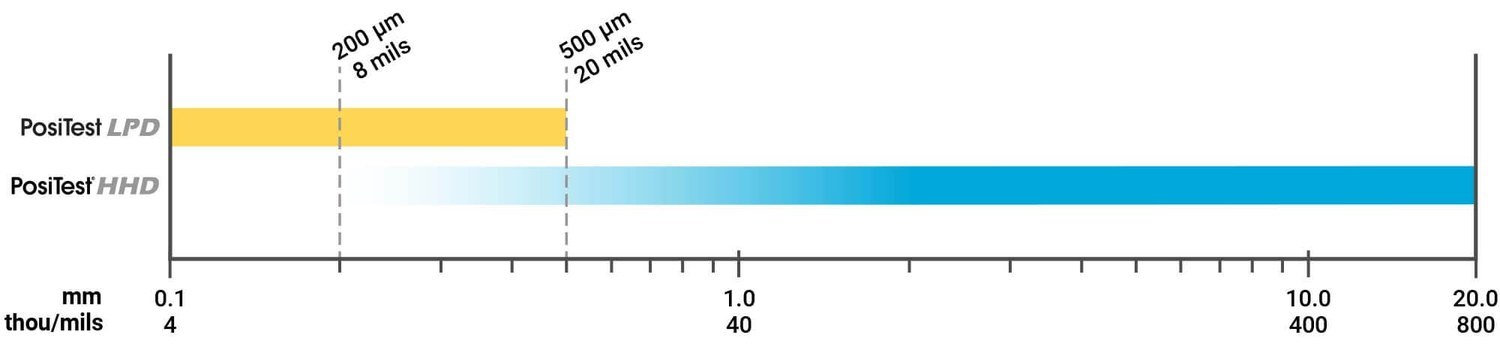
Because these thickness ranges overlap, the appropriate method should be selected in accordance with the coating system and the standards or specifications governing the inspection. The low range of the PosiTest HHD varies with standards.
Low-voltage testing with PosiTest LPD
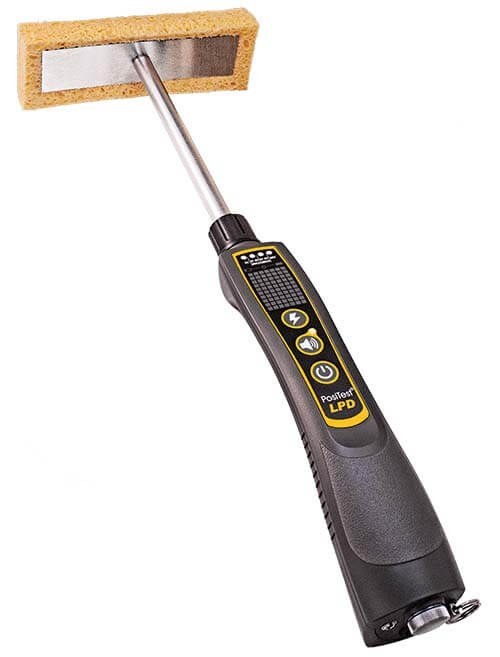
The PosiTest LPD is a low-voltage Pinhole Detector designed for coating systems up to 20 mils (500 μm) thick. During testing, a moistened sponge is moved over the coated surface. If it encounters a pinhole, current flows from the sponge to the substrate and returns through the attached ground wire, producing audible and visible alarms.
The instrument offers four selectable test settings from 9 to 90 V. Its GroundSense™ feature uses an indicator light for each selected voltage: the light changes from blinking to steady when a ground connection is detected.
Available sponge hardware and extension accessories support different test configurations. These include roller sponge hardware for larger surfaces, an inside-diameter sponge attachment, and an 8-inch square customizable sponge that can be cut into a required shape.
High-voltage testing with PosiTest HHD C
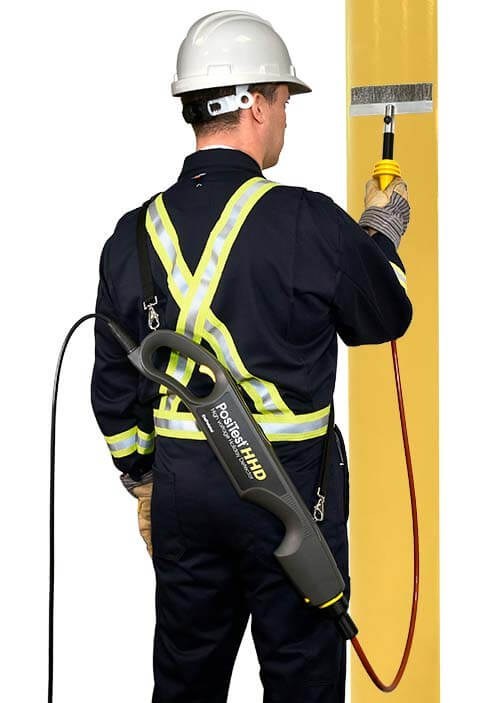
The PosiTest HHD C is a high-voltage holiday detector suitable for detecting defects in coatings with a thickness of 8 mils (200 μm) or greater. It utilizes conductive brush or spring electrodes. The unit employs pulsed DC technology, generating 30 pulses per second, and operates on the principle of circuit completion when the electrode passes over a defect.
These detectors use pulsed DC technology, with pulses emitted 30 times per second. The voltage output is adjustable from 0.5 to 35 kV. A voltage calculator in the instrument menu allows an operator to enter dry film coating thickness and the applicable standard so the instrument can calculate a voltage setting.
The PosiTest HHD can be used in a stick configuration or, with an optional wand attachment, as a shoulder-carried unit. Rolling spring electrodes for pipes and flat wire brushes are available in different sizes. The electrode connectors are made from stainless steel and aluminum, and electrodes can be attached without tools.
A practical inspection step before coating failure
Pinhole and holiday detection helps inspectors locate coating discontinuities while repairs can still be made. By matching the detection method to coating thickness, establishing a reliable ground connection, and scanning the complete coated surface, inspection teams can identify areas that may otherwise allow corrosion or coating failure to develop.