However, the fundamental question remains: When should Sine vibration testing be used, and when should Random vibration testing be used? Misunderstanding these test types can lead to incorrect equipment configuration, resulting in testing errors or the failure to detect critical defects.
Sinusoidal Vibration Test (Sine Test)
In terms of physical nature and origin, sinusoidal vibration is a type of oscillation characterized by amplitude and position that repeat precisely at fixed time intervals. In an industrial plant setting, this type of vibration typically arises from:
+ Dynamic unbalance in rotating components: crankshafts, pistons, fan blades, and electric motors.
+ The cycling frequency of hydraulically operated valves.
Mathematically, sinusoidal vibration is represented by simple trigonometric functions. During spectral analysis (FFT), it appears as extremely sharp energy peaks at the fundamental frequency and higher-order harmonics.
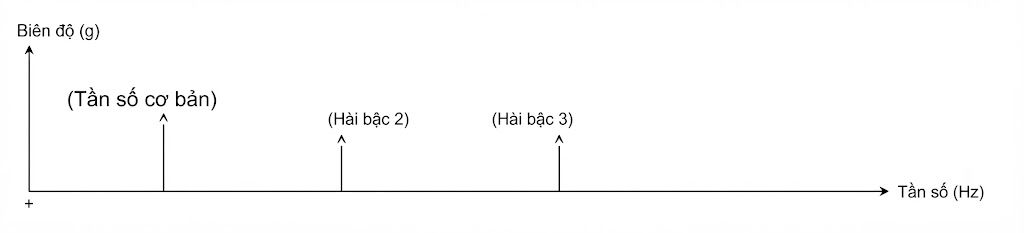
Applications on Vibration and Shock Testers
In testing procedures, engineers rarely subject the equipment to vibration at a fixed frequency; instead, they typically employ the Sine Sweep method. The system continuously sweeps from a low frequency to a high frequency (e.g., 5 Hz to 500 Hz) at a specified sweep rate (octaves per minute).
Objective: To identify the product's resonant frequency. When the vibration table's frequency matches the component's natural frequency, the amplitude of the component's oscillation is amplified manifold, potentially leading to immediate structural failure.
Applicable standards: Commonly used in the aerospace industry or for limit-load durability testing of simple mechanical structures.
Random Vibration Testing (Random Test)
In the real world, vibration is almost never a perfect sine wave. When a truck carrying televisions travels over rough terrain, or a rocket lifts off from its launchpad, the product is subjected to millions of different frequencies occurring simultaneously and changing constantly. This is known as Random Vibration.
At any given moment, the amplitude of the vibration wave cannot be predicted. Consequently, engineers cannot rely on standard metrics like Peak amplitude for measurement; instead, they must adopt a statistical approach:
RMS (Root Mean Square) value: Measures the total energy of the vibration profile.
PSD (Power Spectral Density) (g²/Hz): A metric representing how vibration energy is distributed across the frequency spectrum.
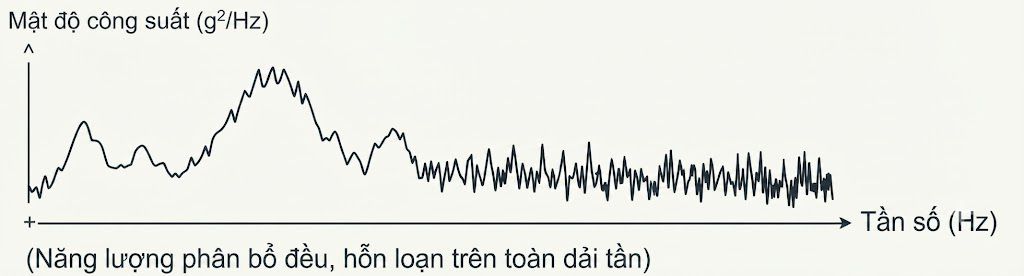
Why is random testing considered the "gold standard" in QA/QC?
Random vibration excites all of a product's resonant frequencies simultaneously. This is crucial because:
- It reveals interaction faults between components (e.g., cables striking the housing when both resonate at different frequencies).
- It accurately simulates 90% of real-world transportation environments (in accordance with ISTA or ASTM standards). Relying solely on sine testing might induce fatigue in one specific part while overlooking a loose screw elsewhere.
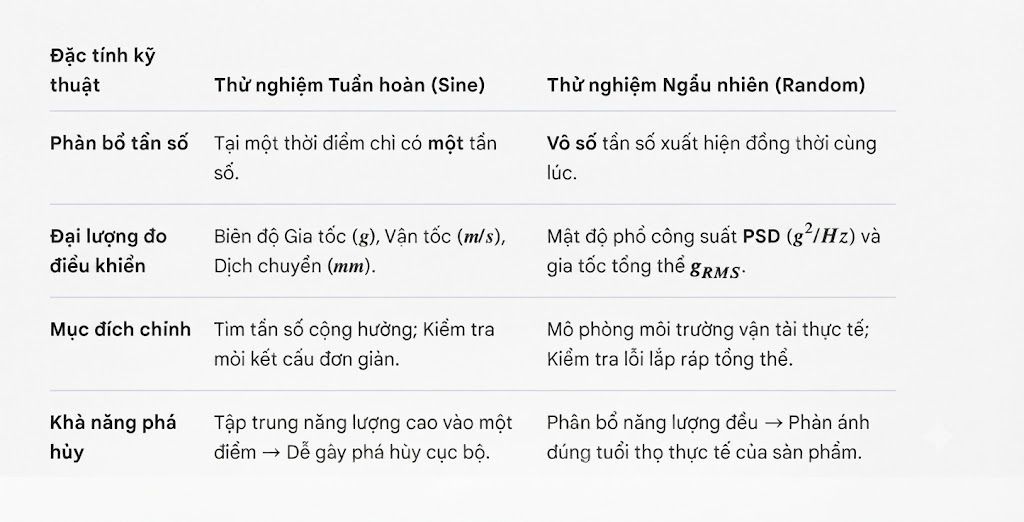
Technical Comparison Table: Sine Test vs. Random Test
Comprehensive Vibration Control and Setup Solutions for Factories
To meet these rigorous testing standards (such as MIL-STD-810G and IEC 60068), enterprises require an integrated system spanning from field measurement to laboratory simulation.
Step 1: Collect actual vibration data using a handheld meter
Before configuring vibration settings on a test table, engineers must measure the actual vibration amplitude of the machinery on the shop floor or inside the truck bed.
The Extech SDL800 handheld vibration meter is an ideal choice, featuring an integrated SD card slot that enables real-time vibration acceleration data logging. Engineers can export data to Excel for Fast Fourier Transform (FFT) analysis to identify critical peaks in periodic oscillation.
Fluke analyzers are well-suited for predictive maintenance, enabling the early detection of issues such as shaft misalignment and bearing failure through in-depth vibration spectrum analysis.
Step 2: Simulation and deep-load testing on the ASLI vibration and shock table system
Once input data is available, the Electrodynamic Vibration Shaker systems distributed by EMIN perform the simulation tasks:
Models ranging from the ASLI ES-1 (70kg) to the ES-20 (300kg) feature next-generation vibration controllers. These allow for the precise programming of complex sine sweep profiles or the direct loading of PSD charts compliant with ISTA or MIL-STD standards to conduct random vibration testing.
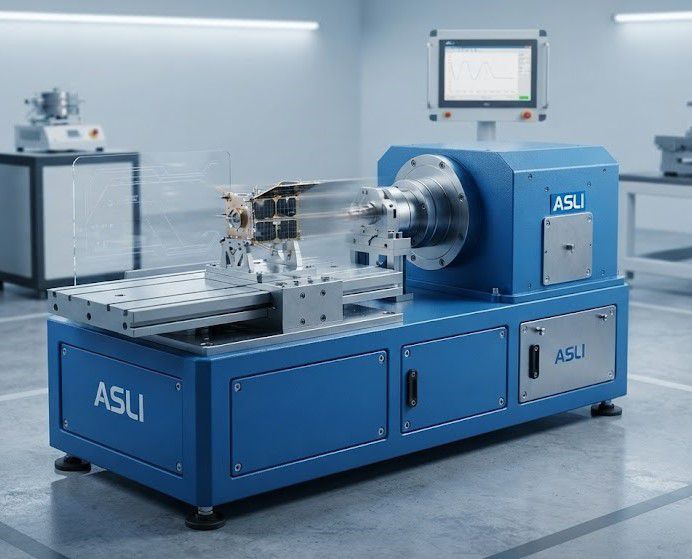
For high-end electronics subjected to harsh operational lifecycles, the ASLI THV-Series which combines a temperature-humidity chamber with a vibration shaker performs Highly Accelerated Life Testing and Stress Screening (HALT/HASS). By simultaneously applying thermal shock and random vibration, these systems force latent defects in circuit board solder joints to surface within just a few hours.
Selecting the right vibration testing method is key to saving businesses billions of dong in warranty costs. Contact EMIN’s team of application engineers today for advice on configuring a vibration shaker system that best meets your product standards.