Fine Wire and Thermocouple Welder
Reliable sensor assembly often depends on one small but critical step: creating a clean, repeatable junction at the wire end. In laboratories, calibration environments, pilot production, and maintenance work, equipment used for joining fine conductors helps technicians prepare thermocouples and other delicate wire assemblies with better consistency and less manual variation. That is where a Fine Wire and Thermocouple Welder becomes especially useful.
This category is focused on compact welding tools designed for fine wire work, particularly for thermocouple junction formation and similar applications involving small-diameter conductors. These instruments are commonly selected when users need controlled energy delivery, practical handling for thin wire, and dependable results across repeated welding cycles.
Where this type of welder fits in temperature work
In many temperature measurement setups, the sensing point itself is created from joined dissimilar metal wires or from very small conductors that must be welded without excessive deformation. A dedicated welder for fine wire work supports this process by concentrating energy at the junction, helping form a bead or weld point suited to sensor fabrication, prototyping, repair, or test preparation.
These tools are particularly relevant when working alongside temperature wire and cable, because wire selection and junction quality directly affect the usability of the finished assembly. For users building or replacing thermocouple tips in-house, this category supports a more controlled workflow than improvised joining methods.
Typical applications for fine wire and thermocouple welders
A fine wire welder is commonly used in environments where thermocouples are built in small quantities, customized for a test setup, or replaced frequently due to process conditions. Typical use cases include research and development, industrial troubleshooting, thermal validation, electronics testing, and educational labs where compact sensor fabrication tools are needed.
It can also be relevant for maintenance teams that need to prepare replacement sensing junctions quickly, especially when working with small-gauge wire. In these situations, a dedicated unit helps improve repeatability while reducing the risk of inconsistent manual joins that may affect measurement performance.
What to consider when selecting a welding unit
The most important selection factors usually include wire size range, power input compatibility, and the type of welding workflow your team uses. For fine wire applications, the supported conductor diameter or AWG range should match the thermocouple or signal wire being processed. Choosing a unit that aligns with your actual wire dimensions helps avoid underpowered or unnecessarily oversized equipment.
Users should also review how often the welder will be used. For bench use in R&D or service work, a compact unit with a practical duty cycle may be entirely suitable. If the broader measurement setup also includes readout and verification steps, related tools such as temperature meters and indicators may be part of the overall process after the junction is formed.
Representative products in this category
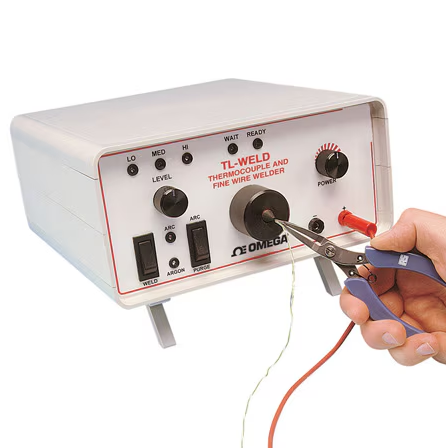
This category includes examples from OMEGA and Dwyeromega, both of which are recognized in temperature-related instrumentation. One example is the OMEGA TL-WELD Fine Wire and Thermocouple Welder, intended for fine wire and thermocouple work across an 18 to 40 AWG range. That makes it relevant for users handling small conductors where controlled junction formation is required.
Also featured are the Dwyeromega TL-WELD Fine Wire and Thermocouple Welder with included accessories and the Dwyeromega TC-WELD Fine Wire and Thermocouple Welder. These models illustrate the category’s practical focus on compact welding tools for fine wire applications, with specifications oriented toward repeated welds per minute and power input flexibility depending on the unit selected.
Why dedicated thermocouple welding equipment matters
Using a purpose-built welder can help improve junction consistency compared with ad hoc joining techniques. In temperature sensing, the quality of the welded point can influence mechanical stability, ease of installation, and the repeatability of fabricated probes used for testing or temporary measurement tasks.
Another advantage is process control. Rather than relying on broad heat sources or manual approximation, a dedicated fine wire and thermocouple welder is intended to deliver energy in a more focused way for small conductors. This is especially important when dealing with delicate wire that can be easily damaged or altered if the joining process is not appropriate for the application.
How this category connects to the wider measurement setup
Fine wire welding is usually one step in a larger temperature instrumentation workflow. After the sensing junction is created, teams may still need accessories for installation, protection, connection, or routine handling. For that reason, users often browse related temperature accessories when planning a complete setup.
In some environments, the welded thermocouple or fine wire sensor is only one part of the thermal verification strategy. Surface checks, spot monitoring, and visual heat analysis may also be used depending on the task. For broader inspection needs, a thermal imaging camera can complement contact-based measurement methods, although it serves a different purpose than a welded sensor junction.
Who typically buys from this category
This category is generally relevant to test engineers, lab technicians, calibration personnel, OEM development teams, and industrial maintenance users who need to build or repair fine-wire sensing points. It also suits buyers who want a compact bench instrument for occasional thermocouple fabrication rather than a larger-scale production welding system.
Because the application often involves delicate materials and repeatable preparation steps, buyers usually value straightforward operation, compatibility with fine wire sizes, and practical integration into an existing temperature measurement workflow. The right choice depends less on marketing claims and more on wire range, power requirements, and how the tool will actually be used day to day.
Choosing with confidence
When comparing options in the Fine Wire and Thermocouple Welder category, it helps to start with the wire sizes you work with most often, the expected frequency of use, and whether the tool will be used mainly for thermocouple junction fabrication, repair, or general fine-wire joining. From there, it becomes easier to narrow the selection to models that fit your bench setup and operating routine.
Whether you are supporting laboratory development, maintenance work, or custom sensor preparation, this category brings together specialized tools for a precise and often overlooked part of temperature measurement. A well-matched welding unit can simplify thermocouple preparation, improve repeatability, and support more consistent results across your measurement process.
Get exclusive volume discounts, bulk pricing updates, and new product alerts delivered directly to your inbox.
By subscribing, you agree to our Terms of Service and Privacy Policy.
Direct access to our certified experts